




TL;DR: Dutch exports to the US dropped 4.7% (€1.4 billion) in 2025 after companies front-loaded shipments ahead of tariff announcements. Manufacturing fell 8% while re-exports grew 3.9%. Specialization and supply chain flexibility are now survival tools for small businesses with transatlantic exposure.
What happened:
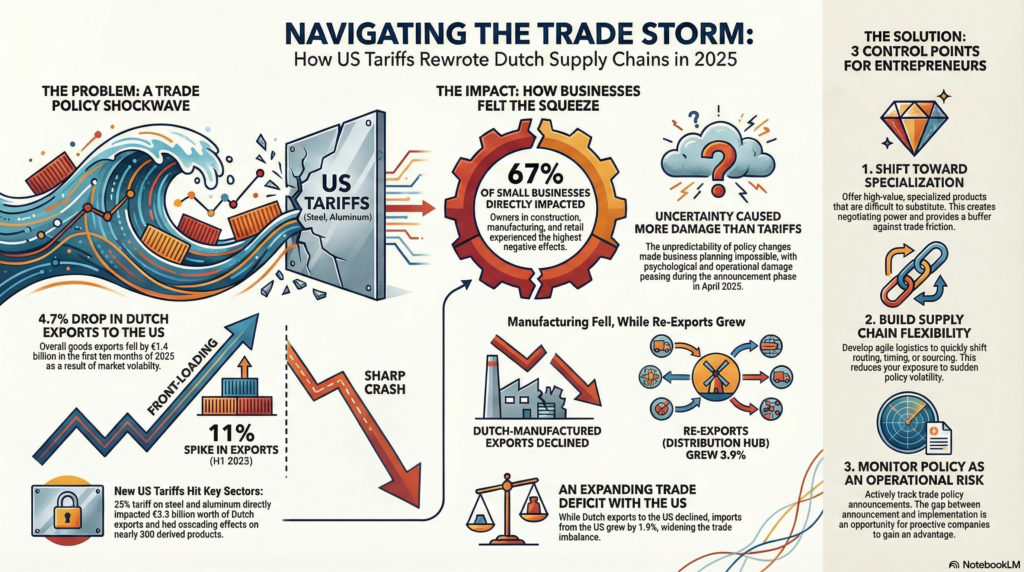
- Dutch goods exports to the US fell from €28.9 billion to €27.5 billion in the first ten months of 2025
- Companies increased shipments 11% in the first half of 2025, then absorbed a sharp correction in the second half
- US steel and aluminum tariffs hit €3.3 billion in Dutch exports (8.5% of total)
- Dutch-manufactured goods declined 8%, but re-exports grew 3.9%
- 67% of small business owners reported direct tariff impact, with uncertainty peaking in April 2025
In the first half of 2025 something strange unfolded in Netherlands-US trade data.
Companies front-loaded shipments. Hard.
Dutch exports to the US jumped 11% in the first six months, with sharp increases in February, March, and April. Then July hit. The pattern reversed. By October, Dutch goods exports to the US had fallen 4.7% year-over-year. That’s a €1.4 billion decline from €28.9 billion to €27.5 billion.
This wasn’t a market correction. This was anticipatory behavior driven by tariff announcements.
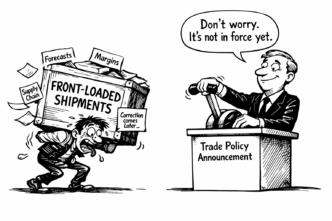
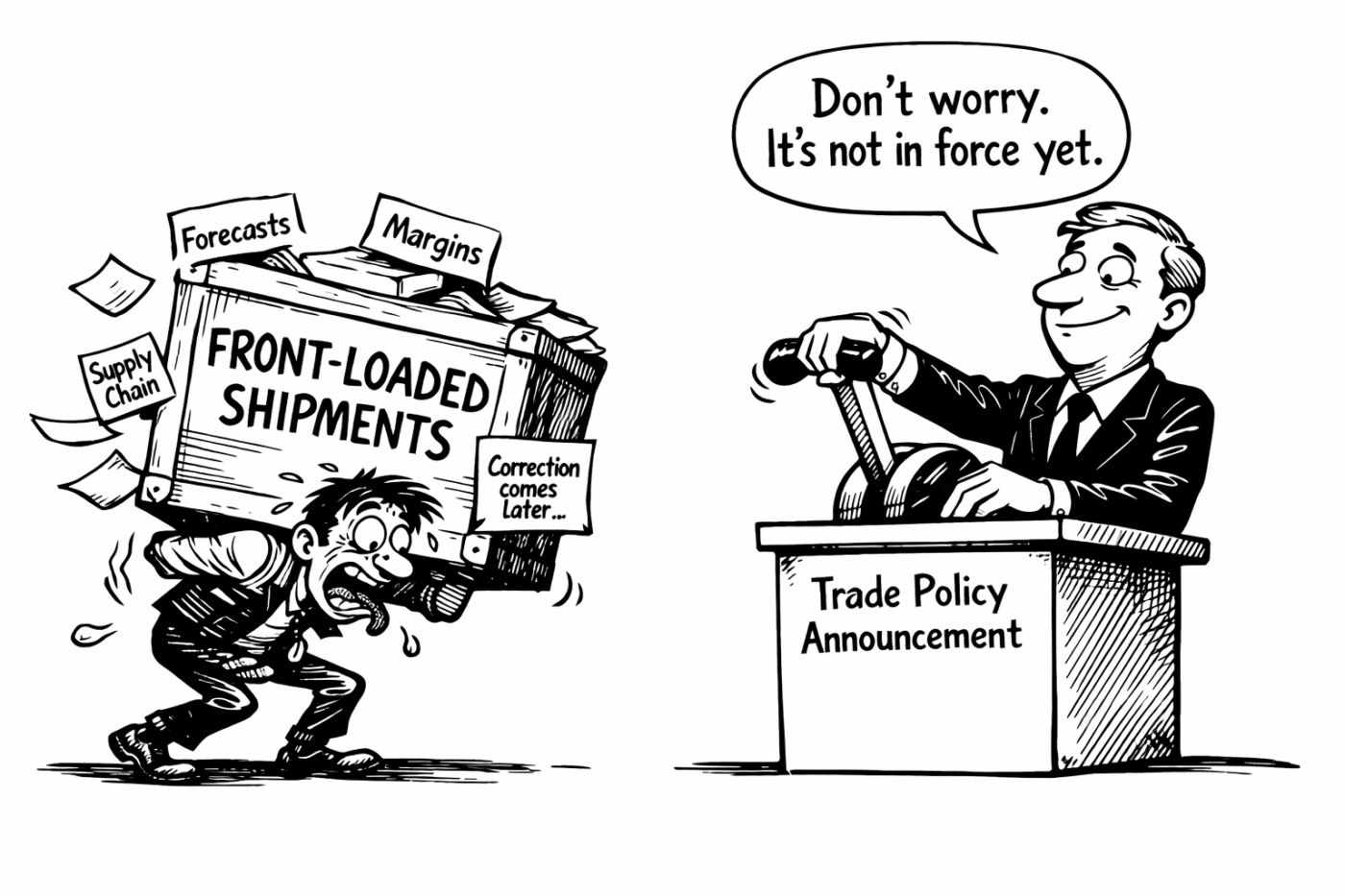
The mechanism is simple. When you announce trade policy changes, you create distortions before implementation. Companies race to beat the deadline. Then they absorb the correction afterward.
For expat entrepreneurs running micro or small businesses in the Netherlands, this pattern reveals something critical about how trade tensions reshape decision-making. Especially if you’re in import/export, localization, or transatlantic operations.
LISTEN TO THE DEEP DIVE ABOUT THIS TOPIC:
How Trade Policy Announcements Created Market Distortions
Here’s what happened.
In March 2025, the US raised import tariffs on steel and aluminum to 25%. That hit €3.3 billion in Dutch exports (8.5% of total Dutch exports to the US in 2024). But the tariffs didn’t stop at raw metals. They applied to almost 300 derived products, including components and packaging materials.
The cascading effect spread through manufacturing supply chains.
Then came the behavioral response. Companies increased imports in Q1 2025 because they wanted to beat the announced tariffs. US imports rose sharply. Dutch exports followed the same pattern. Surge first, contract later.
What the Sector Data Shows
By the second half of the year, the correction arrived. Monthly exports consistently fell below prior-year levels. The most dramatic collapse came in mineral fuel exports, which dropped over 50% because of lower prices and reduced volumes.
Meanwhile, Dutch-manufactured goods declined 8%, while re-exports grew 3.9%.
The divergence matters. The Netherlands’ role as a distribution hub remained somewhat stable. Domestic manufacturing became more vulnerable to trade tensions.
Control point: Trade policy announcements create behavioral distortions before tariffs take effect. Front-loading followed by correction is the predictable pattern.
What Small Businesses Experienced During Tariff Volatility
The data tells one story. Small business owners lived another.
The Impact Numbers
A 2025 survey found that 67% of small business owners reported their business had been directly impacted by tariffs in the past 12 months. Construction, manufacturing, and retail experienced the highest effects. Businesses in coastal states reported bigger impacts than those inland.
Why Uncertainty Does More Damage Than Tariffs
The real damage wasn’t the tariffs themselves. The unpredictability did the harm.
Swift and unexpected tariff increases made planning difficult. You couldn’t model scenarios when the rules kept shifting. Federal Reserve Bank of Boston research found that uncertainty about tariffs rose markedly for all small and medium businesses in April 2025, especially for those that import.
But here’s the asymmetry. A reduction in uncertainty created substantially more optimism than further increases created pessimism. By mid-2025, the negative psychological effect had already peaked.
The damage from uncertainty happens early and hard. After that, businesses adapt or exit.
Control point: Uncertainty peaks early. The psychological damage from policy volatility hits hardest in the announcement phase, not the implementation phase.
Why High-Value Specialization Provides a Buffer
Not all exports collapsed equally.
What Products Survived the Volatility
Machinery and equipment account for 33% of Dutch exports to the US. These high-value, specialized products showed resilience. Pharmaceutical products and specialized components also maintained strength during the first half of 2025.
The pattern is clear. High-value, less-substitutable products provide a buffer against trade fluctuations.
If you’re building or operating a transatlantic business, this matters. The companies that survived the volatility weren’t the largest or best-funded. They were the ones offering products that couldn’t be sourced elsewhere.
Specialization creates negotiating power. Commoditization creates exposure.
Why the Netherlands Remains a Distribution Hub
The Netherlands maintains structural advantages that matter for distribution-focused businesses. Over 1,000 American and Chinese companies have established the Netherlands as their pan-European logistics hub. You get access to 170 million consumers within a 500km radius and 244 million within 1,000km.
The country’s Article 23 VAT deferment system allows businesses to avoid upfront VAT payments on imports. That’s a cash flow advantage unavailable in most other EU countries except Belgium.
But the decline in Dutch-manufactured exports threatens this positioning. If manufacturing weakens, companies may reconsider supply chain routing entirely.
Control point: Specialization creates negotiating power. Commoditization creates exposure. Focus on high-value products that buyers cannot substitute easily.
How the Trade Deficit Is Expanding
Here’s the structural shift that gets overlooked.
What the Imbalance Means
The EU as a whole maintains a trade surplus with the US. The Netherlands doesn’t. Dutch imports from the US grew 1.9% to €48.1 billion in the first ten months of 2025, while exports declined.
The trade deficit is expanding.
This asymmetric relationship intensified throughout 2025. Dutch imports from the US grew while exports declined. That creates long-term implications for bilateral economic relations and potential policy responses.
How Dutch Financial Institutions Are Adjusting Forecasts
Major Dutch financial institutions revised their Netherlands growth forecasts downward due to US tariffs. ABN AMRO adjusted 2025 growth to 1.4% (from 1.8%). Rabobank’s baseline scenario forecasts growth slowing to 1.3% in 2025 and 0.6% in 2026.
The indirect effect of a weakening global economy and trade affects the export-dependent Dutch economy. The manufacturing sector is most vulnerable. Around 60% of its production is destined for export.
Control point: The Netherlands is moving toward a trade deficit with the US. Manufacturing exports are under structural pressure while imports continue growing.
Three Control Points for Expat Entrepreneurs
If you’re operating a micro or small business in the Netherlands with transatlantic exposure, three control points matter.
1. Shift Toward Specialization
High-value, specialized products and services provide resilience. Commoditized offerings face substitution risk when trade friction increases.
2. Build Decision Flexibility Into Supply Chains
The front-loading behavior in early 2025 shows that companies with agile logistics gained advantage. If you can shift routing, timing, or sourcing quickly, you reduce exposure to policy volatility.
3. Monitor Trade Policy as Operational Risk
The gap between announcement and implementation creates distortions. Companies that tracked policy signals and acted early gained months of advantage. Those that waited absorbed the correction unprepared.
The Netherlands remains a strong distribution hub. The decline in manufacturing exports signals structural pressure. If you’re building for the long term, you need to account for the possibility that the Netherlands’ role in transatlantic trade may shift from production-and-distribution to distribution-only.
That’s not a crisis. It’s a clarification.
The system doesn’t care about intentions. It responds to structure, positioning, and proof of value.
Trade policy creates friction. Specialization and flexibility reduce it.
Frequently Asked Questions
Why did Dutch exports to the US decline in 2025?
Dutch exports to the US fell 4.7% (€1.4 billion) because companies front-loaded shipments in the first half of 2025 to beat anticipated tariff deadlines. When the correction came in the second half, monthly exports consistently fell below prior-year levels. US steel and aluminum tariffs hitting €3.3 billion in Dutch exports accelerated this pattern.
What sectors were most affected by US tariffs?
Dutch-manufactured goods declined 8%, with mineral fuel exports collapsing over 50%. Construction, manufacturing, and retail small businesses reported the highest impacts. Machinery and equipment (33% of Dutch exports to the US) showed more resilience because of their high-value, specialized nature.
How does tariff uncertainty affect small businesses differently than the tariffs themselves?
67% of small business owners reported direct tariff impact, but uncertainty caused more damage than the tariffs. Swift and unexpected increases made planning impossible. Federal Reserve Bank of Boston research found uncertainty peaked in April 2025. The psychological damage hits hardest during announcement, not implementation.
Why do high-value products perform better during trade volatility?
High-value, specialized products provide a buffer because buyers cannot substitute them easily. Machinery, pharmaceuticals, and specialized components maintained strength during volatility. Commoditized products face substitution risk when trade friction increases. Specialization creates negotiating power.
Is the Netherlands still a strong distribution hub despite the export decline?
Yes. Re-exports grew 3.9% while manufactured goods declined 8%. Over 1,000 American and Chinese companies use the Netherlands as their pan-European logistics hub. The Article 23 VAT deferment system provides cash flow advantages. But if manufacturing continues weakening, companies may reconsider supply chain routing.
What is the trade deficit situation between the Netherlands and the US?
Dutch imports from the US grew 1.9% to €48.1 billion while exports declined. The trade deficit is expanding. The EU as a whole maintains a trade surplus with the US, but the Netherlands doesn’t. This asymmetric relationship has long-term implications for bilateral economic relations.
How should small businesses prepare for ongoing trade policy volatility?
Focus on three control points. First, shift toward specialization in high-value products that buyers cannot substitute. Second, build decision flexibility into supply chains so you can adjust routing, timing, or sourcing quickly. Third, monitor trade policy as operational risk, not background noise. Companies that tracked policy signals and acted early gained months of advantage.
What is the outlook for Dutch economic growth given these trade pressures?
ABN AMRO adjusted 2025 growth to 1.4% (from 1.8%). Rabobank forecasts growth slowing to 1.3% in 2025 and 0.6% in 2026. The manufacturing sector is most vulnerable because around 60% of its production is destined for export. The weakening global economy affects the export-dependent Dutch economy disproportionately.
Key Takeaways
- Trade policy announcements create behavioral distortions before implementation. Companies front-loaded shipments 11% in early 2025, then absorbed a sharp correction that resulted in a 4.7% annual decline.
- Uncertainty damages small businesses more than tariffs themselves. 67% of small business owners reported direct impact, with psychological damage peaking during the announcement phase in April 2025.
- Specialization provides a buffer against trade volatility. High-value, less-substitutable products like machinery and pharmaceuticals maintained resilience while commoditized goods faced substitution risk.
- The Netherlands is shifting toward a trade deficit with the US. Dutch imports grew 1.9% while exports declined, creating long-term implications for bilateral economic relations.
- Manufacturing exports are under structural pressure. Dutch-manufactured goods fell 8% while re-exports grew 3.9%, threatening the Netherlands’ position as both a production and distribution hub.
- Agile supply chains gained advantage during volatility. Companies that tracked policy signals and adjusted routing, timing, or sourcing quickly reduced exposure to policy volatility.
- Trade friction requires operational discipline. The gap between announcement and implementation creates predictable patterns. Businesses that treat trade policy as operational risk rather than background noise protect themselves.













Comments are closed.