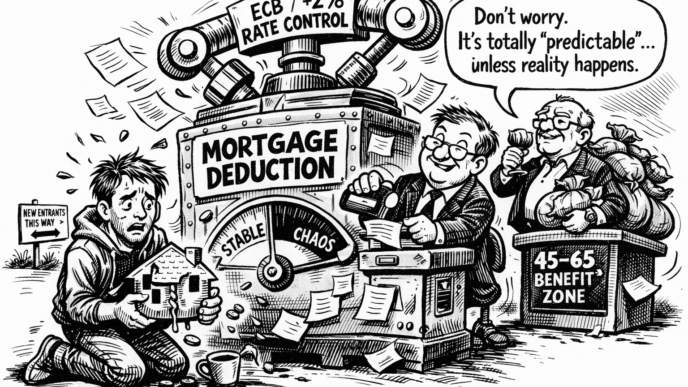






TL;DR: Dutch housing prices climbed 6.2% year-over-year in Q4 2025, reaching €486,000 for existing homes and €520,000 for new builds.
For small business owners in the Netherlands, this means higher wage demands, longer hiring timelines, and increased retention risk.
Housing costs are outpacing wages, causing real income compression for employees and prompting compensation reviews. Review your wage budget, remote work policy, and location strategy now.
What you need to know:
- Housing prices grew 6.2%, while typical wage growth runs 4-5%. Expect employees to negotiate to close this gap.
- Private rental prices jumped 17.4% year-over-year by Q2 2025, requiring a monthly income of € 5,490 to qualify for average rentals.
- Geographic wage differences of 10-15% exist between expensive cities (Amsterdam, Utrecht) and affordable regions (Groningen, Limburg)
- Budget 5-6% wage growth for 2026, not the historical 3%. This applies especially to hard-to-fill roles.
- Remote work policies can serve as a strategic tool to reduce wage pressure by allowing employees to live in cheaper regions.
Dutch housing prices rose 6.2% year over year in Q4 2025. Eight consecutive quarters of growth.
Existing homes average €486,000; new builds reach €520,000.
For micro and small business owners in the Netherlands, this creates direct pressure on wage expectations, employee mobility, recruitment costs, and cash flow planning. Housing is now a business cost input.
What Changed in Q4 2025
The Dutch housing market displayed price acceleration in Q4 2025, though slower than earlier in 2024.
Existing home prices rose 6.2% year-over-year and 0.5% quarter-over-quarter. New builds matched the 6.2% annual rate, down from 8.8% in Q3. Transaction volume jumped 9.7%, showing persistent demand despite high prices.
New build supply fell. Sales dropped 7.6% compared to Q4 2024.
The Netherlands now ranks in the upper tier of EU price growth. Growth exceeds Germany (3.0%), Belgium (3.5%), and France (1.0%). Finland was the only country with declining prices, down 3.1%.
The structural shortage remains unresolved. ABF Research estimates a nationwide housing shortage of approximately 396,000 dwellings, or 4.8% of the total housing stock. Only 31,550 dwellings were completed in the first half of 2025. A year-on-year decline of 3.55%.
Bottom line: Housing supply continues to shrink while demand and prices climb. This structural mismatch won’t resolve quickly.
Why This Matters to Your Business
Housing affordability impacts your cost structure and hiring capability in three ways:
Wage pressure during recruitment and reviews. Employees confronting higher housing costs push for wage increases. Pressure hits hardest for renters and first-time buyers.
Talent mobility limitations. Relocating candidates to the Netherlands gets more expensive. Existing employees resist moving closer to your office when a pricier housing market means higher costs.
Escalated competition for talent. Employees favor employers offering remote work flexibility. They live in cheaper locales while keeping Randstad salaries.
For businesses with physical locations in expensive areas (Amsterdam, Utrecht, Rotterdam), you’re competing on total cost of living, not salary alone.
An employee earning €50,000 in Amsterdam has different net purchasing power than someone earning the same in Groningen or Limburg.
Bottom line: Housing costs make location a competitive factor in talent acquisition and retention.
How Housing Costs Pressure Your Wage Bill
Housing costs are rising faster than wages, compressing employee income.
Housing prices grew 6.2% in Q4 2025. Typical wage growth in the Netherlands runs 4-5%, depending on sector and CAO agreements. The gap creates financial stress.
The rental market increases the pressure. Available rental properties in the private sector dropped 36.4% in Q2 2025 compared to the same period last year. The average rental price per square meter rose 7.9%.
In Q1 2025, the average monthly rent for private-sector housing reached €1,781, a 9.6% year-on-year increase.
By Q2 2025, average private-sector rent rose to €1,830 per month. Up 17.4% year-on-year. To qualify for a rental at this price, tenants need a gross monthly income of at least €5,490, in line with the industry standard of 3-4 times the monthly rent.
This threshold is €800 higher than it was one year ago.
For ZZP workers you contract with, the pressure is more direct. If their housing costs rise 6.2% annually while your contract rates stay static, their effective income declines. Expect renegotiation requests, especially from specialists in tight labor markets (IT, engineering, finance).
They face the same housing cost inflation, lacking the relative security of employment contracts.
Bottom line: The wage-housing gap forces both employees and contractors to seek compensation changes to preserve purchasing power. Key takeaway: Wage negotiations are likely to increase.
What This Means for Margins, Hiring, and Cash Flow
Wage pressure from housing costs doesn’t appear alone. This compounds with other cost increases (energy, materials, services).
The math for small teams: If you employ 5-10 people and each pushes for a 5-6% raise citing living costs, your wage bill increases €15,000-€30,000 annually per employee. For a business with €500,000 in revenue and thin margins, this quickly shifts EBITDA from 8% to 5%.
Hiring timelines extend. Candidates negotiate harder on compensation packages. Budget an additional 10-15% above your initial salary range when you’re competing for talent in high-demand fields.
Retention risk increases. Employees leave for marginal salary improvements (€3,000-€5,000 more annually) because small differences compound against high fixed housing costs.
Cash flow planning has to account for more frequent wage negotiations. If labor costs represent 40-60% of revenue (common in service businesses), and wage growth tracks closer to 5-6% than the 3% you historically budgeted, your cash requirement increases.
For a business with €400,000 in annual wages, the difference between 3% and 5.5% growth is €10,000 annually. Small enough to overlook until you’re handling tight working capital.
Bottom line: Housing-driven wage pressure squeezes margins and extends cash requirements in ways conventional planning models don’t capture. Key takeaway: Update your financial models for accuracy.
Geographic Salary Differences You Need to Understand
Housing costs vary dramatically by region, creating tactical location pressure.
Amsterdam recorded the highest average price at €640,338 in Q3 2025. Rotterdam stayed most affordable at €421,945, 13.38% below the national average.
Rental costs show similar differences. Amsterdam averaged €27.03 per square meter in Q1 2025. Rotterdam saw €20.84, The Hague €20.58, and Utrecht €21.16.
A one-bedroom apartment in Amsterdam’s city center now averages €2,200 per month. Rotterdam averages €1,600. The Hague €1,500.
This geographic variation creates hiring arbitrage. Opening a satellite office in Zwolle, Enschede, or Maastricht lets you access quality talent at wage levels 10-15% lower, even without accounting for housing costs.
This matters more as housing price differences between regions continue growing.
Bottom line: Location strategy becomes a wage management tool. Moving hiring to lower-cost regions reduces compensation pressure without sacrificing talent quality. Key takeaway: Revise location strategy to reduce wage bills.
What to Review and Do Now
Audit your compensation structure against local market rates. Factor in housing cost geography. If you employ people in Amsterdam versus Almere, understand what the housing cost difference means for retention.
Use Intermediair, Nationale Vacaturebank, or sector-specific salary surveys to benchmark.
Evaluate your remote work policy as a strategic compensation tool. If employees work remotely 3-4 days weekly, they’ll live in lower-cost housing markets (Groningen, Friesland, Zeeland) while staying in your talent pool.
This reduces pressure on your wage bill while improving employee quality of life.
Review your ZZP contractor agreements. If you rely on freelance talent and haven’t adjusted rates in 18-24 months, expect renegotiation requests. Budget for them.
Decide whether converting high-value ZZP relationships to employment contracts makes sense if you deliver stability in exchange for rate moderation.
Reconsider your location strategy if you’re planning expansion. Opening a satellite office in a lower-cost region gives you access to quality talent at reduced wage expectations.
The difference between Amsterdam and Groningen salary expectations runs 10-15% for similar roles.
Build housing cost inflation into your 2026 budget planning. If you’ve historically budgeted 3% wage growth, shift to 5-6% for roles difficult to fill or where employees face acute housing pressure.
This prevents mid-year budget surprises.
Bottom line: Proactive compensation and location planning now prevent reactive budget stress later.
The Wage-Housing Feedback Loop
This pressure is self-reinforcing.
Collective labor agreement wages rose 6.7% in 2024. Wage increases of 5% are forecasted for 2025 and 4.1% for 2026. At a 4% mortgage rate, households with two average incomes borrow €12,000 more in 2025 than they did in 2024.
This amount is expected to increase by almost €17,000 in 2026.
Higher wages let households borrow more when bidding on a house. This fuels additional price pressure. Wage increases drive housing prices higher, which then creates pressure for further wage increases.
You’re operating inside this loop whether you recognize it or not.
Bottom line: Wage growth and housing prices reinforce each other, creating a structural cost spiral with no near-term resolution. Key takeaway: Prepare for ongoing pressure without short-term fixes.
The Talent Pool Constraint Ahead
Homeownership among young adults is declining, creating renter dependency.
In 2008, 40% of households under 35 owned a home. By 2024, that dropped to 31%.
Households under 35 renting in the mid or high-end segment often don’t have enough income to finance former rental properties. In 2023, they financed an average of €255,000, more than €120,000 below the average sales price of a former rental home.
To afford a house at the average purchase price of €520,000 in 2025, a household needs a gross annual income of at least €106,000. Only 36% of households earn this much.
Your employees under 35 are increasingly locked into renting, facing annual rent increases of 7.9-17.4%, with limited ability to build equity or stabilize housing costs through ownership.
This financial stress will appear in wage negotiations, retention conversations, and recruitment difficulty.
Bottom line: Young talent faces permanent renter status with no path to housing stability, intensifying wage pressure on employers.
Questions Business Owners Ask
How do rising housing prices affect my wage costs?
Housing prices growing at 6.2% while wages grow at 4-5% creates a purchasing power gap. Employees experience real income compression and seek salary increases to offset higher living costs. For renters, the pressure is more acute. Rental prices jumped 17.4% year-over-year by Q2 2025.
Should I adjust my budget assumptions for wage growth in 2026?
Yes. Shift from historical 3% wage growth assumptions to 5-6%. This applies especially to hard-to-fill roles and employees in expensive regions. The gap between housing cost inflation and wage growth forces higher compensation demands.
How does location affect my hiring costs in the Netherlands?
Housing costs vary dramatically by region. Amsterdam averages €640,338 for homes and €2,200 monthly rent for one-bedroom apartments. Rotterdam averages €421,945 in rent and €1,600 in monthly rent. This creates 10-15% differences in salary expectations for similar roles between expensive and affordable regions.
What should I do about ZZP contractor rate requests?
If you haven’t adjusted ZZP rates in 18-24 months, expect renegotiation requests. Contractors face the same housing cost inflation and lack employment security. Budget for rate increases or decide whether converting high-value contractors to employees makes sense if you deliver stability in exchange for rate moderation.
Do remote work policies reduce wage pressure?
Yes. Remote work lets employees live in lower-cost regions (Groningen, Friesland, Zeeland) while earning Randstad salaries. This reduces their housing cost burden and decreases pressure on your wage bill. Employees working remotely 3-4 days per week gain significant cost-of-living benefits.
Why are employees under 35 particularly affected?
Homeownership among under-35 households dropped from 40% in 2008 to 31% in 2024. To afford a €520,000 home, a household needs an annual income of € 106,000. Only 36% of households qualify. Young employees are locked into renting with 7.9-17.4% annual rent increases and no path to housing stability.
What’s the feedback loop between wages and housing prices?
Higher wages let households borrow more (€12,000 more in 2025, €17,000 more in 2026), fueling additional housing price pressure. This creates a cycle in which wage increases drive housing prices higher, which in turn puts pressure on wages to rise further. You’re operating inside this loop.
Should I consider opening offices in lower-cost regions?
Opening satellite offices in Zwolle, Enschede, or Maastricht lets you access quality talent at wage expectations 10-15% lower, due to housing cost differences alone. This becomes more valuable as regional housing price divergence grows.
What to Remember
- Dutch housing prices at €486,000 (existing) and €520,000 (new) grew 6.2% year over year in Q4 2025. This outpaces the typical wage growth of 4-5% and creates employee purchasing power compression
- Private rental prices jumped 17.4% year-over-year by Q2 2025. This requires a €5,490 monthly income to qualify for average rentals (€800 higher than one year ago)
- Budget 5-6% wage growth for 2026 instead of the historical 3%. Focus on hard-to-fill roles and employees in expensive regions. This prevents mid-year cash flow surprises.
- Geographic salary differences of 10-15% exist between Amsterdam (€640,338 average home price, €2,200 rent) and Rotterdam (€421,945, €1,600 rent). Location arbitrage opportunities exist here.
- Remote work policies become a strategic compensation tool. Employees live in lower-cost regions while maintaining Randstad salaries. This reduces wage pressure.
- Homeownership for under-35 households dropped from 40% (2008) to 31% (2024), locking young talent into permanent renter status with 7.9-17.4% annual rent increases and intensifying wage demands.
- Wage growth and housing prices reinforce each other (households borrow €12,000 more in 2025, €17,000 more in 2026). This creates a structural cost spiral with no near-term resolution
Following Steps
Dutch housing prices at €486,000 for existing homes and €520,000 for new builds represent an affordability crisis, flowing into your wage costs and hiring capability.
The 6.2% annual growth rate exceeds the typical wage growth rate. This compresses employee purchasing power. For micro and small businesses, you’ll see wage pressure, extended hiring timelines, retention risk, and geographic salary differentiation.
Your response must include:
- Compensation compared with local market rates, factoring in housing cost geography
- Deliberate use of remote work policies to reduce wage pressure
- Proactive contractor rate changes for ZZP relationships
- Location planning for future hires, considering lower-cost regions
- Adjusted budget assumptions reflecting 5-6% wage growth as opposed to historical 3% norms
Housing is a direct input cost for your business and requires active management.
Budget for it. Plan around it. Use geography strategically. Review your compensation structure now, before your best employees start seeking marginal salary increases with a greater impact than before.