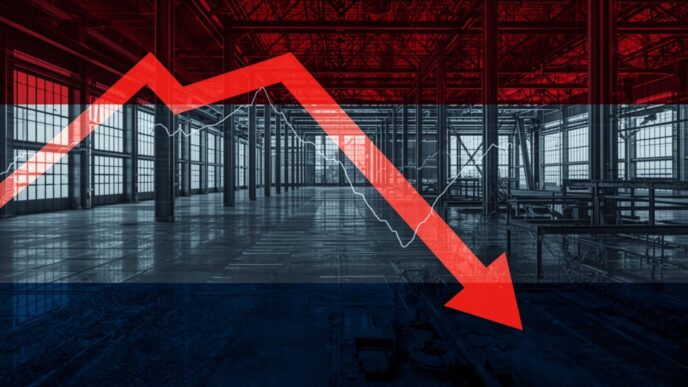






The Dutch economy has operated below structural capacity for 29 months.
Growth continues, but momentum is weak. Consumer confidence is negative, yet spending persists.
Exports are strong, and domestic investment is contracting. Bankruptcies are rising month-over-month. The labor market is shifting from a shortage to a balance.
This environment rewards operational discipline over aggressive expansion.
Expat entrepreneurs need cash reserves, diversified customers, and exposure to export-oriented clients.
Core Answer
- The Netherlands is in a 29-month period of below-trend economic growth, with growth too weak to create momentum.
- Dutch consumers are spending despite negative confidence, creating a confidence-behavior gap.
- Export-oriented sectors are outperforming domestic-focused businesses.
- Bankruptcy rates are rising month over month, particularly in hospitality and retail.
- Strategic priority: maintain 6+ months cash reserves, reduce customer concentration, position toward export-exposed clients.
The Netherlands has been operating below structural capacity for 29 consecutive months.
The signal is buried in the CBS February 2026 Conjunctuurklok report. Not a recession. Not a boom. Something harder to navigate: an economy growing enough to avoid panic, not enough to create momentum.
For expat entrepreneurs running micro and small businesses in the Netherlands, this creates a problem.
You need to understand the currents.
Read the machine correctly. Position your business where friction is lowest, and opportunity is clearest.
What Is the Confidence-Behavior Gap in the Dutch Economy?
Consumer confidence dropped to -24 in February 2026, down from -23 in January. That’s well below the twenty-year average of -11.
Dutch households are pessimistic about their monetary outlooks.
Yet household consumption rose 1.4 percent in 2025.
Dutch consumers are spending despite negative confidence. They say one thing in surveys. They do another thing with their wallets.
Confidence measures expectations. Consumption measures behavior. After these diverge for extended periods, people worry that their financial realities haven’t yet forced behavioral change.
For B2C businesses, this means:
- Sentiment surveys will mislead you when you treat them as demand forecasts.
- Actual transaction data is more reliable than confidence indexes.
- Position your offering around value and issue resolution, not aspiration.
- Dutch consumers are spending, but they’re justifying purchases more carefully.
Bottom line: Dutch consumers say they’re pessimistic but continue spending. Monitor transaction data, not sentiment surveys. Position offerings around value and issue resolution.
Next, let’s look at which sectors are expanding and which are contracting.
The Dutch economy isn’t uniform. Some sectors expand. Others shrink.
Export volumes jumped 7.1 percent year-over-year in December 2025, driven by machinery and petroleum products. Industrial production grew 1.3 percent. The tradable goods sector is performing.
Meanwhile, business investment in tangible fixed assets fell 2.6 percent, with sharp declines in commercial vehicles, trucks, trailers, and vans.
Companies selling to international markets are expanding capacity. Companies focused on domestic delivery and logistics are pulling back on capital spending.
Businesses exposed to export demand outperform businesses dependent on domestic consumption and investment.
If you’re running a service business in the Netherlands, your customers’ exposure to international trade matters more than their size or industry label. A small manufacturer exporting to Germany has a different momentum than a retailer serving only Dutch consumers.
How do you reposition toward serving export-oriented clients? How do you offer services supporting international operations: compliance, logistics coordination, and financial administration for cross-border transactions?
Bottom line: Export-oriented businesses outperform domestic-focused companies. The Netherlands is a small, open economy where foreign demand drives resilience.
How Is the Labor Market Changing?
Unemployment held steady at 4.0 percent in January 2026, but vacancies dropped to 380,000, down 7,000 from the previous quarter.
That’s the third consecutive year of declining job openings.
Total hours worked fell 0.3 percent in Q4 2025. Revenue in the temporary staffing sector (uitzendbureaus) grew just 0.9 percent year over year in Q3, signaling weak demand for adaptable labor.
The labor market is transitioning from a shortage to a balance.
For three years, Dutch employers faced severe talent shortages. Wage pressure was intense. Hiring was competitive and expensive.
That pressure is easing now.
When you’ve struggled to recruit quality people, the next 6-12 months will be easier. Candidates will be more available. Negotiations will be less one-sided.
This shift signals something uncomfortable: businesses are reducing hiring when they expect weaker demand ahead.
Reduced vacancies reflect forward-looking decisions by hundreds of employers who are collectively pulling back on expansion.
Separate your business from the aggregate.
When your business model is defensible and your customer base is stable, use this window to hire strategically. Build capacity while competition for talent is lower. When your revenue is fragile or your customer concentration is high, don’t expand payroll.
Bottom line: The labor market is shifting from shortage to balance. Hiring will be easier, and businesses are pulling back, expecting weaker demand. Use this window strategically if your revenue is stable.
Why Are Bankruptcies Rising In Spite of Economic Growth?
Total bankruptcies in 2025 were down 15 percent compared to 2024, with 3,636 businesses and institutions declared bankrupt.
But in January 2026, bankruptcies rose 6 percent month over month after adjusting for court session days.
The accommodation and food services sector had a bankruptcy rate of 29.5 per 100,000 businesses in December, up from 27.5 the previous year.
Overall stress is easing, but sector-specific fragility persists, and the monthly trend is accelerating.
For expat entrepreneurs, two risks exist:
First, your customers might fail.
When you serve B2B clients, particularly in hospitality, retail, or domestic services, monitor payment behavior closely. Extended payment terms acceptable in 2023 are riskier now.
Install a simple control: track days’ sales outstanding (DSO) monthly. When a customer’s payment cycle deviates from their normal pattern, flag it immediately.
Second, your suppliers might fail.
Supply chain disruption doesn’t only come from geopolitics. Small suppliers going bankrupt mid-contract create disruptions, too.
When you depend on a single vendor for critical inputs, map a backup now. Don’t wait for the failure signal.
The bankruptcy rate also signals something broader: compressed profit margins across the economy.
Businesses that were marginal in 2024 are failing in 2026. Delayed financial stress is surfacing.
Bottom line: Bankruptcy rates are rising month over month, especially in hospitality and retail. Monitor customer payment behavior closely. Map backup suppliers. Operational discipline beats revenue growth in this environment.
What Is Happening to Housing Wealth Effects?
The average price of an owner-occupied home rose 5.4 percent year-over-year in January 2026.
That’s the tenth consecutive month of decelerating price growth.
Month-over-month, prices increased just 1.2 percent from December.
Dutch households have considerable wealth in housing. When home prices were rising 15-20 percent annually in 2021-2022, that created a wealth effect that supported consumer spending.
That effect is fading now.
When your business serves affluent consumers, homeowners, or real estate-adjacent sectors (interior design, home improvement, moving services, mortgage advice), this deceleration matters.
Spending behavior tied to rising home equity is moderating. Discretionary purchases, justified by surging housing wealth, will face more scrutiny.
Demand won’t collapse. The psychological tailwind supporting premium pricing and impulse purchases is weakening.
Bottom line: Housing price growth is decelerating after ten months. The wealth effect supporting consumer spending is fading. Businesses serving affluent consumers should emphasize value retention over luxury.
How Is Government Spending Supporting the Economy?
GDP grew 0.5 percent in Q4 2025, driven primarily by exports and government consumption.
Not private investment. Not household spending.
This reveals the source of economic security.
The public sector is counter-cyclically supporting the economy. Appropriate during below-trend performance, but temporary.
Two consequences for entrepreneurs:
First, opportunities in public procurement may be more stable than those in the private sector.
When your business serves government clients or participates in publicly funded programs (infrastructure, healthcare, education, defense), the revenue stream faces less cyclical risk than purely commercial clients.
Second, as fiscal support eventually tightens, the economic cushion disappears.
Government consumption won’t expand indefinitely. Debt servicing costs are rising. Political pressure for fiscal discipline will return.
After support is withdrawn, private-sector demand will need to carry the economy. When demand falls short, below-trend performance will deepen.
Bottom line: Government consumption is supporting GDP growth. Public procurement offers more stability than private contracts. After fiscal support tightens in 2027-2028, expect a more difficult environment.
What Does Falling Producer Confidence Mean for Your Business?
Producer confidence fell to -1.1 in February from +0.8 in January.
That’s a sharp monthly decline, though it remains above the twenty-year average.
Producer confidence measures how businesses assess order books, production expectations, and inventory amounts.
When this indicator turns negative after months of modest positivity, businesses are becoming more cautious about near-term demand.
For B2B service providers, your clients are tightening planning assumptions. Budgets approved in Q4 2025 get reconsidered in Q2 2026.
When you depend on project-based revenue or discretionary business spending, expect longer sales cycles and more scrutiny on ROI.
Volatility in recent months (ranging from -5.0 in June 2025 to +0.8 in January 2026) demonstrates uncertainty in business planning. Your clients don’t have clear forward visibility.
This creates an opportunity for businesses to reduce uncertainty: compliance services, financial controls, process documentation, and risk management.
Bottom line: Producer confidence dropped sharply from +0.8 to -1.1 in one month. Businesses are tightening planning assumptions. Expect longer sales cycles and more ROI scrutiny. Opportunities exist in services to reduce uncertainty.
What Strategic Posture Works in This Environment?
The Dutch economy isn’t collapsing. It’s also not accelerating.
Growth sufficient to avoid recession, but insufficient to create momentum.
Two types of businesses get punished:
Businesses that assume conditions will improve soon.
Below-trend performance has lasted 29 months. Waiting for a strong recovery has been expensive. When you’ve deferred essential adjustments in the expectation that conditions will normalize, you’re accumulating risk.
Businesses that assume conditions will collapse.
GDP is growing. Consumption is growing. Exports are growing. Extreme caution that prevents you from capturing available demand is also costly.
The strategic posture working in this environment is resilient growth:
- Prioritize cash flow over revenue growth.
- Maintain 6+ months of operating expenses in reserves.
- Reduce customer concentration risk.
- Position toward sectors with export exposure
- Install financial controls that catch drift early.
- Monitor customer payment behavior weekly, not monthly.
- Use the softening labor market to hire strategically.
- Avoid aggressive expansion funded by debt or thin margins.
Bottom line: The economy operates in a narrow band. Neither collapsing nor accelerating. Resilient growth works: prioritize cash flow, maintain reserves, reduce concentration risk, install controls, and monitor payments weekly.
Which Control Points Reduce Exposure Right Now?
If you run a micro or small business in the Netherlands, these controls reduce exposure in the current environment:
Cash flow monitoring: Weekly review, not monthly. Track receivables, payables, and runway. Install a simple alert when the runway drops below 6 months.
Customer credit management: Set payment term limits. Flag customers whose DSO goes beyond normal patterns. Don’t extend terms to win marginal business.
Supplier diversification: Map essential dependencies. Identify backup suppliers before you need them. Single points of failure are expensive when bankruptcy rates are elevated.
Sector positioning: Evaluate your customer base. Are they exposed to export demand or purely domestic consumption? Shift focus toward clients with international exposure.
Margin discipline: Competing on price in a compressed-margin environment is a losing game. Differentiate on value, reliability, or specialization.
Hiring strategy: Use the softening labor market to upgrade talent. But don’t expand payroll unless revenue visibility supports it.
Scenario planning: Model your business at -10% revenue. What breaks? What controls prevent collapse? Install those controls now while you have capacity.
Structure is the price of staying in control after the environment refuses to give you clear signals.
What Question Should You Be Asking About Your Business?
The CBS data shows an economy neither failing nor thriving.
For large corporations with deep reserves and diversified operations, this environment is manageable.
For micro and small businesses, the challenge is harder.
You don’t have the luxury of waiting for clarity. You need to make decisions with incomplete information and a limited margin for error.
The question isn’t whether the Dutch economy will improve.
The question is: Will your business operate profitably in this environment for another 12-24 months?
If the answer is no, the adjustments you need are structural, not tactical.
If the answer is yes, the opportunity is to gain market share from competitors waiting for conditions to improve.
The economy won’t tell you what to do. You need to decide based on the machine you see, not the recovery you hope for.
Frequently Asked Questions
Is the Dutch economy in a recession?
No. GDP grew 0.5 percent in Q4 2025. The Netherlands has been operating below structural capacity for 29 months, and growth continues. This is below-trend performance, not recession.
Why are Dutch consumers spending if confidence is negative?
Confidence measures expectations. Consumption measures behavior. Dutch consumers expect conditions to worsen, but their day-to-day financial realities haven’t yet forced them to cut spending. This difference has continued for months.
Which business sectors are performing well in the Netherlands right now?
Export-oriented sectors are outperforming. Export volumes grew 7.1 percent year-over-year in December 2025. Industrial production grew 1.3 percent. Businesses selling to international markets are expanding. Domestic-focused businesses are contracting.
Should I expand my business in this environment?
Expansion depends on your cash position and revenue consistency. With 6+ months of reserves and stable customers, planned hiring is possible. When revenue is fragile or customer concentration is high, prioritize operational discipline over growth.
How do I protect my business from customer bankruptcies?
Track days sales outstanding (DSO) monthly. Flag customers whose payment cycles go beyond normal patterns. Set payment term limits. Don’t extend terms to win marginal business. Monitor payment behavior weekly, not monthly.
What does the softening labor market mean for hiring?
Hiring will be easier over the next 6-12 months. Candidates will be more available. Wage pressure is easing. Use this window to upgrade talent if your business model is defensible and payroll expansion is supported by revenue visibility.
Why are bankruptcies rising if the economy is growing?
Profit margins are compressed. Businesses that were marginal in 2024 are failing in 2026. Bankruptcy rates rose 6 percent month-over-month in January 2026. Hospitality and retail sectors face elevated fragility. Growth doesn’t eliminate financial stress in low-margin environments.
How long will this below-trend performance last?
The CBS data doesn’t offer a timeline. The Netherlands has operated below capacity for 29 months. Government support is temporary. Plan for this environment to persist through 2027-2028, not to improve quickly.
Key Takeaways
- The Dutch economy has operated below structural capacity for 29 consecutive months. Growth continues, momentum is weak.
- Dutch consumers are spending despite negative confidence. Monitor transaction data, not sentiment surveys.
- Export-oriented businesses outperform domestic-focused companies. Position toward clients with international exposure.
- Bankruptcy rates are rising month-over-month. Monitor customer payment behavior closely and map backup suppliers.
- The labor market is shifting from a shortage to a balance. Hiring will be easier, and businesses are pulling back, expecting weaker demand.
- Government consumption is supporting GDP growth. Public procurement offers more stability than private contracts. Expect fiscal tightening in 2027-2028.
- Strategic priority: maintain 6+ months cash reserves, reduce customer concentration, install financial controls, monitor payments weekly, prioritize cash flow over revenue growth.