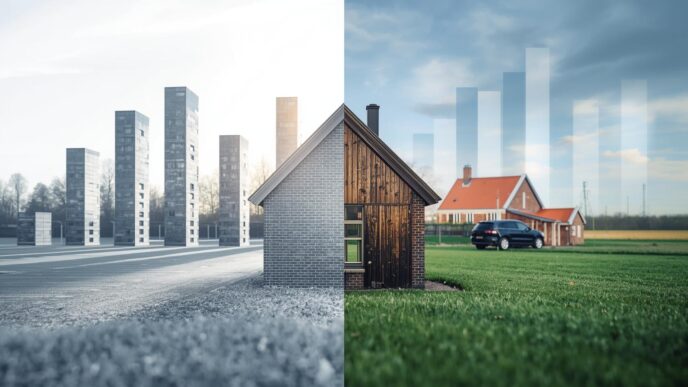






The Netherlands rental housing crisis is a regulatory outcome, not a market accident. The Affordable Rent Act triggered a 36.4% collapse in private rental supply while average rents rose 7.9%. Private landlords sold 20,000 properties in six months. The affordable segment shrank to 30.1% of supply while attracting 44.2% of demand. Student housing lost 10,000 rooms. Construction permits dropped 14.54%. Over 200,000 homes sit empty despite acute shortages. The crisis creates direct operational risk for businesses through talent retention failure and wage pressure.
Core Facts:
- Private rental supply dropped 36.4% year-over-year in Q2 2025 after the Affordable Rent Act took effect July 1, 2024
- Average rent reached €1,781 nationally, requiring €5,343 monthly income to qualify under the 3x rule
- Affordable properties under €1,500 represent 30.1% of supply but attract 44.2% of applications
- Student housing lost 10,000 rooms between Q1 2024 and Q1 2025, with projections of 45,000 more by 2027
- Construction permits declined 14.54%, while the structural shortage reached 395,000 homes
The Netherlands didn’t stumble into a rental housing crisis. It engineered one.
I’ve watched the mechanism unfold with the precision of a machine designed to do exactly what nobody intended.
The Affordable Rent Act took effect on July 1, 2024. Within six months, 20,000 buy-to-let transactions flooded the market. That’s over 30% of all housing transactions in Q4 2024 alone.
Private landlords didn’t hesitate. They sold.
The regulation expanded rent controls from 144 to 186 points, capping monthly rent at €1,184.82. The intention was protection. The consequence was exodus.
What Happened to Rental Supply After the Affordable Rent Act?
The data shows what happened after the regulation hit:
Private rental supply collapsed by 36.4% year-over-year in Q2 2025. At the same time, average rental prices per square meter rose 7.9%.
The market didn’t correct. It constricted.
Demand hit the highest level since measurement began. Each listed rental property now receives an average of 47 responses. That’s a 47% jump in competition.
The supply-demand mismatch by price segment:
- Properties under €1,500/month: 30.1% of supply, 44.2% of applications
- Properties above €2,000/month: 36.5% of supply, 18.3% of applications
The mismatch isn’t a market failure. It’s a structural distortion. Regulatory pressure created supply withdrawal exactly where demand concentrates.
Bottom line: Rent control triggered landlord exit, which reduced supply, which increased competition and prices. The regulation produced the opposite of its intended outcome.
How Bad Is the Student Housing Shortage?
Students absorbed the sharpest edge of this crisis.
The Netherlands lost 10,000 student rooms between Q1 2024 and Q1 2025.
City-specific losses:
- Amsterdam: 30% reduction
- Delft: 44% reduction
The cause traces directly to landlords selling properties after the regulatory changes. The shortage now stands at 20,000+ rooms. Projections show an additional 45,000 rooms disappearing by 2027.
This isn’t a temporary squeeze. It’s a structural withdrawal from a market segment that no longer works for private operators.
Reality check: Student housing economics broke under rent control. Landlords exited. Supply won’t return without changed incentives.
Who Gets Excluded by Current Income Requirements?
The rental market operates on a simple formula: tenants must earn three times the monthly rent.
Income thresholds at current market rates:
- Average national rent (€1,781): requires €5,343 monthly income
- Affordable range (€1,500): requires €4,500 monthly income
Median-income earners don’t clear that bar. They earn too much to qualify for social housing but not enough to access the shrinking private rental market.
I call this the trapped middle. The system created a gap where middle-income households have no viable housing pathway.
One market analyst captured it precisely: “We see a growing group of people who earn too much for regulated housing but not enough to access the unregulated sector. These middle-income earners are stuck.”
The trap: Income requirements rose because supply contracted. Supply contracted because of regulation. Regulation targeted affordability. The outcome is less affordability for the middle.
Why Isn’t New Construction Solving This?
New supply isn’t coming to rescue the market.
Construction decline data:
- Permits declined 14.54% year-over-year
- Only 38,660 permits granted in H1 2025
- Government target: 100,000 new homes annually
- Structural shortage: 395,000 homes (highest in over a decade)
The government set a target of 100,000 new homes annually. It’s not hitting it.
Even when permits get approved, the average timeline from project start to key handover runs 8 to 12 years. The supply-side constraint ensures the shortage persists regardless of demand signals.
Simple math: Construction is declining while the shortage grows. Timeline lag means today’s permits become tomorrow’s housing. The gap widens faster than building closes it.
Why Are 200,000 Homes Empty During a Housing Crisis?
This part exposes the system’s fragility:
Vacancy data:
- Total empty homes: 200,670
- Total vacant space: 21.5 million square meters
- Amsterdam alone: 22,000 empty homes
- Vacancy increase: 3% from beginning of 2025
Vacancy increased during an acute shortage.
The market isn’t suffering from absolute scarcity. It’s suffering from structural misalignment between regulatory frameworks, landlord economics, and tenant accessibility.
The disconnect: Homes exist. Demand exists. The regulatory and economic structure prevents them from meeting. This is system failure, not market failure.
What Does This Mean for Businesses Operating in the Netherlands?
Running a company in the Netherlands means this crisis creates operational exposure:
Talent retention weakens. Employees who don’t find housing leave or don’t relocate. Your hiring radius shrinks.
Compensation pressure increases. Housing costs force wage demands higher. Your labor costs rise without productivity gains.
Geographic flexibility disappears. Expanding to secondary cities doesn’t solve the problem. Rotterdam saw rental prices per square meter increase 8.0%. The Hague rose 6.4%. The crisis spread from primary to secondary markets.
The housing market stopped being a background condition. It became a business constraint.
Business impact: Housing scarcity translates directly into hiring difficulty, retention failure, and wage inflation. This is operational risk, not social policy.
How Should Businesses Respond?
You don’t control housing policy. You control your operating model.
Practical adjustments:
- Build housing flexibility into compensation structures
- Offer relocation support that reflects actual market conditions, not outdated assumptions
- Consider remote-first models that reduce geographic dependency
The market won’t self-correct when structural barriers prevent supply from aligning with demand. Plan accordingly.
Control point: You adjust to reality faster than reality adjusts to policy. Build operations around constraints, not wishes.
Frequently Asked Questions
What caused the Netherlands rental housing crisis?
The Affordable Rent Act (July 1, 2024) expanded rent controls, which triggered private landlords to sell properties. This caused a 36.4% collapse in private rental supply while demand hit record levels. The regulation intended to create affordability but produced supply withdrawal instead.
How much income do you need to rent in the Netherlands?
Tenants need three times the monthly rent. At the national average of €1,781, tenants need €5,343 monthly income. For affordable properties around €1,500, tenants still need €4,500. Median-income earners often don’t qualify.
Why is student housing disappearing in the Netherlands?
The Netherlands lost 10,000 student rooms between Q1 2024 and Q1 2025. Landlords sold properties after rent control made student housing unprofitable. Amsterdam lost 30% of student rooms, Delft lost 44%. Projections show 45,000 more rooms disappearing by 2027.
Why are homes empty during a housing shortage?
Over 200,670 homes stand empty despite acute shortages. Vacancy increased 3% in 2025. The problem is structural misalignment between regulatory frameworks, landlord economics, and tenant accessibility. Homes exist, demand exists, but the system prevents them from meeting.
Is new construction solving the housing crisis?
No. Construction permits declined 14.54% year-over-year. Only 38,660 permits were granted in H1 2025, far below the 100,000 annual target. The structural shortage is 395,000 homes. Even approved projects take 8 to 12 years to complete.
How does the housing crisis affect businesses?
The crisis creates three operational risks. First, talent retention weakens because employees leave when they don’t find housing. Second, compensation pressure increases as housing costs drive wage demands higher. Third, geographic flexibility disappears because the crisis spread to secondary cities too.
What is the trapped middle in the Netherlands housing market?
The trapped middle refers to median-income earners who earn too much to qualify for social housing but not enough to access the private rental market. They’re excluded from both segments and have no viable housing pathway.
Will rent control solve affordability in the Netherlands?
No. Rent control triggered landlord exit, which reduced supply in the affordable segment. Properties under €1,500 now represent only 30.1% of supply while attracting 44.2% of applications. The regulation produced less affordability, not more.
Key Takeaways
- The Netherlands rental crisis is a regulatory outcome. The Affordable Rent Act triggered a 36.4% supply collapse while rents rose 7.9%.
- Supply and demand are misaligned by structure, not market forces. Affordable properties (under €1,500) are 30.1% of supply but attract 44.2% of applications.
- The trapped middle is growing. Median earners cannot access social housing or afford private rentals at €5,343 income requirements.
- Student housing is collapsing. 10,000 rooms lost in one year, with 45,000 more projected by 2027.
- Construction is declining, not increasing. Permits dropped 14.54%, while the shortage reached 395,000 homes.
- Over 200,000 homes sit empty during acute shortages. This is system failure, not scarcity.
- Businesses face operational risk through talent retention failure, wage pressure, and geographic constraints. Housing became a business constraint, not background condition.
The Netherlands built this crisis through cumulative regulatory choices that individually seemed reasonable. The mechanism was predictable. The consequence is now visible.
Systems don’t care about intentions. They respond to structure.