





Paying suppliers before receiving proper invoices creates documentation gaps that the Belastingdienst will reject during audits. Order confirmations are not invoices. Without compliant invoices, you lose VAT reclaims, expense deductions, and audit defensibility. Fix this by requesting invoices before payment.
Core Answer:
- Order confirmations are commercial documents. Invoices are legal accounting documents required for VAT reclaims and expense deductions.
- The Belastingdienst requires proof of compliant invoices during audits. Payment proof alone doesn’t satisfy requirements.
- Documentation gaps accumulate across transactions and surface during audits when you’re forced to reconstruct months of records.
- Prevention is simple: no invoice, no payment. Request invoices before processing any supplier payment.
LISTEN TO THE DEEP DIVE ABOUT THIS TOPIC:
What Is the Difference Between Order Confirmations and Invoices?
Order confirmations are commercial documents. They confirm intent.
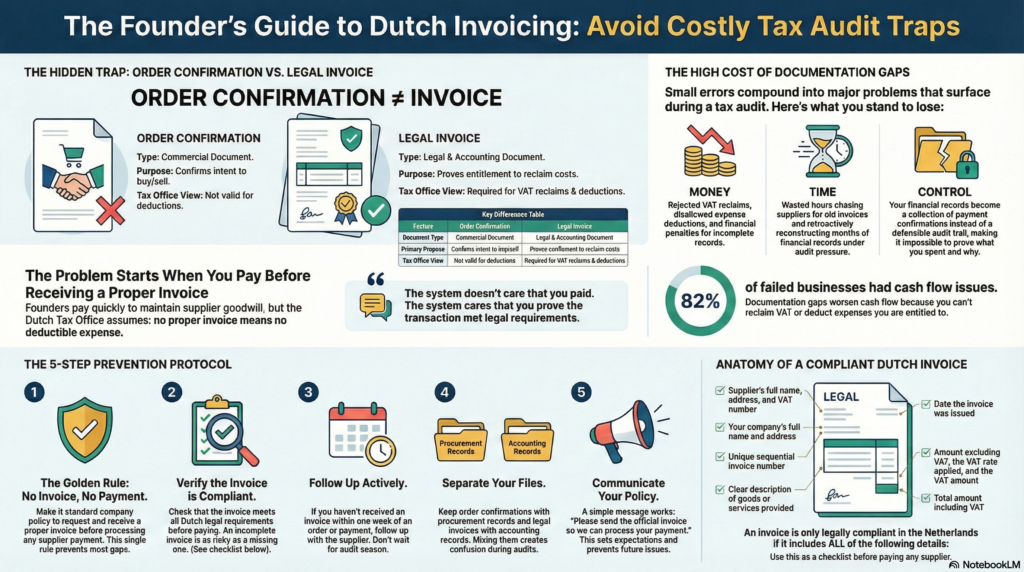
Invoices are legal accounting documents. They support VAT claims, justify expenses, and withstand scrutiny from the Tax Office.
The system doesn’t care that you paid. The system cares that you prove the transaction met legal requirements.
If the invoice doesn’t meet Dutch legal standards, you can’t reclaim VAT. If you can’t produce a compliant invoice during an audit, your deduction gets rejected.
Bottom line: Order confirmations confirm you ordered. Invoices prove you’re entitled to reclaim costs.
How Documentation Gaps Form
Here’s the sequence:
- You order something from a supplier.
- The supplier sends an order confirmation.
- You pay immediately because the relationship is good and the amount is clear.
- The invoice arrives weeks later, or not at all.
You’ve created a documentation gap.
Most founders pay suppliers fast and assume the paperwork will follow. The Belastingdienst assumes the opposite: no proper invoice means no deductible expense, no VAT reclaim, and no defensible position during an audit.
The failure isn’t sudden. Documentation gaps accumulate quietly across dozens of transactions until an audit forces you to reconstruct months of missing records.
Key insight: Small documentation errors compound into cash flow problems because you can’t reclaim VAT or justify expenses without proper invoices.
Why Founders Pay Before Receiving Invoices
Founders ignore proper invoice sequencing because paying fast feels efficient.
Paying fast maintains supplier goodwill. Waiting for invoices feels like unnecessary friction. The amounts are small. The supplier is trusted. The relationship is informal.
But informal relationships don’t translate into compliant documentation.
You’re operating under information asymmetry. The supplier benefits from quick payment regardless of when they send the invoice. You bear the administrative risk if the documentation is incomplete or arrives late.
Reality check: The most dangerous vulnerabilities accumulate in foundational practices that feel too small to formalize.
What Happens When Documentation Gaps Break
When this breaks, the consequences show up as:
Money: Rejected VAT reclaims. Disallowed expense deductions. Penalties for incomplete records.
Time: Retroactive reconciliation work. Chasing suppliers for invoices months after payment. Reconstructing transaction trails during audits.
Control: You can’t prove what you spent or why. Your financial records become a collection of payment confirmations instead of a defensible audit trail.
Cash flow: Research shows that 82% of businesses that failed had some sort of cash flow issue. Documentation gaps compound cash flow problems because you can’t reclaim VAT or justify expenses without proper invoices.
The Tax Office’s approach is evidence-based. You must prove compliance. Assertions don’t count.
What this means for you: Documentation gaps create financial exposure that surfaces during audits when reconstruction becomes expensive and time-consuming.
How to Prevent Invoice Documentation Gaps
Install these controls before documentation gaps become expensive:
1. Request the invoice before you pay
Make this a standard protocol. No invoice, no payment. This single rule prevents most documentation gaps.
2. Verify the invoice meets Dutch legal requirements
Check for your company details, VAT numbers, clear descriptions, correct amounts, and invoice dates. Incomplete invoices create the same exposure as missing ones.
3. Track outstanding invoices actively
If you’ve paid but haven’t received an invoice within one week, follow up. Don’t wait until audit season to discover the gap.
4. Separate order confirmations from invoices in your filing system
Order confirmations belong in procurement records. Invoices belong in accounting. Mixing them creates confusion during audits.
5. Build supplier communication into your payment workflow
A simple message works: “Please send the official invoice before we process payment.” This prevents complex problems.
6. Assign one person to verify invoice completeness before payment approval
This adds a control layer without adding bureaucracy.
Implementation note: These controls are behavioral adjustments, not systemic overhauls. Install once, benefit permanently.
What Proper Invoice Documentation Delivers
When you maintain proper invoice documentation, you get:
Proof that withstands Tax Office scrutiny. Clear financial records that support VAT reclaims. Fewer surprises during audits. More mental space for building the business instead of reconstructing the past.
Administrative discipline isn’t constraint. Administrative discipline is the foundation that lets you operate without constant financial anxiety.
Structure is cheaper than recovery. Install the control once. Save the panic forever.
Frequently Asked Questions
What makes an invoice legally compliant in the Netherlands?
A compliant invoice must include your company name and address, your VAT number, the supplier’s details, invoice date, invoice number, clear description of goods or services, amounts excluding VAT, VAT rate and amount, and total amount including VAT.
Can I use an order confirmation for my tax return?
No. Order confirmations are commercial documents that confirm intent. The Belastingdienst requires proper invoices for VAT reclaims and expense deductions. Order confirmations don’t meet legal requirements.
What happens if I paid a supplier but never received an invoice?
You bear the risk. During an audit, you can’t reclaim VAT or deduct the expense without a compliant invoice. Contact the supplier immediately and request the official invoice. Don’t wait for audit season.
How long should I wait for an invoice before following up?
Follow up within one week of payment if you haven’t received the invoice. Waiting months creates reconstruction work and increases audit risk.
Should I stop paying suppliers who send order confirmations instead of invoices?
Yes. Adopt a no invoice, no payment protocol. Request the official invoice before processing payment. This single rule prevents most documentation gaps.
Can I create my own invoice if the supplier doesn’t send one?
No. The supplier must issue the invoice. You can’t create invoices for purchases. Request the supplier to send a compliant invoice and keep records of your requests.
What’s the penalty for missing invoices during a tax audit?
The Belastingdienst will reject VAT reclaims and disallow expense deductions for transactions without compliant invoices. You’ll also face penalties for incomplete records. The financial impact compounds across all affected transactions.
How do I organize invoices versus order confirmations in my filing system?
Keep them separate. Order confirmations belong in procurement records to track what you ordered. Invoices belong in accounting records to support VAT reclaims and expense deductions. Mixing them creates audit confusion.
Key Takeaways
- Order confirmations confirm intent. Invoices are legal accounting documents required for VAT reclaims and expense deductions. They’re not interchangeable.
- Paying before receiving invoices creates documentation gaps that surface during tax audits when reconstruction becomes expensive.
- The Belastingdienst requires proof of compliance. Payment confirmations alone don’t satisfy legal requirements for VAT reclaims or expense deductions.
- Information asymmetry exists: suppliers benefit from quick payment, but you bear the administrative risk when documentation is incomplete or late.
- Prevention is simple: adopt a no invoice, no payment protocol. Request invoices before processing supplier payments.
- Proper invoices must include company details, VAT numbers, clear descriptions, correct amounts, dates, and invoice numbers to meet Dutch legal standards.
- Administrative discipline creates business freedom. Structure is cheaper than recovery. Install controls once, eliminate panic permanently.