



TL;DR: 175,000 workers in the Netherlands lived below the poverty line in 2024 despite being employed. This marks the first increase after five years of decline. The cause is employment instability, not unemployment. Flexible contracts, inexperience, self-employment without staff, and single-income households drive this structural problem. Founders who rely on flexible labor structures contribute to the risk and face delayed costs through turnover, regulation, and reputational damage.
175,000 workers in the Netherlands lived in poverty in 2024. Not unemployed. Working.
This is the first increase after five years of decline. The reversal happened fast.
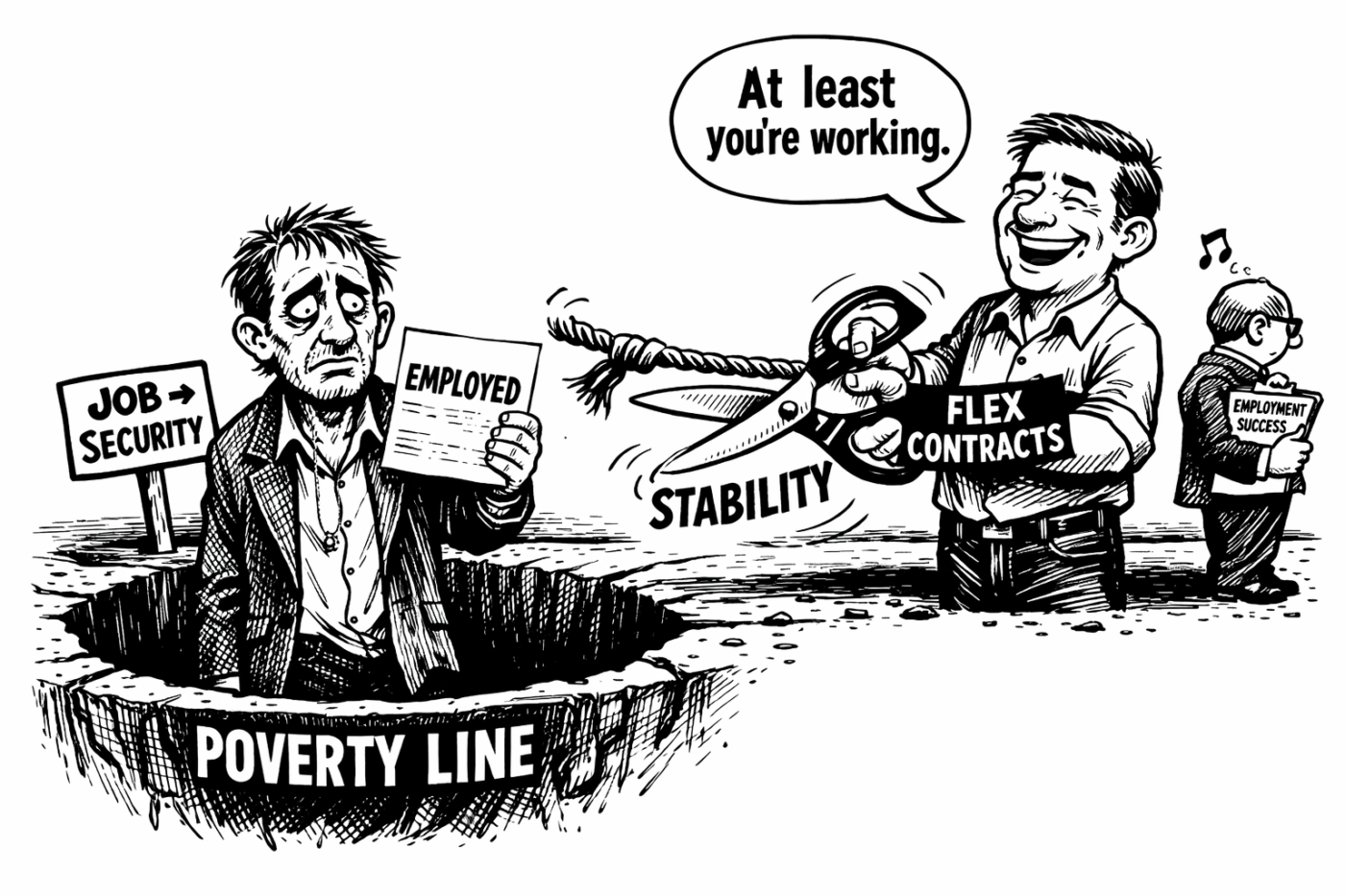
The mechanism is not unemployment. The mechanism is employment without stability.
Core findings:
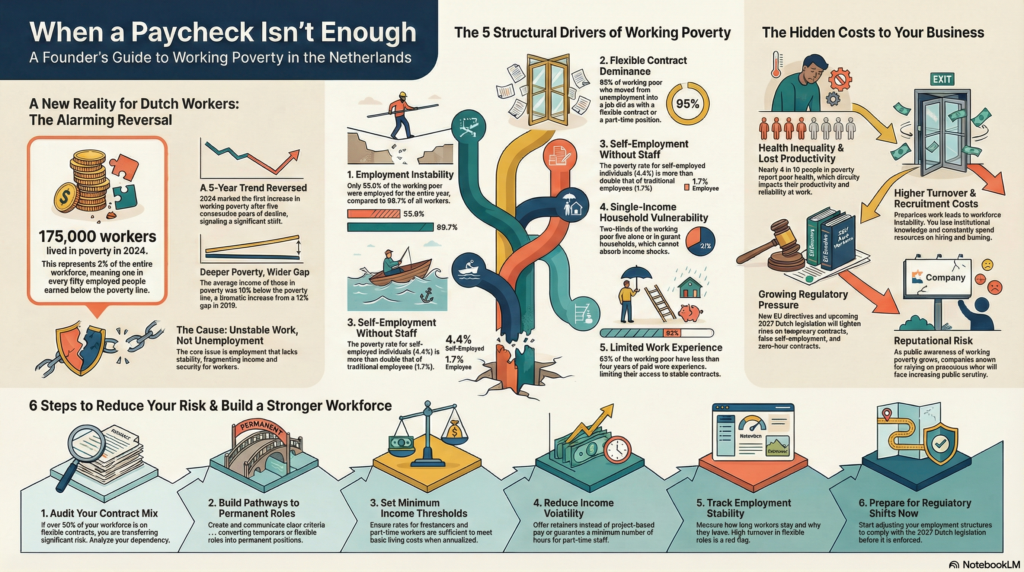
- 2% of all workers (175,000 people) earned below the poverty line in 2024
- Only 55.6% of working poor worked the entire year, compared to 89.7% of all workers
- Self-employed workers without staff face 4.4% poverty rate versus 1.7% for traditional employees
- 95% of working poor transitioning from unemployment hold flexible contracts or part-time positions
- Two-thirds of working poor live alone or in single-parent households
LISTEN TO THE DEEP DIVE ABOUT THIS TOPIC:
Why Having a Job No Longer Guarantees Security
The data shows having a job no longer guarantees staying out of poverty.
2% of all workers earned income below the poverty line in 2024. That is one in every fifty workers.
The assumption has always been simple: work equals security. The labor market is now breaking that equation.
I see this pattern everywhere. Founders hire flexibly. Workers accept unstable terms because stable positions disappeared. The system transfers risk downward. Poverty becomes the cost of participating.
The working poor are not lazy. They are trapped in a structure that no longer holds.
What Triggers Working Poverty: Five Structural Factors
The CBS report reveals the mechanism in detail. Working poverty is not one cause. Working poverty is a combination of structural fragilities that compound.
Employment Instability
Only 55.6% of the working poor worked the entire year. Compare that to 89.7% of all workers. The gap is enormous.
Nearly half of the working poor experienced inconsistent employment. They worked, stopped, started again. Income came in fragments.
Limited Work Experience
63% of the working poor had less than four years of paid work experience. Inexperience does not limit earnings only. Inexperience limits access to stable contracts.
Young workers get hit hardest. 24% of the working poor are under 25. They enter a labor market that offers flexibility as a feature and instability as a consequence.
Self-Employment Without Staff
The poverty rate among self-employed workers without staff is 4.4%. This is more than double the 1.7% rate for traditional employees.
Freelancers face a harsher reality. According to recent analysis, long-term poverty is more common among freelancers. 1.1% live below the poverty line for three years or longer compared to 0.2% of traditional employees.
The entrepreneurship narrative sells freedom. The data shows fragility.
Flexible Contract Dominance
95% of working poor who transitioned from unemployment to employment held flexible contracts or worked part-time.
The Netherlands has the highest percentage of flexible workers in the EU. Around 2.7 million people hold flexible contracts compared to 5.5 million with permanent contracts.
Flexibility transferred risk. Workers absorbed it.
Single-Income Household Vulnerability
Two-thirds of the working poor live alone or in single-parent households. Single-income households cannot buffer income shocks.
Dual incomes are no longer optional. They are structural necessities.
Bottom line: Working poverty results from employment structures that fragment income, limit advancement, and transfer economic risk to workers least able to absorb it.
Why Working Poverty Reversed in 2024
Working poverty declined for five years. Then it reversed in 2024.
The timing matches the removal of energy subsidies. According to CBS data, government purchasing power measures lifted people on benefits out of poverty. Workers were left behind.
The safety net caught one group and missed another.
This reveals something uncomfortable: social policy creates two-tier systems where workers fall through structural gaps.
The average income of those living in poverty was 19% below the poverty line in 2024. In 2018, the gap was 12%. The income shortfall widened dramatically.
Poverty is not more common only. Poverty is deeper.
What this means: Policy interventions targeted at benefit recipients do not automatically protect workers. Cost-of-living pressures hit employed people harder when support systems exclude them.
Why Founders Miss This Risk
Most founders do not see working poverty as their problem.
You hire flexibly because the business demands it. You offer part-time contracts because full-time commitments feel risky. You work with freelancers because it is efficient.
All of this makes operational sense.
The structure transfers economic risk to the people with the least capacity to absorb it.
What founders miss:
Flexible Employment Creates Income Instability
Income instability is the biggest worry for 47% of independent workers globally. The instability does not disappear when the contract ends. The instability compounds.
Young Workers Get Locked Into Precarious Cycles
You hire them on short contracts. They gain experience slowly. Stable employers prefer experienced workers. The loop tightens.
Single-Income Households Cannot Recover From Gaps
A two-month contract gap for a freelancer in a single-parent household is not a pause. A two-month contract gap is a crisis.
The Cost Shows Up Later
Working poverty does not announce itself. Working poverty accumulates quietly until health deteriorates, productivity drops, or the worker exits the labor market entirely.
You are not creating poverty intentionally. You are participating in a system that produces poverty structurally.
The reality: Operational efficiency in hiring creates delayed costs through workforce instability, health deterioration, and regulatory exposure.
What Working Poverty Costs Your Business
Working poverty does not stay contained.
Health Inequality and Productivity Loss
Nearly four in ten people living in poverty in the Netherlands rate their health as poor. Life expectancy is shorter by nine years for men and seven years for women compared to the general population.
Poor health reduces productivity. Reduced productivity limits income. The cycle reinforces itself.
Workforce Instability and Turnover
Workers in poverty experience higher turnover. You lose institutional knowledge. You spend more time recruiting and onboarding.
Regulatory Pressure
The EU Platform Work Directive entered into force on December 1, 2024. The directive introduces the presumption of an employment relationship to eliminate false self-employment. Basic rights including minimum wage and paid holidays now extend to gig workers.
The Netherlands is responding. Under new 2027 legislation, the current six-month break period after three successive temporary contracts will extend to five years. Zero-hour contracts will be replaced by bandwidth contracts with set minimum and maximum working hours.
Governments are recognizing structural employment problems. Regulatory costs will follow.
Reputational Risk
Public awareness of working poverty is increasing. Companies that rely heavily on precarious labor will face scrutiny.
The cost is not immediate. The cost is delayed and compounding.
Critical insight: Working poverty creates measurable business costs through health-related productivity loss, higher turnover, regulatory penalties, and reputational damage.
How to Reduce Your Exposure
You cannot solve working poverty alone. You reduce your contribution to the structure producing it.
Audit Your Contract Mix
What percentage of your workforce is on flexible, temporary, or zero-hour contracts? If the percentage is above 50%, you are transferring significant risk.
Build Pathways From Flexible to Permanent
Create clear criteria for converting temporary contracts to permanent positions. Make the pathway visible.
Set Minimum Income Thresholds
If you hire freelancers or part-time workers, ensure the rate allows them to meet basic living costs when annualized.
Reduce Income Volatility
Offer retainer arrangements instead of project-by-project contracts. Guarantee minimum hours for part-time workers.
Track Employment Stability as a Metric
Measure how long workers stay with you and why they leave. High turnover in flexible roles signals structural problems.
Prepare for Regulatory Shifts Now
The 2027 Dutch legislation and EU Platform Work Directive will change how you classify and compensate workers. Start adjusting your employment structure before enforcement begins.
What you control: These controls do not eliminate working poverty. These controls reduce your exposure to the costs it produces.
The Structural Reality
Working poverty is not an edge case anymore.
Working poverty is a pattern embedded in how modern labor markets operate. Flexibility became the default. Stability became the exception. Risk transferred downward.
The system does not care about intentions. The system measures proof and consequences.
Ignore this and absorb the costs later: higher turnover, regulatory penalties, reputational damage, workforce instability.
Install controls now that reduce exposure before the pressure builds.
Structure is cheaper than recovery.
Frequently Asked Questions
What is working poverty?
Working poverty occurs when employed individuals earn income below the poverty line despite being active in the labor market. In the Netherlands, 175,000 workers lived in poverty in 2024, representing 2% of all workers.
Why did working poverty increase in 2024 after five years of decline?
The increase coincides with the removal of energy subsidies. Government purchasing power measures lifted people on benefits out of poverty while leaving workers behind. The average income shortfall for those in poverty widened from 12% below the poverty line in 2018 to 19% in 2024.
What employment patterns increase working poverty risk?
Employment instability is the primary driver. Only 55.6% of working poor worked the entire year compared to 89.7% of all workers. Flexible contracts dominate, with 95% of working poor transitioning from unemployment holding flexible or part-time positions.
Are self-employed workers more vulnerable to working poverty?
Yes. Self-employed workers without staff face a 4.4% poverty rate compared to 1.7% for traditional employees. Long-term poverty is more common among freelancers, with 1.1% living below the poverty line for three years or longer versus 0.2% of traditional employees.
How does household structure affect working poverty?
Two-thirds of the working poor live alone or in single-parent households. Single-income households cannot buffer income shocks. Dual incomes have become structural necessities for economic stability.
What regulatory changes are coming?
The EU Platform Work Directive entered force on December 1, 2024, introducing presumption of employment relationships and extending minimum wage and paid holiday rights to gig workers. Dutch 2027 legislation will extend the break period after three successive temporary contracts from six months to five years and replace zero-hour contracts with bandwidth contracts.
What business costs result from working poverty?
Health-related productivity loss occurs because nearly four in ten people in poverty rate their health as poor. Workforce turnover increases institutional knowledge loss. Regulatory penalties and reputational damage grow as public awareness increases.
How do founders reduce exposure to working poverty risks?
Audit contract mix to identify if more than 50% of workers hold flexible arrangements. Build clear pathways from temporary to permanent positions. Set minimum income thresholds for contract work. Reduce income volatility through retainers and guaranteed minimum hours. Track employment stability as a metric. Prepare for regulatory shifts before enforcement begins.
Key Takeaways
- Employment without stability is replacing unemployment as the primary mechanism driving poverty in the Netherlands
- Working poverty results from five structural factors: employment instability, limited work experience, self-employment without staff, flexible contract dominance, and single-income household vulnerability
- The 2024 reversal occurred because policy interventions targeted benefit recipients while excluding workers from cost-of-living support
- Founders who rely on flexible labor structures create delayed costs through workforce instability, health deterioration, regulatory penalties, and reputational damage
- Self-employed workers without staff face 4.4% poverty rates, more than double the 1.7% rate for traditional employees, with freelancers experiencing long-term poverty at five times the rate of traditional workers
- Regulatory pressure is building through the EU Platform Work Directive and 2027 Dutch legislation that will fundamentally change classification and compensation requirements
- Reducing exposure requires auditing contract mix, building conversion pathways, setting minimum income thresholds, reducing volatility, tracking stability metrics, and preparing for regulatory shifts before enforcement