






Dutch tax residents must report all foreign bank accounts, investments, and crypto holdings under Box 3 requirements. The Common Reporting Standard shares account data from 100+ countries with Dutch tax authorities. Penalties reach 300%, and correction periods extend twelve years back. Proactive disclosure beats reactive compliance.
What you need to know:
- The Netherlands taxes worldwide assets for all tax residents
- Foreign banks automatically report account data to Dutch tax authorities through CRS
- Pre-filled tax returns don’t include all foreign accounts, full disclosure is your responsibility
- Penalties for undeclared foreign assets reach 300% with a twelve-year lookback period
- Voluntary correction before detection reduces penalties and closes exposure
I keep hearing the same assumption from small business owners: “It’s a personal account abroad. I don’t need to report it.”
That assumption creates exposure.
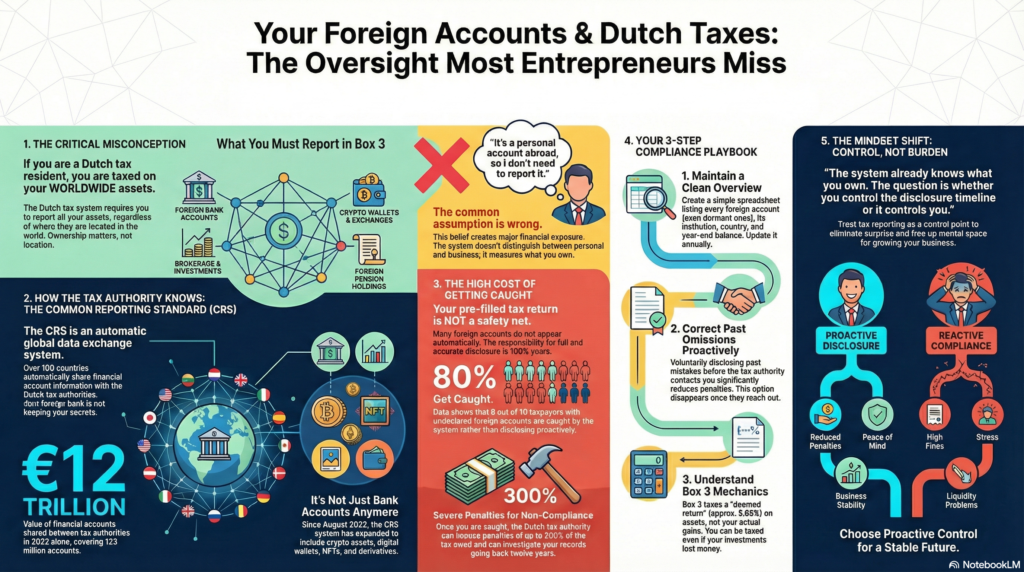
The Netherlands taxes worldwide income and assets. If you’re a Dutch tax resident, every foreign bank account, brokerage portfolio, crypto wallet, and investment holding falls under Box 3 reporting requirements.
The system doesn’t care if the account feels personal. It measures what you own, wherever it sits.
LISTEN TO THE DEEP DIVE ABOUT THIS TOPIC:
How Does the Netherlands Tax Foreign Accounts?
The Netherlands operates on a worldwide taxation principle. Dutch tax residents report all assets regardless of location.
This includes:
- Foreign bank accounts
- Brokerage and investment accounts
- Crypto wallets and exchanges
- Pension holdings abroad
- Savings accounts in other countries
These assets fall under Box 3 of the Dutch income tax system. You pay tax on a deemed return of approximately 5.88%, not your actual gains or losses.
Bottom line: Location doesn’t matter. Ownership does. If you’re a Dutch tax resident, you report everything.
What Is the Common Reporting Standard and How Does It Work?
The Common Reporting Standard (CRS) connects over 100 countries in automatic data exchange.
The mechanism works like this:
Foreign banks report account information directly to their local tax authority. That authority shares the data with the Netherlands. In 2022 alone, information on 123 million financial accounts worth €12 trillion moved between tax authorities.
Your foreign bank isn’t keeping secrets. It’s feeding data to the Dutch tax authority.
The CRS expansion now includes crypto assets, digital wallets, NFTs, and derivatives. The gray areas disappeared in August 2022.
Key insight: The reporting infrastructure already sees your foreign holdings. The question is whether you report them first.
Why Pre-Filled Tax Returns Don’t Protect You
Some foreign accounts appear in your pre-filled tax return. Many don’t.
The responsibility for complete disclosure sits with you, regardless of what auto-populates. Pre-filled data is not a safety net.
Slovenian tax data shows that only 19.7% of CRS-reported accounts had been proactively disclosed by taxpayers before detection. That means 80% of people get caught by the system instead of staying ahead of it.
What happens when you’re caught:
- The Dutch tax authority opens a correction window going back twelve years
- Penalties for Box 3 omissions reach 300% of the tax owed
- The liquidity drain disrupts business operations
- Voluntary disclosure options disappear once the authority contacts you
Reality check: Pre-filled returns create false confidence. Complete disclosure is your responsibility, not the system’s.
How to Report Foreign Accounts Correctly
You don’t need complex systems. You need simple, consistent documentation.
Step 1: Maintain a clean overview
- List every foreign account, even if dormant or low-balance
- Track year-end balances in a single spreadsheet
- Include account numbers, institutions, and countries
- Update it annually before tax season
Step 2: Correct past omissions proactively
Voluntary disclosure before detection reduces penalties and closes exposure windows. Waiting until the tax authority contacts you eliminates that option.
Step 3: Understand Box 3 mechanics
The Netherlands taxes a deemed return of approximately 5.88% on investment assets, regardless of actual performance. You pay tax on fictional gains even when your portfolio loses value.
Structure your holdings with that distortion in mind.
Control point: Simple documentation eliminates surprise. Build the structure once, save the panic forever.
Why Compliance Is a Control Point, Not a Burden
Most founders treat tax reporting as a burden. I see it as a control point.
When you document foreign holdings clearly, you eliminate surprise. You remove the risk of compounding penalties. You free up mental space for growth decisions instead of reactive fire drills.
The system already knows what you own. The question is whether you control the disclosure timeline or it controls you.
Final word: Structure beats stress. Proactive disclosure beats reactive compliance.
Frequently Asked Questions
Do I need to report a foreign bank account with a low balance?
Yes. The Netherlands requires reporting of all foreign accounts regardless of balance. Box 3 applies to total worldwide assets, not individual account thresholds.
What counts as a foreign account for Dutch tax purposes?
Any financial account held outside the Netherlands, including bank accounts, brokerage accounts, crypto exchanges, investment platforms, and pension holdings abroad.
Will my pre-filled tax return show all my foreign accounts?
No. Pre-filled returns don’t reliably include all foreign account data. Complete disclosure is your responsibility, not the tax authority’s.
What are the penalties for not reporting foreign accounts?
Penalties for undeclared Box 3 assets reach 300% of the tax owed. The correction window extends twelve years back for foreign asset omissions.
How does the Dutch tax authority find out about foreign accounts?
Through the Common Reporting Standard, which connects over 100 countries in automatic data exchange. Foreign banks report account information directly to Dutch tax authorities.
What is Box 3 and how does it tax foreign accounts?
Box 3 is the Dutch wealth tax system. It taxes a deemed return of approximately 5.88% on investment assets, regardless of actual performance or losses.
Should I correct past omissions of foreign accounts?
Yes. Voluntary disclosure before detection reduces penalties and closes exposure windows. Once the tax authority contacts you, voluntary disclosure options disappear.
Do crypto holdings count as foreign accounts?
Yes. The CRS expansion now includes crypto assets, digital wallets, NFTs, and derivatives. All crypto holdings require Box 3 reporting.
Key Takeaways
- Dutch tax residents must report all worldwide assets, including foreign bank accounts, investments, and crypto holdings under Box 3
- The Common Reporting Standard automatically shares financial account data from 100+ countries with Dutch tax authorities
- Pre-filled tax returns don’t reliably include foreign accounts. Complete disclosure is your legal responsibility
- Penalties for undeclared foreign assets reach 300% with a twelve-year lookback period
- 80% of taxpayers get caught by the system instead of proactively disclosing foreign holdings
- Voluntary correction before detection reduces penalties and closes exposure
- Simple documentation eliminates surprise and protects business liquidity