


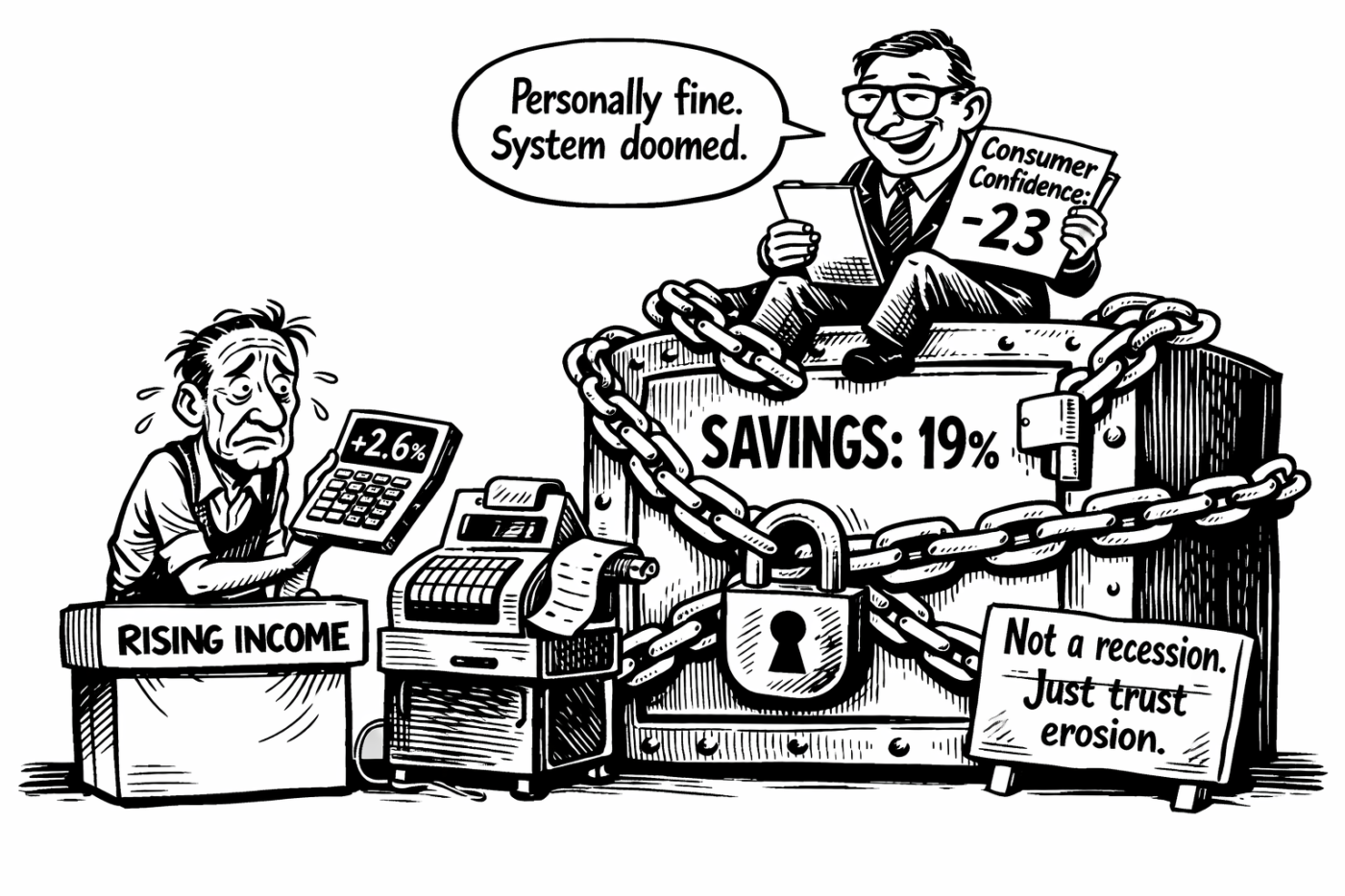

TL;DR: Dutch consumer confidence dropped to -23 in January 2026, below the 20-year average of -11. Consumers have rising incomes but won’t spend because they expect the economy to worsen. This creates a structural problem for businesses: income grows at 2.6%, spending grows at 1.2%, and savings hit 19%. The gap between micro stability and macro distrust means traditional recovery assumptions are broken.
What You Need to Know
- Consumer confidence fell from -21 to -23 in January 2026, driven by worsening expectations for future economic conditions.
- 69% of Dutch consumers expect the general economy to decline, but only 16% expect their personal finances to worsen.
- Dutch households save 19% of income in 2025, up from 17% in 2019, showing crisis-level behavior during recovery.
- Businesses dependent on consumer spending face a structural trust problem, not a temporary cyclical downturn.
- Operators need to adjust for low-velocity spending: optimize for risk reduction messaging, shorter decision cycles, and tighter cash management.
I’ve been watching Dutch consumer confidence numbers for years. The January 2026 drop to -23 tells me something most analysts miss.
The problem isn’t the decline itself. The problem is what this reveals about how consumers process economic reality.
Consumers are not reacting to what’s happening. They’re reacting to what they think will happen next.
LISTEN TO THE DEEP DIVE ABOUT THIS TOPIC:
How Dutch Consumer Confidence Is Measured
Statistics Netherlands measures confidence through five component questions. The index aggregates responses into a scale from -100 to +100. When you see -23, negative sentiment outweighs positive sentiment by a meaningful margin.
Here’s the part that matters for anyone running a business in the Netherlands:
The economic climate sub-indicator dropped from -35 to -40 in a single month. That’s a forward-looking measure. Consumers aren’t assessing what happened last quarter. They’re betting on what breaks in the next twelve months.
This is precautionary behavior dressed up as consumer sentiment.
The purchasing readiness indicator fell from -11 to -12. Small move. Wrong interpretation if you think it’s about willingness to spend. It’s about willingness to expose yourself financially when you don’t trust the system to hold steady.
Bottom line: Consumers are protecting themselves against future uncertainty, not responding to current conditions.
Why 69% of Consumers Expect Economic Decline
Research shows that during periods of economic uncertainty, 69% of Dutch consumers expected the general economic situation to decline in the next 12 months. Only 16% expected a decline in their household financial situation.
Read that again.
Most people think the economy will deteriorate, but their personal finances will stay fine.
What This Divergence Means
Dutch consumers don’t trust the macro environment, even when their micro reality looks stable. They’re watching leading indicators businesses often ignore: trade barriers, electricity capacity constraints, political noise. Then they translate those signals into personal financial caution.
The behavior pattern is rational. When you don’t trust the system, you protect yourself first. You save more. You spend less. You delay large purchases even when you can afford them.
The Netherlands now has one of the highest household savings rates in Europe at 19% in 2025, up from 17% in 2019. That’s crisis-level savings behavior during what’s technically a recovery period.
The reality: Macro distrust drives micro caution, even when personal finances remain stable.
What This Means for Business Operators in the Netherlands
If you’re running a business that depends on Dutch consumer spending, you’re facing a structural problem, not a cyclical one.
The Broken Link Between Income and Spending
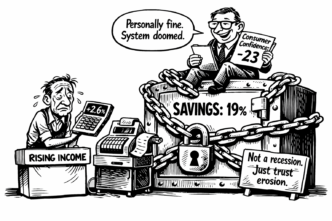
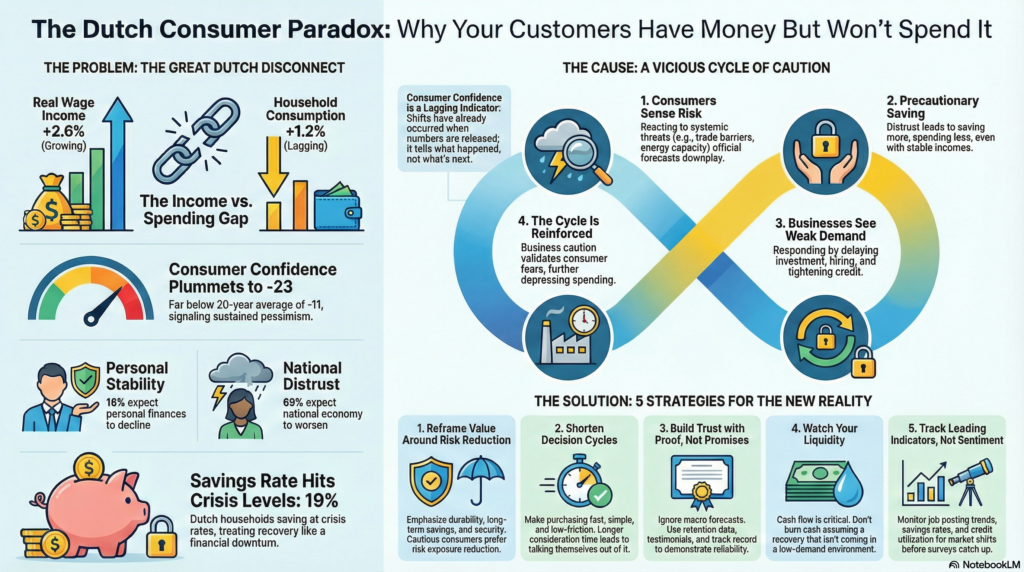
European households now spend less than €0.85 of every euro earned. Household consumption rose only 1.2% in 2025, half the pace of real wage growth at 2.6%. Income is growing. Spending isn’t following.
The transmission mechanism from wages to consumption is broken.
This isn’t about affordability. This is about trust erosion. Consumers are holding cash because they don’t believe the economic environment will remain stable enough to justify exposure through spending.
How Uncertainty Spreads Through the Economy
De Nederlandsche Bank describes uncertainty as “like corrosion in the engine of our economy.” Their research found that uncertainty shocks lead to rapid declines: economic sentiment falls by 2.3% and industrial confidence by 1.6% within just a few months.
The corrosion spreads. Businesses see weak demand signals. They delay investment. They hold hiring. They tighten credit. Consumers see these signals and save more. The loop reinforces itself.
Key insight: You’re facing a trust deficit that creates a self-reinforcing cycle of caution on both sides of the transaction.
What Happened Between November 2025 and January 2026
In November 2025, Dutch consumer confidence improved from -27 to -21. That was the most significant monthly improvement in more than four years.
Two months later, the improvement reversed.
Confidence isn’t stabilizing. It’s oscillating based on forward-looking anxiety, not backward-looking performance.
Why Past Performance No Longer Predicts Future Sentiment
The CBS data shows that consumers improved their assessment of past financial situations. But their outlook for future personal finances worsened. That’s the tell.
When people say “I did fine last quarter, but I don’t trust next quarter,” they’re not being irrational. They’re reading systemic signals that official economic forecasts often smooth over.
ING expects Dutch GDP growth of only 1.3% in 2026. Economists note this is “slightly below the Dutch economy’s estimated potential.” Translation: the economy is underperforming what it could achieve given available labor and capital resources.
The gap exists because of elevated global trade barriers and unmet conditions like electricity capacity constraints. These aren’t temporary disruptions. These are structural drags.
What this tells you: Consumers are reading structural signals that official forecasts downplay, and adjusting behavior accordingly.
How to Adjust Your Business Strategy
If you’re operating a business in this environment, waiting for consumer confidence to recover is not a strategy. You need to adjust for a market where consumers have income but won’t deploy it.
Five Control Points That Reduce Exposure
1. Reframe value propositions around risk reduction, not aspiration.
Dutch consumers are in precautionary mode. Products and services that reduce their exposure (insurance, durability, long-term cost savings) will outperform discretionary luxury.
2. Shorten decision cycles.
The longer a consumer has to think about a purchase, the more time they have to talk themselves out of buying. Reduce friction. Make the decision smaller, faster, easier to reverse if needed.
3. Build trust through proof, not promises.
Consumers don’t believe macro forecasts. They believe evidence. Show them how your business has performed under stress. Show them customer retention data. Show them how you’ve managed through past disruptions.
4. Watch your own liquidity more carefully than your competitors’ marketing.
If consumer spending stays suppressed, cash flow becomes the limiting factor faster than market share. The businesses that survive weak demand cycles are the ones that didn’t burn cash assuming a recovery that didn’t come.
5. Track leading indicators, not lagging sentiment.
Consumer confidence is a lagging indicator. By the time the number moves, the behavior has already shifted. Watch job posting trends, credit utilization, savings rate changes, and supplier payment terms. These tell you what’s coming before sentiment surveys catch up.
Action point: Stop waiting for sentiment recovery and start building for sustained low-velocity spending.
Understanding the Structural Reality
The current -23 index sits significantly below the 20-year average of -11. That’s not a temporary dip. That’s a sustained divergence from historical norms.
What Official Forecasts Tell You
The European Commission forecasts that “consumer confidence remains low, prompting a further increase in precautionary savings, as consumption growth lags behind income growth” throughout 2025-26.
This is official recognition that improved household finances won’t translate into economic activity.
The mechanism is clear: consumers earn more, save more, spend less. Businesses see weak demand, delay expansion, tighten operations. The cycle reinforces caution on both sides.
What Breaking the Cycle Requires
Breaking the cycle requires either a massive external shock to restore trust, or a slow grind where businesses learn to operate profitably in a low-velocity spending environment.
I don’t see the shock coming. That leaves the grind.
What you’re facing: A sustained structural shift, not a cyclical downturn waiting to reverse.
What This Means for Your Decision-Making
If you’re waiting for Dutch consumers to “return to normal,” you’re waiting for a version of the market that doesn’t exist anymore.
The New Consumer Reality
The data shows a population that:
- Has improving income but won’t spend it
- Trusts their personal situation but not the system
- Saves at crisis levels during a technical recovery
- Views large purchases as exposure, not opportunity
That’s not a temporary mood. That’s a behavioral shift.
Who Survives This Environment
The businesses that adapt to this reality will build models that don’t depend on consumer confidence recovering. They’ll optimize for lower transaction volumes, higher value per transaction, longer customer retention, and tighter cash management.
The businesses that don’t adapt will keep waiting for sentiment to improve while their cash position deteriorates.
Confidence is a lagging indicator. By the time it recovers, the market will have already moved. The operators who survive this phase are the ones who stopped waiting and started adjusting.
The system doesn’t reward optimism. It rewards preparation.
Frequently Asked Questions
What is consumer confidence and how is it measured in the Netherlands?
Consumer confidence is measured by Statistics Netherlands through five component questions covering economic climate and purchasing readiness. Responses are aggregated into an index ranging from -100 to +100, where negative numbers indicate pessimism outweighs optimism.
Why did Dutch consumer confidence drop in January 2026?
The drop from -21 to -23 was driven by worsening expectations for future economic conditions. The economic climate sub-indicator fell from -35 to -40, showing consumers are betting on deterioration over the next twelve months, not responding to current conditions.
How does Dutch consumer confidence compare to historical averages?
The January 2026 reading of -23 sits significantly below the 20-year average of -11. This represents a sustained divergence from historical norms, not a temporary cyclical dip.
Why are Dutch consumers saving instead of spending despite rising incomes?
Dutch consumers don’t trust the macro environment to remain stable. Even though 69% expect the general economy to decline, only 16% expect their personal finances to worsen. This creates precautionary saving behavior. The household savings rate reached 19% in 2025, up from 17% in 2019.
What is the gap between income growth and spending growth in the Netherlands?
Real wage growth reached 2.6% in 2025, but household consumption rose only 1.2%. European households now spend less than €0.85 of every euro earned. The transmission mechanism from wages to consumption is broken because of trust erosion, not affordability.
How does uncertainty affect business confidence?
De Nederlandsche Bank research found that uncertainty shocks lead to rapid declines: economic sentiment falls by 2.3% and industrial confidence by 1.6% within just a few months. The effect spreads as businesses delay investment and hiring, which consumers see and respond to by saving more.
What should businesses do in a low consumer confidence environment?
Stop waiting for recovery. Reframe value propositions around risk reduction. Shorten decision cycles. Build trust through proof of past performance. Watch liquidity more carefully than market share. Track leading indicators like job postings and credit utilization, not lagging sentiment surveys.
Is this a temporary downturn or a structural shift?
The evidence points to a structural shift. The European Commission forecasts continued low confidence and rising precautionary savings throughout 2025-26. Consumers are reading structural signals like trade barriers and electricity capacity constraints, not temporary disruptions.
Key Takeaways
- Dutch consumer confidence dropped to -23 in January 2026, below the 20-year average of -11, driven by forward-looking anxiety about economic deterioration.
- 69% of consumers expect the general economy to decline, but only 16% expect their personal finances to worsen. This creates precautionary saving behavior despite stable personal finances.
- Income grows at 2.6%, spending grows at 1.2%, and savings hit 19%. The link between wages and consumption is broken because of trust erosion, not affordability constraints.
- Businesses face a structural problem, not a cyclical downturn. Waiting for sentiment recovery is not a strategy when consumer behavior has fundamentally shifted.
- Operators need to reframe value around risk reduction, shorten decision cycles, build trust through proof, manage liquidity carefully, and track leading indicators instead of lagging sentiment.
- Consumer confidence is a lagging indicator. By the time it recovers, the market will have moved. Survival depends on adjusting now, not waiting for conditions to improve.