






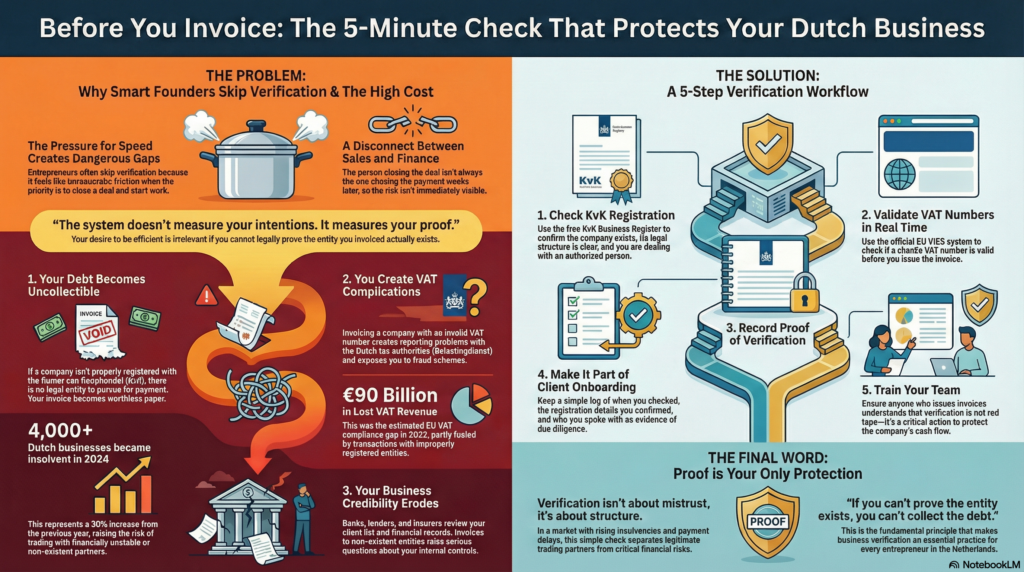
Verifying business registration with the Kamer van Koophandel (KvK) and validating VAT numbers before invoicing protects your cash flow. Skipping these checks exposes you to uncollectible debt, VAT reporting problems, and credibility damage. Verification takes minutes and prevents months of collection failures.
Core Answer:
- Check KvK registration before issuing invoices to confirm the entity exists and signatories have authority.
- Validate VAT numbers in real time using the EU validation system to avoid tax reporting complications.
- Record proof of verification to demonstrate due diligence if disputes arise.
- Build verification into your client onboarding workflow, not as a one-time check.
- Train your team to treat verification as cash flow protection, not bureaucracy.
LISTEN TO THE DEEP DIVE ABOUT THIS TOPIC:
What Happens When You Skip Registration Checks
I heard about this from a client recently. A few years back, they worked with what looked like a legitimate company. They delivered. The company paid late. Then they disappeared. When my client tried to collect, they discovered the company was never properly registered with the Kamer van Koophandel. No valid VAT number. No legal entity to pursue. The invoice became worthless paper. Verification isn’t extra admin. It’s cash flow protection.
How Registration Verification Failures Build Risk
The risk follows a predictable pattern:
You meet a potential client. They seem professional. You agree on terms. You deliver the work. You send the invoice.
Everything feels normal until payment is late.
Then you discover the company isn’t registered properly. Or the VAT number is invalid. Or the person who signed has no authority to bind the company.
You’re not dealing with a payment delay. You’re dealing with uncollectible debt.
In the Netherlands, registration in the Business Register is compulsory for every company and almost every legal entity. The register answers two questions: Does this Dutch company exist? Is the person I’m dealing with an authorized signatory?
When you skip this check, you remove the safety mechanism the system provides.
Bottom line: Registration checks reveal authority problems before they become collection failures.
Why Founders Skip Verification
The pressure to maintain momentum makes verification feel like friction.
You want to close the deal. You want to start the work. Asking for KvK registration details or validating a VAT number feels bureaucratic.
The reality: the system doesn’t measure your intentions. It measures your proof.
There’s also a separation between operational speed and financial awareness. The person closing the deal isn’t always the person chasing payment six weeks later. The risk becomes visible only after the problem has already formed.
For many founders, verification feels like extra work because nobody taught them it was foundational. Business training focuses on sales, marketing, product development. Administrative controls get treated as optional.
They’re not optional.
Bottom line: Speed pressure creates verification gaps, but proof matters more than intentions.
What It Costs When You Don’t Verify
The cost shows up in three places:
Collectability Collapses
Dutch domestic companies normally make payments within 47 days, but delays of up to 14 days remain common. When you’re dealing with an improperly registered entity, those delays escalate into total loss.
Under Dutch law, the payment term for invoices to businesses is 30 days, with a maximum of 60 days by agreement. Legal proceedings from issue to judgment take about two months on average.
When the debtor has become insolvent, most bankruptcies are terminated without any payments to unsecured creditors. You lose everything.
Over 4,000 Dutch businesses entered insolvency in 2024. This is a 30% increase from the previous year. When you trade with entities that lack proper registration, you expose yourself to being an unsecured creditor in a growing wave of business failures.
VAT Complications Multiply
If you invoice a company with an invalid VAT number, you create reporting problems with the Belastingdienst.
In 2023, the EU VAT compliance gap amounted to 9.5% of VAT Total Tax Liability. EU Member States lost around €90 billion in VAT revenues in 2022. At least €13 billion of this loss is linked to intra-EU VAT carousel fraud.
Trading with improperly registered entities exposes you to these schemes. The European Public Prosecutor’s Office had over 2,000 active fraud-related investigations by the end of 2024, with more than half of the estimated €13.15 billion in damage linked to cross-border VAT fraud.
You don’t need to be involved in fraud to suffer consequences. You just need to have invoiced the wrong entity.
Administrative Credibility Erodes
When your financial records contain invoices from non-existent or improperly registered entities, credibility issues emerge with multiple stakeholders.
Banks assess creditworthiness using business registration data. Lenders review your client list. Insurers evaluate your risk profile.
An incorrect or outdated registration detail like an SBI code linked to your KvK registration creates serious consequences. Your SBI code determines collective labor agreements, pension fund obligations, tax filings, insurance claims, and subsidies. Misalignment creates reporting errors.
When your records show you’ve been trading with entities that don’t exist, questions about your controls arise.
Bottom line: Verification failures create uncollectible debt, VAT exposure, and credibility damage across banks, lenders, and insurers.
How to Verify Business Registration Correctly
Verification doesn’t require complex systems. It requires discipline.
Check KvK Registration Before You Invoice
Use the Business Register to confirm the company exists, the legal structure is clear, and the person you’re dealing with has authority. This takes minutes. It prevents months of collection effort.
Validate VAT Numbers in Real Time
The EU provides a VAT number validation system. Use it before you issue an invoice. If the number is invalid, you know immediately. You address it before the transaction is complete.
Record Proof of Verification
Keep a log of when you checked, what you confirmed, and what the registration details were at the time. If a dispute arises later, you have evidence you performed due diligence.
Make Verification Part of Your Onboarding Process
Don’t treat it as a one-time check. Build it into your client intake workflow.
New client? Verify registration. Existing client with a new legal structure? Verify again. Annual review? Confirm registration is still valid.
Train Your Team to See Verification as Protection
If you have people who close deals or issue invoices, make sure they understand why verification matters. It’s not bureaucracy. It’s the control that keeps cash flow stable.
Bottom line: Build verification into workflows, validate in real time, and document everything.
Why This Matters More Now
The rise in insolvencies means more companies are operating on fragile ground. The pressure to maintain cash flow means some businesses are using payment delays deliberately to manage liquidity.
Research shows that 40% of Dutch businesses struggle with managing late or unpaid invoices. 22% of SMEs identify cash flow as their most significant challenge to business growth.
When you trade with unverified entities, you compound these risks.
Verification is the mechanism that separates legitimate trading partners from exposure risks. It’s not about mistrust. It’s about structure.
The system doesn’t care about your intentions. It measures your proof.
If you can’t prove the entity exists, you can’t collect the debt.
Bottom line: Rising insolvencies and payment delays make verification more critical, not less.
Frequently Asked Questions
How do I check if a Dutch company is properly registered?
Use the Kamer van Koophandel (KvK) Business Register to search for the company by name or registration number. The register confirms whether the entity exists, shows the legal structure, and identifies authorized signatories. This check takes minutes and is free to perform.
What is a VAT number and why does it matter for invoicing?
A VAT number is a unique identifier issued by tax authorities for businesses registered for Value Added Tax. When you invoice a company with an invalid VAT number, you create reporting problems with the Belastingdienst and expose yourself to VAT fraud schemes. Always validate VAT numbers using the EU VIES system before issuing invoices.
What happens if I invoice a company that isn’t registered?
You create uncollectible debt. Without proper registration, there is no legal entity to pursue for payment. Legal proceedings require a valid entity. If the company becomes insolvent or disappears, you become an unsecured creditor with no recourse. The invoice becomes worthless.
How often should I verify business registration for existing clients?
Verify registration at three points: initial onboarding, when the client changes legal structure, and during annual reviews. Companies change ownership, merge, or restructure. A registration valid last year might not be valid today. Regular verification catches these changes before they become collection problems.
Does verification apply to both Dutch and international clients?
Yes. For Dutch entities, check KvK registration. For EU entities, validate VAT numbers through the VIES system. For international entities outside the EU, verify registration through the equivalent business registry in their jurisdiction. The principle remains the same: confirm the entity exists and has legal standing before you invoice.
What should I document when I verify a client’s registration?
Record the date of verification, the registration number checked, the legal name and structure confirmed, and the authorized signatories identified. Store this documentation with your client records. If a dispute arises, this evidence demonstrates you performed due diligence.
Is asking for registration details offensive to clients?
No. Verification is standard business practice. Professional clients expect it. Resistance to providing registration details is a red flag. If a client refuses to share KvK registration or VAT numbers, you’re dealing with a control problem before any work begins.
Can verification prevent all payment problems?
No. Verification confirms legal existence and authority. It doesn’t guarantee payment behavior or financial stability. However, verification eliminates the category of loss where you invoice entities that don’t exist or lack authority to contract. This removes the worst-case scenario: total loss with no recourse.
Key Takeaways
- Verify KvK registration and VAT numbers before issuing invoices to prevent uncollectible debt and VAT reporting problems.
- Over 4,000 Dutch businesses entered insolvency in 2024, a 30% increase from 2023, making verification more critical as trading partner risk rises.
- Skipping verification exposes you to three categories of damage: collapsed collectability, VAT compliance complications, and eroded administrative credibility with banks and insurers.
- Build verification into your client onboarding workflow as a standard control, not a one-time check.
- Document verification actions with dates, registration numbers, and confirmed details to demonstrate due diligence if disputes arise.
- The system measures proof, not intentions. If you can’t prove the entity exists, you can’t collect the debt.