


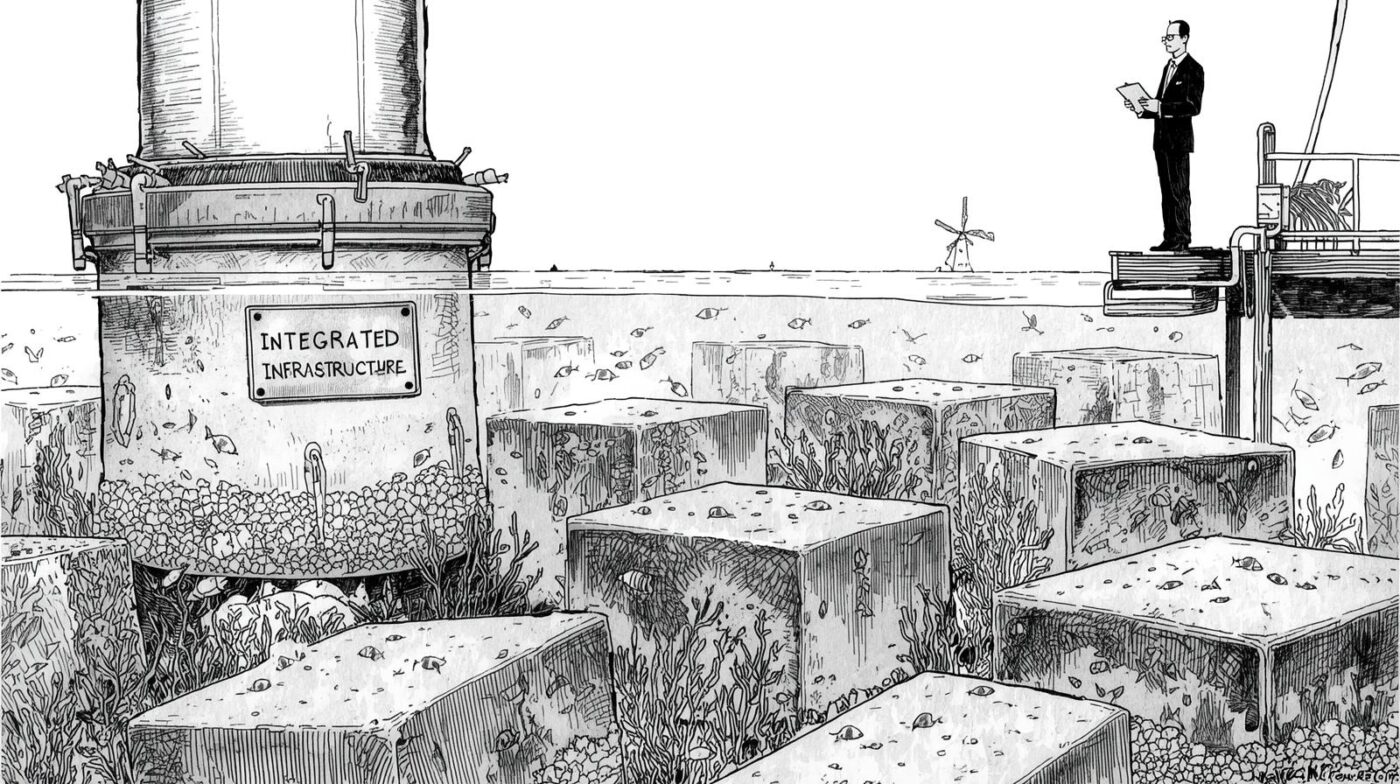

Offshore wind companies operating in the North Sea now install specialized concrete structures around turbine foundations. The structures, called Reef Cubes, feature textured surfaces and varied geometries meant to support marine habitat development.
This follows several decades during which the seabed served as a foundation anchor point. Marine life colonized turbine bases independently since the mid-2010s. The industry needed about five to seven years of working groups, feasibility studies, and pilot programs to formalize what was already happening.
Corporate accounting systems now categorize the structures under terms including “integrated infrastructure investment,” “dual-purpose capital expenditure,” and “natural capital infrastructure.” The people who design them hold titles such as Marine Habitat Engineer, Ecological Infrastructure Designer, and Head of Blue Infrastructure.
Project documentation describes the method as “enhanced habitat complexity” and “provision of heterogeneous substrate conditions.” Water movement around the cubes gets described as “hydrodynamic variability that supports diverse ecological niches.” Official monitoring programs exist to “quantify ecological uplift metrics” and document that marine species use structures when structures are present.
The OranjeWind project, a collaboration between RWE and TotalEnergies, presents this at industry conferences as “co-location of energy generation and ecosystem restoration” and “simultaneous value streams.” The method moves beyond sequential frameworks toward parallel benefit generation.
Early offshore wind development took place within what industry representatives call “a different regulatory and conceptual setup that prioritized singular operational objectives.” Environmental considerations were limited to compliance requirements.
The practice became standard after companies recognized that not incorporating ecological features started to look negligent. Infrastructure now generates what documentation calls multiple forms of capital.
Industry documentation calls this a paradigm shift in how industrial projects measure success.