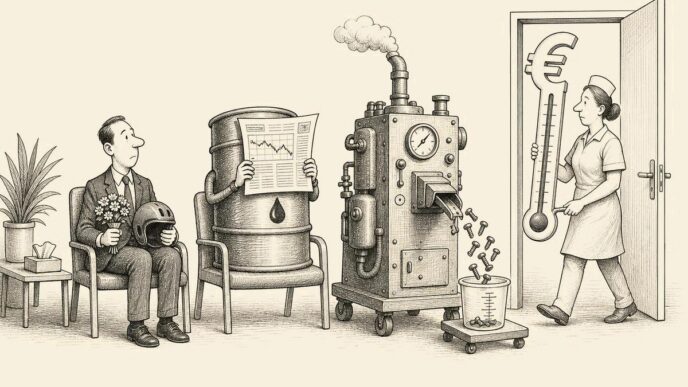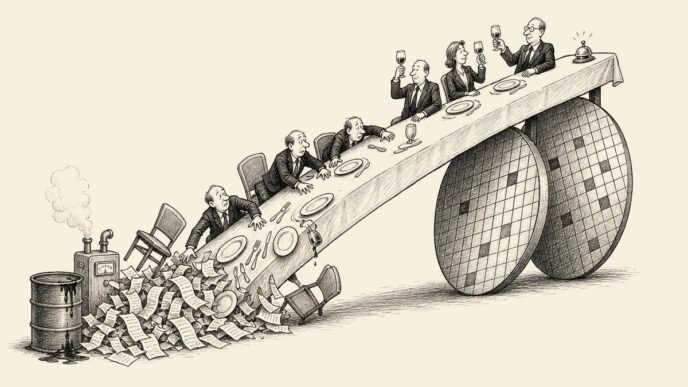




CBS points to weak confidence, export drag and cost pressure, not a collapse.
There is a kind of Dutch economy that can keep a small business busy while still making the owner uneasy. The phone rings, the calendar is not empty, invoices go out. Yet every quotation feels shorter-lived, every supplier email deserves closer reading, and every hiring decision asks for more evidence than it did a year ago.
The signal has to become readable
That is how I read the latest CBS business-cycle picture. In May, the Business Cycle Tracer was just as negative as in April. Its indicator stood at -0.51, and 11 of its 13 indicators were below their long-term trend. CBS treats this as a macroeconomic picture, not a diagnosis of every household, company or region. A founder does not trade the Dutch average. A founder trades the next order, the next wage run, the next VAT payment, the next customer who pays on day 42 instead of day 21.
A weak signal with real activity
The temptation is to turn a negative business-cycle reading into a recession story. That would be too simple. CBS estimated that Dutch GDP rose by 0.1 percent in the first quarter of 2026 compared with the previous quarter, and by 1.2 percent compared with a year earlier. Manufacturing output in March was 1.7 percent higher than a year earlier. April bankruptcies, adjusted for court-session days, were 12 percent lower than in April 2025.
So the economy is not standing still. The problem is that the movement is narrow and uneven.
Household consumption was unchanged from the previous quarter in Q1. Exports weighed on growth, with goods and services exports down 0.6 percent from the previous quarter and goods exports down 1.2 percent. Consumer confidence fell to -46 in May, far below its twenty-year average of -11, and purchase willingness weakened again. Entrepreneur confidence at the start of Q2 fell to -14.8, with negative confidence in all sectors covered by the CBS survey.
This is the difficult combination: activity without comfort. A company can still be busy, but the old shortcuts become expensive. A price list that was roughly right in February may already be weak in May. A stock order based on last year's season may sit longer than expected. A new employee may be needed operationally, while the order book does not yet carry the full payroll risk.
Where the squeeze enters the business
Take a small installation company in Brabant. It has work for the next six weeks, mostly maintenance, some renovation, a few small commercial jobs. The owner sees no crisis. Then the supplier sends a new price note for materials. Fuel costs are higher than planned. A subcontractor wants an adjustment. Two customers approve quotations late, after the quoted price has already become thin. One larger debtor pays after a reminder, not before.
Nothing dramatic has happened. Still, the business has changed.
CBS reported that industrial output prices were 4.9 percent higher in April than a year earlier, after a 1.4 percent increase in March. Petroleum-industry output prices were 48.8 percent higher year on year, and chemical-industry prices were 11.6 percent higher. CBS linked the April increase to higher oil prices connected with the geopolitical situation in the Middle East.
What the signal changes
That does not mean every small firm has the same cost shock. It means the owner needs to know where the exposure sits. Fuel, transport, plastics, packaging, cleaning products, components, subcontracted work and supplier surcharges can move before customers accept higher selling prices. The margin loss often arrives quietly, hidden inside a normal-looking turnover figure.
I read this as a margin story before I read it as a growth story. Turnover still flatters many businesses. Gross margin tells the truth earlier.
Labour and finance are quieter pressures
The labour market is cooling, but it is not loose. CBS counted 378 thousand vacancies at the end of Q1, 6 thousand fewer than a quarter earlier. There were still 91 vacancies for every 100 unemployed people. In April, unemployment was 3.9 percent. Collectively negotiated hourly wages, including special remuneration, were 4.5 percent higher in Q1 than a year earlier.
For small employers, that is an awkward setting. Recruitment may be slightly less frantic, but payroll remains a fixed commitment. When demand is softer and costs are moving, a hiring decision becomes a cash-flow decision as much as an operational one.
Finance adds another layer. DNB warned in its spring 2026 Financial Stability Overview that cyber and operational risks are among the largest threats to financial stability, linked to rapid AI development and geopolitical tensions. It also pointed to energy prices, market corrections, government debt positions and private credit. The ECB kept its three key rates unchanged on 30 April and said upside risks to inflation and downside risks to growth had intensified.
A small business may not read central-bank language at breakfast. It may still feel the consequences. A bank asks for more recent figures. A supplier shortens payment tolerance. An insurer asks sharper questions. A large customer tightens onboarding. A credit decision takes longer because the file is incomplete.
This is why I do not separate market pulse from administration. In a soft economy, the ledger becomes part of the market. Debtor ageing, stock ageing, quote validity, supplier concentration, tax reserves and current management accounts are not back-office matters. They decide how much room the business has when the outside world becomes less forgiving.
Fewer bankruptcies do not remove pressure
The fall in bankruptcies is welcome. CBS counted 293 bankrupt businesses, institutions and sole proprietorships in April after adjustment for court-session days, 12 percent fewer than a year earlier and 3 percent fewer than in March. That is real relief.
It should not make owners sleepy. Bankruptcy is the visible end of a process. Many firms feel pressure much earlier, through late payment, tax timing, wage costs, supplier terms, weaker conversion or silent downsizing. CBS also showed that the highest April bankruptcy rates were in transport and storage, industry and hospitality. Those are sectors where fuel, staff, equipment, occupancy, supplier prices and customer behaviour can meet quickly inside cash flow.
What founders should check
For hospitality, a consumer with weaker purchase willingness may still go out, but choose fewer extras. For transport, a contract without proper indexation can turn volume into strain. For industry, higher input prices can punish slow quotation discipline. None of this requires panic. It requires the owner to stop reading turnover as proof of safety.
The useful response is discipline, not retreat
The wrong conclusion would be to freeze every investment. CBS found that fixed-asset investment rose 0.7 percent in Q1 and contributed positively to growth. Some parts of manufacturing are still moving strongly, including machinery output in March. A blanket stop can damage a good business as surely as careless expansion can.
The better answer is selectivity. An investment that improves productivity, protects margin, reduces dependency or strengthens resilience may still make sense. An investment based only on hope, old seasonality or a vague feeling that the market will improve deserves a colder look.
This is also where tax and compliance timing enter the real economy. No new tax rule sits at the centre of this signal. The pressure is simpler and more practical: VAT, payroll taxes and income or corporate tax instalments do not wait politely for slow debtors. Profit, cash and tax reserve are related, but they are not the same thing. In a month like this, confusing them is one of the easiest ways to lose room.
The same applies to payment controls. DNB's attention to cyber and operational risk may sound far from a small workshop, studio, agency or café. It is not far at all. A changed bank account on a supplier invoice, a rushed payment request, a weak approval process or a system outage can become costly precisely when margins are already thinner.
I would use this CBS signal as a reason to look closely, not to look grim. Compare May orders with April and with last year. Separate price-driven revenue from volume. Recalculate margin with current supplier costs and wages. Look at the ten largest debtors. Test stock against confirmed demand. Keep the bank and tax picture current before anyone asks for it.
The Dutch economy is still moving. That is the useful part of the story. But it is moving with weaker confidence, export drag, renewed producer-price pressure and labour costs that still matter. For the owner of a small business, May 2026 is not a month for slogans. It is a month for evidence.
The calm company will not be the one that predicts the economy perfectly. It will be the one that knows, early enough, which sales are profitable, which costs are moving, which customers are slowing, and which decisions can wait until the numbers have earned the risk.
Sources
Referenced in the article
Column | Market Pulse
Dutch Industry Is Selling More, but Cash Still Needs Proof
A 2.3 percent turnover rise helps, but the real test for small manufacturers is margin, payment.
Column | Market Pulse
Dutch Labour Is Looser, Not Easy
Why a falling unemployment rate asks for cash discipline, not.
Column | Real Estate
A Cooler Housing Market Is Still Heavy
The Dutch price index paused in April, but small firms still carry the pressure through wages, credit.
The Polder is written for readers who need the Dutch business environment translated into practical meaning. Corrections, source policy and editorial accountability are part of the publication record.