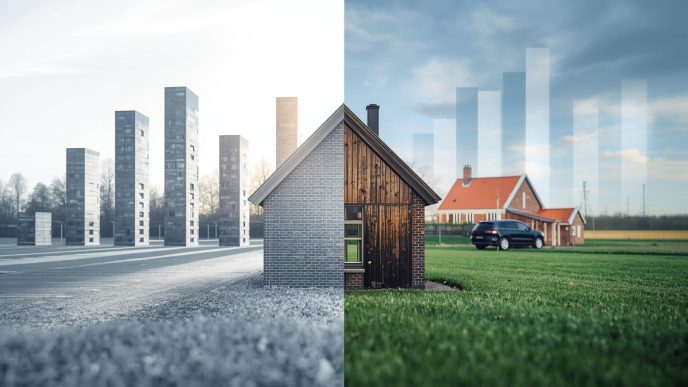




The land is visible, but firms will live inside the gap between plans, permits and finished homes.
At a kitchen table in Flevoland, a contractor reads the housing plan with one eye on his roster and one eye on the bank balance. Can he take another site? Can he hold a quote for a year? Will the first invoice arrive before the second payroll run?
The signal has to become readable
That is why the Rijksoverheid announcement of 8 June 2026 matters. The State, the province of Flevoland and Almere will work more closely to speed up large-scale new-build housing. Almere has space for at least 60,000 homes in the coming decades. The stated pace is 2,500 to 3,000 homes a year, with a route toward a cooperation agreement in 2027.
Read this less as a celebration of future homes and more as a practical signal. Almere is where Dutch housing ambition meets the ordinary pressure of delivery: permits, workers, transport, rent rules, finance, paperwork and cash.
The gap before the neighbourhood
A large housing programme creates a business market before it creates a neighbourhood. First come tenders, soil work, architects, engineers, installers, temporary site services, payroll files, lenders, accountants and municipal tables. Only later come the families, schools, cafés, shops and care providers that make the place feel settled.
CBS reported 23.5 thousand permitted new-build dwellings in the first quarter of 2026, more than a year earlier. In the same quarter, 13.7 thousand new-build homes were completed, fewer than a year earlier. The pipeline of permitted but not yet delivered homes rose to 226.6 thousand.
That is the part that matters for a small firm. More permits bring more visible work. Fewer completions tell you the market still struggles to turn paper into keys. The space between those two facts is where risk sits.
What the signal changes
For contractors, suppliers and advisers, that gap can turn into working-capital pressure. A full order book can still hide a weak cash position. The tax bill, holiday allowance or subcontractor invoice arrives on time even when the site does not.
The margin lives in the delay
Take the contractor at the kitchen table. He may be invited into a serious Almere project with a public frame behind it. That looks safe. Yet his margin can still leak away through wage drift, late starts, subcontractor scarcity, material lead times or payment milestones that do not match the work.
UWV says the Dutch labour market has cooled but remains tight, with many technical and construction occupations still tight or very tight. CBS reported negotiated wages up 4.5% year-on-year in the first quarter of 2026. Construction was among the larger risers, at about 7.2%.
A tender that treats labour as stable may look tidy and still be wrong. The pressure lands on the hourly rate, the subcontractor chain and the payroll file. It also reaches the supplier who pre-finances stock and the adviser who spends time chasing approvals.
That is why the business lesson is not only about housing volume. It is about timing discipline. In a market like this, delay has a cost, and someone in the chain pays it.
Transport sets the rhythm
Almere Pampus shows the next layer. The State reserved €54 million in 2024 for a high-quality public transport connection to open up the first phase of 7,500 homes. The aim is to start construction of the first home in Pampus in 2030. The IJmeerverbinding will be discussed later in 2026.
For developers and local businesses, that sequence matters. A district is not only land and drawings. It needs movement. If transport comes in phases, commercial footfall comes in phases too. A bakery, childcare provider, cleaner, physiotherapist or maintenance company can believe in the long-term city and still sign a lease too early.
Flevoland gives the demand case real weight. CBS reported that the province had the fastest population growth in 2025, at more than 14 per 1,000 residents. Almere itself grew by 13.4 per 1,000. This is a real market, but local demand still has to meet local phasing. A future customer is not the same as a customer next month.
Rent rules meet building costs
Housing policy also shapes the revenue side. Rijksoverheid’s 2026 rent caps limit annual increases to 4.1% for social housing from 1 July, 6.1% for mid-rent from 1 January and 4.4% for the free sector from 1 January. Those limits matter when build costs, finance costs and affordability targets sit in the same spreadsheet.
What founders should check
For housing corporations, developers and landlords, Almere will not be judged only by how many homes fit on the map. Product mix matters. Kadaster’s first-quarter housing market note pointed to strong starter activity and a lower investor share of the housing stock.
That points to demand for homes people can actually buy or rent within the rules, not only assets that look efficient in a model. Public ambition and private discipline need to meet here. A project that only works if every decision arrives early is not the same as a project that can survive normal Dutch delay.
The file is part of the build
Under the Omgevingswet and the Wet kwaliteitsborging voor het bouwen, relevant new-build work in gevolgklasse 1 requires private quality assurance, a kwaliteitsborger and a bouwmelding through the Omgevingsloket. For small builders and project owners, that makes evidence part of the schedule.
This is not paperwork in the lazy sense. It is proof of who did what, when, under which role and with which responsibility. In construction chains, the same discipline touches VAT, invoicing moments, payroll tax records, subcontractor files, retentions and project cost allocation.
The contractor at the kitchen table knows this already, even if he would not describe it in policy language. He wants the job. He also wants to know whether the contract protects his price, whether the payment dates protect his cash and whether the project record will still make sense when the work is finished.
Almere’s 60,000-home promise is large enough to attract attention across the Netherlands. The better reading is smaller and more useful. Follow the phase, the permit, the transport decision, the labour market and the invoice.
The opportunity is real. So is the waiting time. The firms that benefit will not be the ones that only admire the number of homes. They will be the ones that know which part of the promise has become a funded, staffed and documented job.
Sources
- CBS source
- Almere ondersteund bij grootschalige nieuwbouw | Rijksoverheid.nl
- Rijksoverheid – Woondeals progress and bottlenecks
- Rijksoverheid – Woningbouwimpuls spring 2026 awards
- Rijksoverheid – Rent caps 2026 (social, mid, free sector)
- CBS – Existing home prices and transactions April 2026
- Kadaster – Q1 2026 housing market mix (buyers, investors, starter segment)
- CBS – Temporary housing permits halved in 2025
Referenced in the article
Column | Ledger & Tax
A Cross-Border Exit Can Leave Payroll With the Real Bill
A Den Haag tax ruling turns a senior severance deal into a wage-tracing.
Column | Market Pulse
Dutch Retail Is Selling More, but Margin Decides the Story
April sales rose in real volume, yet small retailers still need to read the till.
Column | Human Resources
When Succession Shares Meet Payroll, Evidence Carries the Risk
A Dutch court ruling shows why ownership, cost and motive matter before payroll sees.
The Polder is written for readers who need the Dutch business environment translated into practical meaning. Corrections, source policy and editorial accountability are part of the publication record.