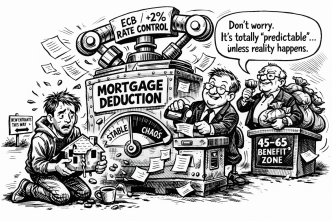
After a share sale, old Vpb losses may not carry the value a buyer expected.
A buyer of a small property BV usually starts with the visible things. The rent roll. The vacancy risk. The roof schedule. The loan terms. Then, somewhere in the spreadsheet, there is a quieter line: old corporate income tax losses, meant to soften the tax bill when profit returns.
The signal has to become readable
That line can change the mood at a table. It can make the price look fairer, the bank case easier, and the first years after acquisition less tight. In Dutch real estate, though, that line deserves more care than many deal models give it. A Vpb loss is not a building, not a tenant, and not cash. After the shares move, it may not be usable in the way the buyer expects.
The share movement matters
The Advocate General's conclusion in case 23/01379 shows the pattern clearly. A housing corporation sold 55.02% of the shares in a daughter NV on 8 July 2016. The NV and two subsidiaries had belonged to a corporate-tax fiscal unity with the housing corporation. After the sale, that unity ended and a new fiscal unity formed with the NV as parent.
The NV wanted to offset pre-joining losses of the subsidiaries against its 2016 profit. The inspector refused loss relief under Article 20a of the Corporate Income Tax Act 1969. That is the practical signal for any property owner, buyer, or adviser. The tax question did not start with the buildings. It started with the change in the ultimate interest.
Article 20a limits forward loss relief when the ultimate interest in the taxpayer has changed in an important degree compared with the start of the oldest year with an unrelieved loss. In plain language, old losses do not always travel into a new ownership setting as if nothing happened.
Where real estate tricks the eye
Real estate can look active in business life. A landlord deals with tenants, service charges, maintenance, complaints, refinancing, insurance, municipal letters, and sometimes staff. No one who has managed property would call that passive in the ordinary sense.
What the signal changes
Tax law asks a different question. For Article 20a, real estate made available to third parties can count as investment for the investment test. The current policy decision on Article 20a, in force since March 2024, also treats rental to a non-connected body as investment for that test.
That distinction is not a technical side note. It is the difference between a company that feels operational and a loss position that may still be restricted after an ownership change. A public-housing background can explain why a structure exists. It does not decide the corporate-tax treatment by itself.
Fiscal unity is not a washing machine
Many founders and small property investors hear fiscal unity and think of simplicity. Belastingdienst guidance explains why. On request, a parent and subsidiaries can be treated as one taxpayer for Vpb, with the subsidiaries' results attributed to the parent. One practical advantage is that losses of one company can be offset against profits of another inside the same unity.
That advantage is real, but it is not magic. The subsidiaries still exist legally and fiscally. A fiscal unity can organise results, but it does not clean the history of ownership, old loss years, pre-joining losses, or statutory limits. When a share sale breaks one fiscal unity and another starts, the tax file does not become new just because the group chart has changed.
This is where transaction language gets loose. People say they are buying property. Sometimes they are buying property, a rent stream, debt risk, tax history, and a hope that old losses will still work. Those are different assets with different proof.
The cash effect is quiet, not theoretical
Belastingdienst guidance says Vpb losses are first offset against taxable profit from the previous year and then against future profits. Since 2022, forward loss relief is in principle unlimited in time, with a quantitative limit for profits above EUR 1,000,000. The same guidance also points to changes in company interests as a situation where special conditions may block loss relief.
That is the sentence a buyer should hear before the price is settled. Unlimited time is not unconditional use.
What founders should check
The cash effect can be modest in one year and decisive over three. If a buyer expected old losses to reduce tax while rent income recovered, the loss of that relief can change working capital, maintenance room, dividend timing, and debt-service comfort. It does not mean the property is bad. It means the tax asset was more conditional than the spreadsheet admitted.
A sector with debt needs sharper files
DNB reported that Dutch banks had lent EUR 340 billion to the Dutch business sector by March 2026. Around EUR 149 billion went to companies active in real estate, mainly housing associations. That scale matters because a small assumption in a tax forecast can turn into a real financing difference once interest, repair budgets, and rent timing are added.
The housing-corporation context matters too. Rijksoverheid reported in January 2026 that housing corporations face a EUR 19.4 billion shortfall against agreed investments in the National Performance Agreements through 2034. A tax loss that cannot be used will not explain that gap. Still, it shows why cash-room assumptions in housing-linked structures deserve care.
This is not a market-panic story. CBS reported that the bankruptcy rate for rental and trade of real estate in April 2026 was 2.4 per 100,000 businesses, down from 11.9 a year earlier. DNB has not framed the market as a broad real-estate failure wave. The sharper point is less dramatic and more useful. In a market that still finances property, a deal can still stumble on tax usability.
Back at the table
Return to the buyer with the rent roll and the old losses. The better conversation is not whether the loss exists. It is which taxpayer carries it, from which year, under which ownership chain, and through which fiscal-unity history. It is whether the rental activity has been classified with Article 20a in mind. It is whether the price model still works if loss relief is partly or fully blocked.
I would want that conversation before signatures, not after the first profitable year. I would want the formal loss decisions next to the share history, not in a separate folder that only the tax adviser reads. I would also separate the value of the bricks from the value of the tax position. The bricks may still be worth what the market says. The loss is a conditional claim on future tax treatment.
That is the practical discipline. A Dutch property company is not only a balance sheet with buildings. It is a chain of dates, owners, tax years, tenants, financing choices, and proof. The tax loss may help. It may not. Either way, it does not belong in the rent roll as if rent and relief were the same kind of income.
The calmer deal is the one that knows the difference before it pays for it.
Sources
Referenced in the article
Column | Ledger & Tax
When Administrative Convenience Costs €1.3 Billion: The Dutch Tax Interest Case
The Dutch Supreme Court ruled on January 16, 2026, that corporate taxpayers were illegally charged higher.
Column | Ledger & Tax
When Your Supplier Goes Bankrupt, the Tax Bill Doesn’t: What CJEU Case C-121/24 Means for VAT Liability
The Court of Justice of the European Union answered a question tax directors worry.
AEX Closing Brief | Market Pulse
AEX slips back as cost pressure keeps Amsterdam disciplined
AEX slipped 0.49%; cost pressure kept Amsterdam disciplined, not.
The Polder is written for readers who need the Dutch business environment translated into practical meaning. Corrections, source policy and editorial accountability are part of the publication record.