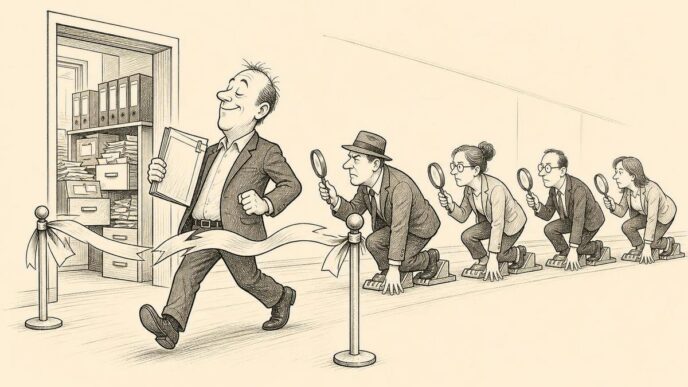
Small firms do not need more suspicion. They need better pauses before contracts, invoices and payments.
On 21 May 2026, KVK put a plain number on a familiar habit. Fifty-five percent of entrepreneurs do not check a new business relation for a KVK number. One in five hardly check new relations at all. This is not only a fraud story. It is a story about how quickly small businesses decide to trust.
A Dutch control file starts before the deal becomes exposed. It starts when a new customer asks for credit, when a supplier wants a prepayment, or when a signer sends a contract in a hurry. At that moment, a short pause can protect the work, the cash and the people around the company.
A check before the deal moves
A small company rarely begins with a fraud file on the table. It begins with an email, a referral, a quotation or a friendly call. For example, a furniture maker receives a first order from a new hospitality company. The design is approved, the deadline is tight, and the invoice will follow later.
The contact may sound reliable. Still, the first question is simple: does the file know who is asking for trust? The KVK number is that first pause. Every company and organisation in the Dutch Handelsregister receives one. The register can be searched by name, address or KVK number.
An extract can show the owner, director, proxy, signing authority, incorporation date, address data and bankruptcy status. Also, KVK reports that 43 percent of entrepreneurs do not know insurers consult Handelsregister data, for example in claims handling. Almost one third do not know that registered data can be legally leading.
Identity belongs in the ledger
A number is not the whole check. It is the entry point. In practice, the file should match the KVK number, legal name, trade name, address, business activity, signer, VAT ID, invoice identity and payment request. One mismatch may have an innocent explanation. Several mismatches deserve attention before money or goods move.
That is why the contract, invoice and ledger must point to the same economic route. Belastingdienst invoice rules place identity inside the administration. VAT invoices need full legal names, full addresses, VAT identification numbers, the KVK number when relevant, the invoice date and a unique invoice number.
A trade name can be used when it is registered at KVK with address and place. For intra-EU supplies and services, VAT ID checks support the position that the customer is an entrepreneur. Therefore, when VAT treatment depends on who the other party is, identity belongs in the file before the invoice is treated as settled.
The contract lesson is just as practical. In a recent Rechtbank Limburg case, the court treated public Handelsregister information on signing authority as decisive for a third party. An internal agreement between partners did not override the register, because the register showed full authority. The person across the table may be familiar, but the register can decide who may bind the organisation.
The file must stay fresh
The check also ages. KVK says 60 percent of Dutch companies change at least one registered detail each year, such as address, owner or business activity. Dutch law also works on a short rhythm. Changes must be registered no later than one week after the relevant fact occurs.
So a file that was correct at onboarding can become stale during a long relationship. The same applies inward. If your own trade name, address, activity or functionaries are outdated, the weakness sits in your own file. A client can find it. So can a bank, insurer, supplier or tax officer.
Pressure makes small errors expensive
Market conditions make the habit more valuable. CBS, KVK, EIB, MKB-Nederland and VNO-NCW reported business confidence at minus 14.8 at the start of the second quarter of 2026. Confidence was negative in all sectors. More companies also expected sales prices to rise.
At the same time, CBS reported 301 bankruptcies in March 2026 after adjustment for court session days. That was 12 percent more than a year earlier. The bankruptcy-rate trend had been slightly downward since autumn 2024, but pressure was still visible. Pressure makes small control errors more expensive.
A valid KVK number confirms identity, not solvency. It cannot promise that a customer will pay or that a supplier will deliver. But without the identity file, the company starts from a weaker position when something goes wrong. The unpaid invoice is harder to recover. The VAT position is harder to defend.
Trust still needs a first line
Small firms do not need heavy bureaucracy for this. They need a repeatable habit that fits the size of the exposure. Before the first contract, delivery, credit sale, prepayment or changed bank detail, the file should answer a few questions.
Who is the counterparty? Where is it registered? What does it do? Who may sign? Which VAT ID supports the invoice? Do the payment details fit the known relation? These questions do not replace trust. They give trust a cleaner starting point.
Trust remains essential in business. The point is not to replace it with paperwork. The point is to give trust a clean file before pressure takes over. In Dutch business traffic, the KVK number is often the first line of that file. For a small company, that first line can prevent a long reconstruction after the fact.
Referenced in the article
Column | Ledger & Tax
The €4,200 Receipt: What I Learned When Documentation Cost More Than the Expense
A micro BV owner lost €4,200 in VAT deductions during an audit because invoices showed a personal name.
Referenced by The Polder
Column | Compliance
Dutch Sustainability Claims Are Becoming Business Control Files
is not leaving the market. It is entering the same control shelf as contracts, VAT records, payroll files and debtor follow-up. For…
The Polder is written for readers who need the Dutch business environment translated into practical meaning. Corrections, source policy and editorial accountability are part of the publication record.