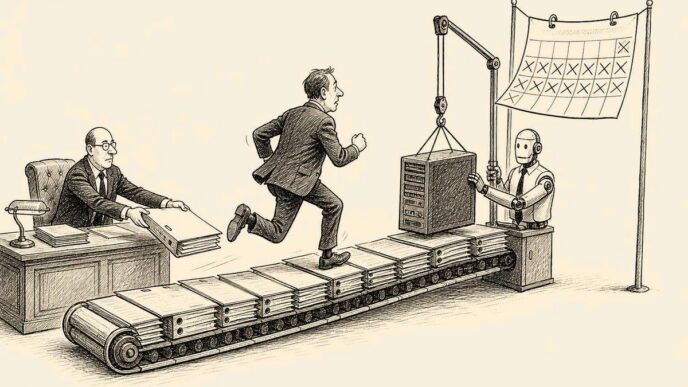




CBS shows more call-up work and fewer zzp workers, while tax and wage pressure tighten.
A small employer does not meet the labour market through a chart. It meets it on Thursday afternoon, when next week’s roster still has two open shifts, one contractor is harder to justify, and a part-timer asks for more hours. That is where the latest CBS figures land. The form of labour is changing, and the form now decides cash. That makes Dutch flex work pricing roster an evidence question, not only a policy headline.
Flex work is rising again
On 23 June 2026, CBS reported that the first quarter of 2026 was the third quarter in a row with more flexible employees than a year earlier. CBS counted 2.7 million employees aged 15 to 75 in flexible work, 63 thousand more than a year earlier. Permanent employment also rose by 60 thousand, but total paid employment only moved to just over 9.8 million. The headline is calm. The structure is not.
Availability becomes evidence
Most of the rise came from call-up or substitute workers and from temporary staff without a prospect of a permanent contract. Call-up or substitute workers rose from 956 thousand to 1.005 million. Temporary employees with a prospect of permanent work fell from 614 thousand to 597 thousand. Agency workers also fell, from 345 thousand to 331 thousand. The labour market is not simply expanding. It is being rebuilt in thinner and more cautious forms.
Adults are in the mix too
This is not only a student pattern. More than a quarter of call-up or substitute workers were aged 25 or older. In the 25 to 45 group, the number rose from 113 thousand to 130 thousand. In the 45 to 75 group, it rose from 129 thousand to 145 thousand. For founders and payroll advisers, that matters. Call-up work is no longer just pocket money on the side. It is part of the adult wage bill.
The roster is also a cash document
At the same time, CBS counted 574 thousand working people who wanted more hours and were available for them. They wanted 8.5 extra hours a week on average. A small employer should read that carefully. Some capacity may already sit in the part-time team, if the match is real and the roster can absorb it.
A cooler market is still tight in the wrong places
The wider labour picture is softer, but not loose. At the end of the first quarter, CBS counted 378 thousand open vacancies, 6 thousand fewer than one quarter earlier. Labour-market tension fell to 91 vacancies per 100 unemployed people. In May, unemployment was 3.9 percent, with 399 thousand unemployed people.
UWV still describes most occupations as tight or very tight. It counted that pressure in 87 of 93 occupational groups. Technical work, care and welfare remain hard to staff. That is the daily tension for a small business: the aggregate market cools, but the missing person still blocks delivery, hours, and revenue.
Tax now follows the file
The same labour shift has a tax edge. Belastingdienst ended the enforcement moratorium on labour relationships on 1 January 2025. Normal enforcement applies again. If false self-employment is established, payroll-tax corrections and additional assessments can follow. From 2026, culpability fines can also apply, while default fines will still not be imposed in 2026.
Model agreements for zzp work remain available until 31 December 2029. Their value depends on the work being done as described. In practice, the contract label matters less than the daily pattern. If the person is scheduled like staff, instructed like staff and tied economically to one client, the file has to be read as such.
The wage floor keeps moving
The price of variable work is rising too. From 1 July 2026, the statutory gross minimum hourly wage for workers aged 21 and older is €14.99, up from €14.71 in the first half of the year. CBS also reported that collectively agreed hourly wages, including special remuneration, were 4.5 percent higher in the first quarter than one year earlier. Contractual wage costs rose by 4.4 percent.
What small employers should map
Rijksoverheid also reported that the Tweede Kamer adopted the flexible workers bill on 12 May 2026. If the Eerste Kamer also agrees, entry into force can follow on 1 January 2028. Zero-hour call-up contracts would then give way, for many workers, to bandwidth contracts with a minimum and maximum number of hours. The maximum may be no more than 130 percent of the minimum.
The roster becomes the real file
That is why the roster is no longer a scheduling note. It is a price file. It tells the founder whether the business can still live on variable labour, or whether the same hours are becoming structural. It also tells the adviser where the tax, labour, and wage risk sits before the payroll account brings the bill home.
One more line matters. The Nederlandse Arbeidsinspectie says that from 1 January 2028, companies may only hire workers from labour suppliers listed in the official admission register. That turns supplier checking into routine business discipline. For a small employer, the check will sit next to the wage run, not outside it.
What changes tomorrow morning
The practical choice is usually plain. Keep using flexible labour where the work is genuinely variable. Offer more hours to trained part-time staff where the work repeats. Or change the business itself, through price, opening hours, automation, or service level. None of those choices is neat. All of them are better than pretending the roster is still cheap when the market, the tax file and the wage floor say otherwise.
The real signal from CBS is not a hiring boom. It is a shift in form. Employers are rebuilding capacity in cautious ways while old shortcuts lose room. The businesses that stay ahead will know which hours are truly variable, which work is genuinely independent, and which labour cost belongs in the customer price before it reaches payroll.
Sources
- CBS source
- CBS – Cooling labour market with remaining tightness
- CBS – May 2026 unemployment and working population
- CBS – Underused part-time capacity
- Rijksoverheid – Flex reform and call-up contract risk
- Belastingdienst – Tax enforcement on false self-employment
- Belastingdienst – Model agreements for zzp work
- Nederlandse Arbeidsinspectie – Agency labour and labour-supplier admission
Referenced in the article
Column | Human Resources
Dutch Flex Reform Makes Every Roster a Business Choice
The 2028 deadline is conditional, but the work design question has already.
Column | Governance
A Dutch Online Meeting Still Has to Earn Its Decision
The adopted bill makes digital access possible, but valid decisions still need patient governance.
AEX Closing Brief | Market Pulse
Amsterdam pauses while the real economy stays awake
AEX slipped 0.12%; business signal: demand holds, but rates and energy keep margins.
The Polder is written for readers who need the Dutch business environment translated into practical meaning. Corrections, source policy and editorial accountability are part of the publication record.