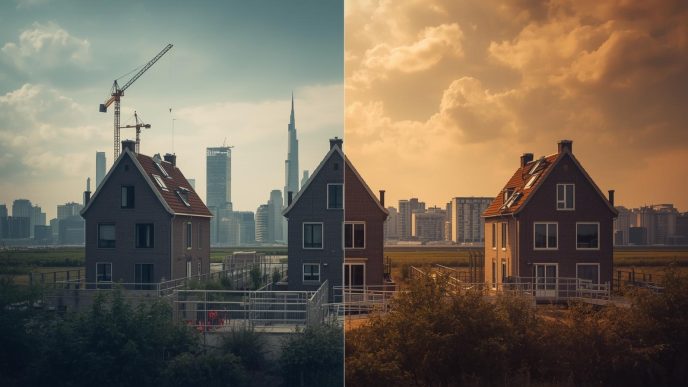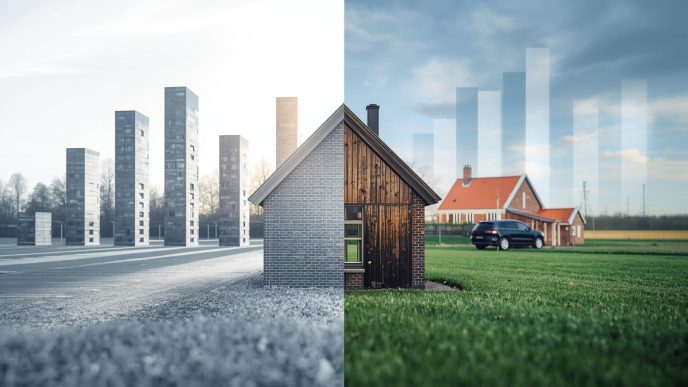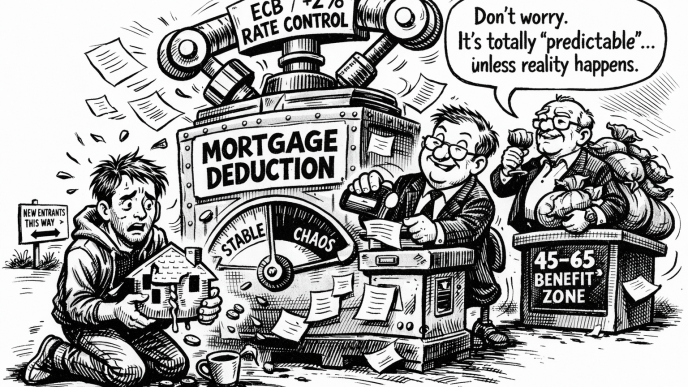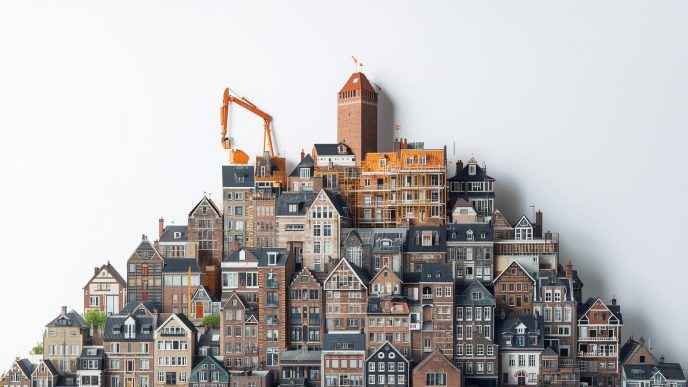
The May figures look calmer, but cash, tax and square metres still decide the deal.
A small broker in Zwolle does not need another national chart to know the mood has changed. Buyers ask more questions. Sellers still remember last year's bids. The notary quote arrives, and the room in the budget shrinks again.
The signal has to become readable
CBS and Kadaster reported on 22 June that existing owner-occupied homes were 4.4 percent more expensive in May 2026 than a year earlier. Prices also rose 0.6 percent from April. The index reached 154.9, with 2020 as 100, and stood 16.6 percent above the July 2022 peak.
That is the market in one line: slower pace, still high ground. A 4.4 percent rise sounds calmer than the double-digit rhythm of 2024 and early 2025. Yet the earlier surge still sits inside the asking price, the mortgage calculation, the WOZ-based bill and the family discussion around the kitchen table.
The price is not the whole story
Kadaster registered 19,120 existing-home transactions in May, 2.5 percent fewer than one year earlier. In the first five months of 2026, 94,523 homes were sold, 5 percent more than in the same period last year. One softer month sits inside an active year.
Average transaction price in May came in at €487,383. CBS uses the price index for price development, because it adjusts for quality differences between homes sold. That distinction matters for a founder, lender, broker or estate adviser. Without it, the wrong story enters the file.
A month with more smaller homes can make the average look gentler while the market still rises. A month with more detached homes can make the average look harsher than the real movement. The index tells one story. The deed at the notary tells another.
Local pressure is uneven
The freshest regional and property-type detail still comes from the first quarter. Existing homes were then 5.2 percent more expensive than a year earlier. Drenthe posted the strongest provincial rise at 8.2 percent. Noord-Holland had the smallest at 3.3 percent. Detached houses rose faster than apartments.
What the signal changes
That matters in a small business meeting. A construction firm near Assen, a mortgage adviser in Amsterdam and a family company looking for staff near Eindhoven do not face the same housing pressure. National averages help orientation, but local cash has the final vote.
Kadaster's first-quarter figures also show a change in who is selling. Investors sold more than 4,500 more homes to owner-occupiers than they bought from owner-occupiers. Those investor-sold homes were often cheaper, which dampened the average transaction price. First-time buyers bought 43 percent of all owner-occupied homes bought in that quarter.
Here the market becomes human again. The young employee who finally buys may be buying smaller, further away, or with less repair money after transfer. The landlord who sells leaves one fewer rental option for the next hire. One door opens. Another becomes narrower.
Permits are not keys
Supply is moving, but slowly. CBS reported 23,500 new-build permits in the first quarter, 4,700 more than a year earlier. At the same time, 13,700 new-build homes were completed, 1,800 fewer than one year earlier. The pipeline of permitted but not completed homes rose to 226,600.
A permit matters, but it is not a key in someone's hand. Between permit and completion sit financing, objections, grid issues, labour, materials, contract changes and weather. For a small builder, those steps decide margin. For a buyer, they decide when rent stops and mortgage payments begin.
Read the permit number as pressure for tighter planning, not as quick relief. Work may be visible in the pipeline while cash still waits for milestones, variations and paid invoices.
Tax arrives on its own calendar
Housing pressure also lands in the tax calendar. CBS reported that the average WOZ value of a home in 2026 was €439,000, 10.3 percent higher than one year earlier. The 2026 WOZ value is based on market value as of 1 January 2025. Earlier market heat still arrives later in municipal tax, income tax and water board charges.
Transfer tax adds another layer. In 2026, the rate is 2 percent for a home the buyer will live in for a longer period, unless the starter exemption applies. Qualifying starters under 35 can fall under the 0 percent exemption when all conditions are met. A home not used as the buyer's main residence, such as a rental or investment home, carries an 8 percent rate. Other immovable property, including shops and offices, sits at 10.4 percent.
What founders should check
Those rates do not turn a market by themselves. They do change the cash needed at completion. They also change the gap between a family purchase, a property BV decision and a mixed-use transaction.
The company balance sheet is closer than it looks
Many micro-entrepreneurs think of housing as private life, separate from the company. That line is often thinner than it looks. The house can be collateral, comfort, stress, pension thinking, inheritance planning, or the reason an owner accepts less salary for too long.
Staff bring housing pressure into work as well. DNB and AFM reported in March that house prices had risen 21 percent since mid-2023, while incomes had risen 14 percent. More than half of starters had a mortgage above 90 percent of the home value, and starters used on average 92 percent of their borrowing capacity.
That does not make every buyer reckless. It means small changes matter. A slightly lower appraisal can break a plan. A delayed transfer can add rent and bridge costs. A renovation that seemed modest can eat the buffer meant to protect both household and business.
This is why the broker in Zwolle is right to slow the conversation down. Not to frighten the buyer. Not to flatter the seller. Simply to keep the numbers in their proper places: index, asking price, appraisal, WOZ value, transfer tax, mortgage capacity, renovation money and cash after completion.
The May figures describe a market that has cooled in pace while staying expensive in level. DNB expects existing-home prices to rise by 3 to 4 percent per year between 2026 and 2028, and still sees starter affordability as historically poor.
For small business owners, that is the practical reading. One headline will not make the decision simple. Read the price level next to the tax bill, the loan, the local market, the rental alternative, the staff reality and the cash left after the notary. Dutch housing is quieter than before. It is not yet easy.
Sources
- CBS source
- CBS – Price index method and transaction-price limits
- CBS – Regional and property-type split, latest quarterly view
- Kadaster – Investor sales, starters, and mix effects
- CBS – New housing permits, completions, and supply pipeline
- DNB – DNB housing market forecast and affordability
- DNB – Mortgage lending norms and household leverage
- DNB – Macro forecast for homes, income, and mortgage capacity
Referenced in the article
Column | Human Resources
Burn-out Pressure Reaches Small Employers Through the Roster
Official data points less to a spike than to longer absences, tighter cover, and harder.
Column | Governance
A Dutch Online Meeting Still Has to Earn Its Decision
The adopted bill makes digital access possible, but valid decisions still need patient governance.
Column | Ledger & Tax
A DGA’s Gym Bill Needs the Right Payroll Year First
Older arbo disputes and current WKR choices do not live under the same Dutch payroll rule.
The Polder is written for readers who need the Dutch business environment translated into practical meaning. Corrections, source policy and editorial accountability are part of the publication record.