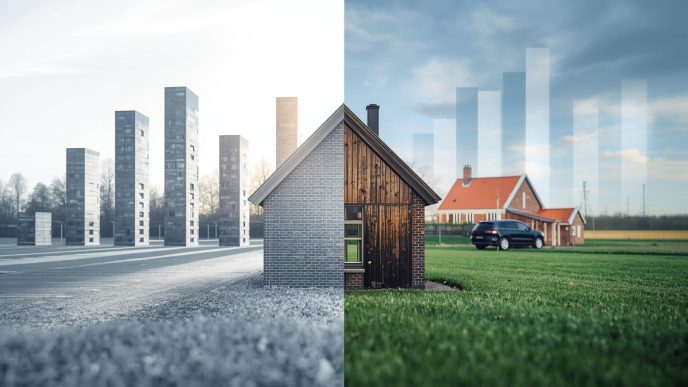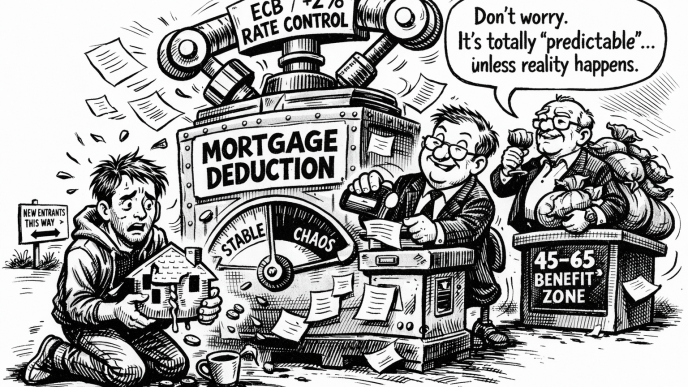
A stronger 2027 build outlook helps, but rents, staff and margins still depend on local delivery.
A small contractor looking at his 2027 order book may feel the first lift of optimism. More homes could mean steadier work, better planning and a stronger case for keeping skilled people close. Rijksoverheid said on 1 July 2026 that ABF Research expects 99,700 homes to be realised in 2027. If that happens, the 100,000-home mark comes within reach for the first time since the early 1990s.
The signal has to become readable
That is a serious signal. It is also a delivery story, not a price story. A forecast does not house a nurse, lower a founder’s rent or put cash in a subcontractor’s bank account. The real question is whether plans, permits, power, finance and labour turn into finished homes in the right places.
Delivery is still the bottleneck
The housing shortage has improved, but only a little. Government figures based on ABF show it fell from 4.8 percent in 2025 to 4.6 percent in 2026. ABF expects the shortage to move towards about 2 percent in 2034 if 100,000 homes a year become a structural pace.
Recent output still looks tight. CBS reported 69,200 completed new-build homes in 2025. In the first quarter of 2026, builders added 13,700 new homes and received permits for 23,500 more. The pipeline of permitted but not yet completed homes rose to 226,600.
That pipeline matters. A permit sits much closer to delivery than a plan, but it is still not a front-door key. ABF also puts gross plan capacity for 2026 to 2030 at 823,400 homes, with 386,200 already adopted by municipal councils. On paper, the route is there. In business life, the chain still has to hold.
Rules, permits and power
The Wet versterking regie volkshuisvesting entered into force on 1 July 2026. It gives national government, provinces and municipalities stronger steering power over how many homes are built, where they are built and for whom. Regionally, two thirds of homes must be affordable, including 30 percent social rent.
For developers and municipalities, that changes the reading of a project. The question is no longer only how many units fit on a site. It is whether the local programme, affordability mix, permit route, appeal timing, grid position and financing fit together.
What the signal changes
Appeal procedures for housing and energy infrastructure can be shortened, which may save time. Still, a shorter route only helps when the file is buildable. A weak calendar stays weak, even with stronger public steering behind it.
Grid capacity belongs in the same sentence. The government says network operators invest about €8 billion a year in grid expansion. From 1 July 2026, priority in congested areas is limited to three groups, including basic needs such as homes, schools and public transport. From 1 October, municipalities can request capacity earlier in the building process.
That shift matters. Electricity is now a real estate condition, not a technical afterthought. A project can look healthy on paper and still stall if the connection arrives too late.
Not every new home fits the same household
The national count hides a local mismatch. CBS says at least half of all new-build homes have been apartments since 2023. The average size of new-build homes fell from 118 square metres in 2021 to 99 square metres on 1 January 2026. CBS also reports that 73 percent of permitted homes in the pipeline are apartments or upper and lower-floor dwellings.
More apartments can be exactly what some cities need. They help starters, smaller households and people who want to live near work. But they do not answer every housing question. A logistics firm hiring shift workers, a care provider filling early rosters or a family business relocating staff may need homes that match wages, household size, schools and commuting time.
That is why the housing forecast belongs in the employer’s notebook as much as in the developer’s model. CBS found that in 2024 households in private rental homes spent a median 30.0 percent of income on housing costs. Starter households in private rental homes had the highest reported median ratio, at 35.1 percent.
What founders should check
Those figures travel straight into wage talks, roster pressure, staff turnover and the radius from which a small company can recruit. A founder may see national supply improving and still lose candidates because the local rental market eats too much of the wage.
Prices still set the tone
The purchase market has not turned soft. CBS and Kadaster reported that existing owner-occupied house prices were 4.4 percent higher in May 2026 than a year earlier. Kadaster registered 19,120 transactions that month, 2.5 percent fewer than a year earlier.
DNB expects house-price growth of about 3 to 4 percent a year between 2026 and 2028, and says affordability for starters remains historically poor. In March 2026, DNB and AFM concluded that relaxing mortgage lending standards for home buyers is undesirable. They also reported that house prices had risen 21 percent since mid-2023, while incomes rose 14 percent over the same period.
For buyers and owner-managed companies, that means the acquisition math still sits apart from supply hope. Belastingdienst lists 2026 transfer-tax rates of 2 percent for a qualifying main residence, 8 percent for a dwelling not used as a main residence and 10.4 percent for other immovable property.
Back at the contractor’s desk
Return to the contractor with the 2027 order book. The forecast may support confidence. It may justify conversations about staff, materials and bank facilities. But the margin still sits in timing, payment terms, subcontractor continuity, guarantees and the risk of a site waiting for a connection or final local decision.
The same discipline applies outside construction. A shop weighing a lease renewal, a founder trying to hire in Utrecht, a landlord planning renovation or a lender assessing a small development cannot budget on the national target alone.
The better question is local: which homes, in which municipality, under which decision, with which grid position, at what price and by when?
The calm reading is this. The Netherlands may be moving toward a production level that eases the shortage over time. That matters. But a tight housing market only relaxes when people receive keys, rents meet wages, projects connect to power and small businesses can plan staff and cash without guessing where their workers will live.
Referenced in the article
Column | Market Pulse
Dutch Shops Sell More as the Cash Question Gets Sharper
CBS recorded real growth in May, but for small retailers the harder job starts after closing time.
The Polder is written for readers who need the Dutch business environment translated into practical meaning. Corrections, source policy and editorial accountability are part of the publication record.