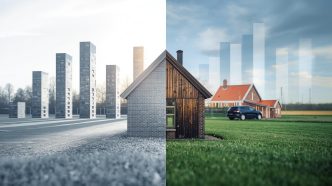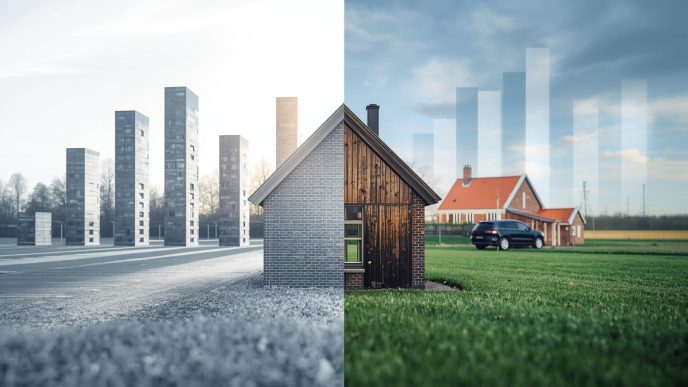
The new package shifts pressure from waiting to proving that a project can start cleanly.
A founder sits at a kitchen table with a land option, a bank term sheet, a builder asking for a start date, and a municipality that cannot promise what the law will not support. That is the real venue for nitrogen policy. The issue is no longer abstract. It is whether a project can move without getting caught between map, permit, and cash flow.
The signal has to become readable
On 26 June 2026, the cabinet set out a package to restart permit granting. It includes a calculation threshold for very low deposition, zones around vulnerable nature, and money for nature recovery and sector measures. For real estate and construction, the practical test is simple. Can a project show small deposition, a location that passes scrutiny, and a construction method that survives review?
Room on paper, discipline on the ground
The cabinet wants a legally durable calculation threshold so activities with very limited deposition no longer need a nature permit for that part. A bill with new targets is planned for October 2026. Until then, some files may find a route, but only if the preparation is tight and the numbers are clean.
The map will also shift. Roughly 100 nitrogen-sensitive Natura 2000 areas will get extra zones. About 15 may carry a 1,000 metre zone, while the others get about 500 metres. A plot that looks cheap on paper can become expensive in time. A pricier site outside pressure zones can win once holding costs, objections, financing delays, and builder availability are counted.
What the signal changes
The state is also putting money behind execution. The package carries a 20 billion euro envelope, including 9 billion for support in zones, 2.2 billion for nature restoration and management, and 250 million for industry and mobility measures. For builders, two details matter most. Emission-reducing upgrades can be permitted again. Saldering can help unlock new projects.
Nature still sets the boundary
The policy sits on a hard baseline. PBL reported in March 2026 that statutory nitrogen goals were not on track. Deposition on sensitive Natura 2000 areas fell 32 percent between 2005 and 2023. The share of sensitive nature below the critical deposition value rose from about 21 percent to 30 percent. PBL estimates about 33 percent for 2030, against a 50 percent statutory target.
Those numbers shape credibility. A threshold is not just a line in software. Authorities will still watch cumulative effects and connect nitrogen to water quality, desiccation, soil pressure, farm pressure, and local recovery work. That reality lands in a permit file, and it lands there fast.
For a small developer, the translation is practical. Use electric machinery where possible, phase deliveries, limit site movements, and document the calculation cleanly in AERIUS. A modest infill or modular project may get a chance. A cheap plot close to sensitive nature without a zone plan can become a cash trap before a shovel moves.
The housing market will not wait politely
Market pressure is already visible. CBS reported 23.5 thousand new-build dwelling permits in the first quarter of 2026, and 13.7 thousand new-build completions. There were 226.6 thousand permitted but not yet completed dwellings in the pipeline. That gap is business pain. Cash sits in land, design, and options while output lags behind.
What founders should check
Prices add heat. CBS and Kadaster recorded existing owner-occupied homes 4.4 percent more expensive in May 2026 than a year earlier. The average transaction price was 487,383 euros. That figure is not quality-adjusted, but the direction is clear. For a founder, this is not only a household story. It shapes staff recruitment, wage pressure, and where a business can still afford to settle.
In April, the government also set an ambition to halve the design and permit stage from about eight years to about four years, within a roughly ten-year plan-to-completion baseline. It expects 15,000 homes per year from optopping, conversion, splitting, and shared housing, and wants at least half of new homes to be factory-built within four years. Nitrogen relief helps only if these routes can absorb the work.
Finance, labour, and tax still count
The arithmetic does not relax because a permit route opens. DNB reports 340 billion euros in Dutch bank lending to businesses as of March 2026, just under half to SMEs. SMEs paid around 3.6 percent on outstanding loans, versus around 3.1 percent for larger firms. Banks will still test whether a project can move from permit to drawdown and into completion, sale, or rent without legal shocks.
Labour is the second brake. UWV highlights shortages in electricians, plumbers, insulation workers, roofers, supervisors, work planners, and calculators. If more projects clear permitting, rosters and critical subcontractors become the next constraint. A missed crew can hurt cash flow as hard as a missed permit.
Tax frames acquisition strategy as well. In 2026, transfer tax is 2 percent for a dwelling used as the buyer’s long-term main residence, 8 percent for a dwelling not used as the buyer’s main residence, and 10.4 percent for other immovable property. For small landlords and mixed-use buyers, that belongs in the return model from day one.
A careful close
The stikstof freeze is being loosened, not melted away. The better projects will know their map and their method, and will carry lender conditions, subcontractor capacity, and tax position in the same pack as the AERIUS run. The announcement gives room to plan and prepare. It does not excuse sloppy timing or vague files.
Sources
- CBS source
- Kabinet haalt Nederland van het stikstofslot | Rijksoverheid.nl
- PBL – Latest official nitrogen and nature evaluation
- PBL – Calculation threshold and legal durability
- Rijksoverheid – Area-based execution near vulnerable nature
- Rijksoverheid – Government housing acceleration policy
- CBS – Annual housing additions and permit lag
- CBS – Latest monthly building-permit value and permit counts
Referenced in the article
AEX Closing Brief | Market Pulse
AEX close: moved clearly lower
AEX slipped 0.65%; cost pressure kept Amsterdam disciplined, not panicked.
Column | Ledger & Tax
A Dutch VAT Refund Is Cash Only After the Evidence Holds
A short Hoge Raad ruling shows why old invoices can decide tomorrow's cash.
The Polder is written for readers who need the Dutch business environment translated into practical meaning. Corrections, source policy and editorial accountability are part of the publication record.