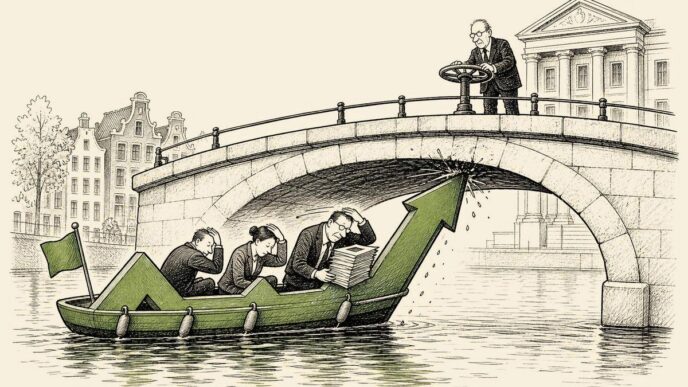
CBS puts June inflation at 2.9 percent, but wages, energy and services still decide the small firm’s margin.
At the counter of a small café, inflation is not a national percentage. It is the price of coffee beans, the next energy instalment, the kitchen roster and the question of whether a customer will still order lunch after seeing the new menu.
The signal has to become readable
CBS gave that counter conversation a fresh number on 1 July. In its flash estimate, Dutch CPI inflation fell to 2.9 percent in June 2026, down from 3.5 percent in May. Consumer prices were 0.6 percent lower than in May. That helps the mood. It still leaves the owner with July wages, supplier bills and a customer who checks the menu twice.
The number at the counter
The useful part of the CBS release is not only the fall in the total. It is the split underneath it. Food, drinks and tobacco were flat in the June flash estimate. Industrial goods excluding energy and motor fuels rose only 0.7 percent. Those are the calmer lines.
Services rose 4.1 percent. Energy including motor fuels rose 6.0 percent. Consumption abroad rose 5.7 percent. Many small firms live closer to that second story than to the calm average.
A hairdresser sells time. A cleaning company sells hours. A delivery business sells routes. A repair shop sells skilled labour and parts that arrive through a cost chain. For those firms, the headline CPI number is a weather report seen through a window. The real storm, or the real calm, is in payroll, fuel, rent, supplier invoices and customer hesitation.
I read the June figure as cooling, not settling. The temperature has fallen, but the room is still warm.
Where the pressure stayed
The timing matters. From 1 July 2026, the statutory gross minimum hourly wage for workers aged 21 and older is €14.99, up from €14.71 in the first half of the year. CBS also reported that negotiated hourly wages including special remuneration were 4.5 percent higher in the first quarter than a year earlier. Contractual wage costs rose 4.4 percent.
Those figures enter the company through the July payroll run, holiday allowance accruals, premiums, sector rates and the hard choice between longer opening hours and a thinner roster.
What the signal changes
The café owner at the counter may hear customers say inflation is falling. She may also see that Saturday coverage costs more, the dishwasher repair costs more, and the delivery surcharge has not disappeared. If she raises prices, she risks losing orders. If she absorbs everything, margin disappears quietly.
Producer prices add another layer. CBS reported that manufacturing output prices in May were 5.8 percent higher than a year earlier. Petroleum-product prices were 46.7 percent higher and chemicals 18.9 percent higher, while food manufacturing prices were lower. A small firm buying packaging, cleaning materials, fuel-linked goods or transported stock can still feel supplier pressure when the consumer-price headline softens.
Demand is awake, but careful
The Dutch market is not frozen. CBS reported that retail turnover in May was 2.9 percent higher than a year earlier, with volume up 2.3 percent. Non-food did better than food, and online turnover rose 4.8 percent. There is spending in the system.
Yet spending is not the same as confidence. CBS consumer confidence improved sharply in June, from -46 to -39, but it remained far below its twenty-year average of -11. Willingness to buy also improved, but stayed weak. The indicator for major purchases was still deeply negative.
That is the customer many founders recognise. Not absent. Not reckless. Selective.
Business sentiment adds another warning. CBS reported business confidence at -14.8 at the start of Q2, down from -1.8 at the start of Q1. On balance, 29.7 percent of entrepreneurs expected selling prices to rise in the next three months. The cost pass-through debate is still alive in ordinary invoices.
DNB’s June outlook fits the same mood. It projects Dutch GDP growth of 0.8 percent in 2026 and inflation of 2.7 percent. It also expects household consumption to stagnate this year, with business investment held back by higher costs, uncertainty and interest rates. CBS reported modest GDP growth of 0.2 percent in the first quarter compared with the previous quarter. The economy is moving, but not with enough force to rescue every margin.
The ledger tells the truth
For a micro or small business, the best inflation reading starts in the ledger. Which five lines actually move cash? Wages, rent, energy, transport, stock, finance costs and debtor days often matter more than the national average.
There is also a contract point that deserves more attention than it usually gets. From 2026, CPI and HICP use 2025 as the base year. CBS advises using CPI series for indexation unless a contract or regulation explicitly names HICP. For adjustment periods ending in January 2026 or later, CBS points to the 2025=100 series.
What founders should check
That sounds technical until an invoice goes out with the wrong index, the wrong period or the wrong base year. Then it becomes a customer dispute, a rent discussion or understated revenue. Inflation is not only a market issue. It is also a control issue.
Hospitality and lodging have their own extra tension. From 2026, VAT on lodging in hotels, guesthouses and short-stay holiday accommodation is 21 percent. Belastingdienst also treats facilities belonging to the lodging supply, such as gas, electricity, water and parking in combination with lodging, under that rate. When customers compare all-in prices, tax, staff, energy and procurement meet in one visible number.
The same discipline applies outside hospitality. A cleaner may need to test whether the hourly fee still covers travel, admin and absence. A small retailer may need to separate higher turnover from stronger cash. A transport operator may need to know whether fuel clauses, route planning and payment terms still protect the margin.
What owners can do with it
Cooling inflation is useful. It can soften talks with customers and may reduce pressure in some future index-linked adjustments. It does not pay July wages by itself, and it does not lower every supplier invoice at the same speed.
The practical work is modest, but it has to be concrete. Compare the June CPI headline with the company’s own cost lines. Review index-linked contracts. Check the July payroll settings. Recalculate margins where fuel, energy, imported goods or staff-heavy delivery carry the real cost.
For service firms, the hourly rate should still cover paid time, unpaid admin, travel, absence and employer charges. For retailers, volume growth should be separated from margin growth. For hospitality and lodging, all-in customer prices need to match VAT, staff, procurement and energy reality.
The calm conclusion is simple. Treat the 2.9 percent figure as a signal that the fever is lower. Do not treat it as permission to stop measuring. The firms that will handle this phase best are not the loudest price raisers or the most optimistic cost absorbers. They are the ones that read the market through their own cash, contracts and rosters, then make small decisions before pressure becomes visible at the counter.
Referenced in the article
Column | Market Pulse
Health Sells, but Dutch Trust Sets the Checkout Terms
Drugstore growth is real, but health retail still lives and dies on clean claims, consent, prices.
Column | Market Pulse
Inflation Anxiety Leaves Small Firms With a Price Trust Problem
Dutch households still spend, but many now ask what each euro has to prove.
The Polder is written for readers who need the Dutch business environment translated into practical meaning. Corrections, source policy and editorial accountability are part of the publication record.