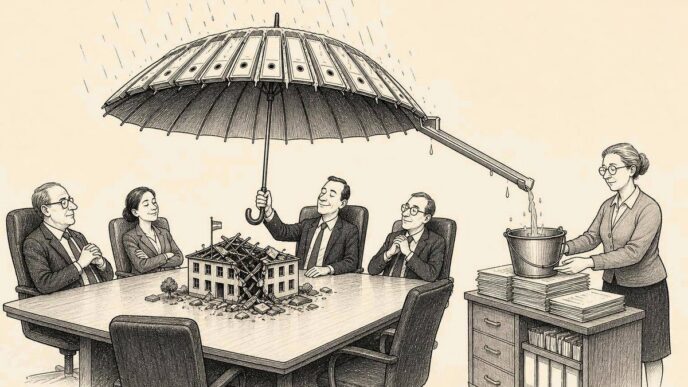
The proposed €38 presumption is civil law, but the tax pressure is already real.
The invoice arrives like any other: a self-employed worker, €32 an hour, VAT shown, Chamber of Commerce number on the footer, neat description of the work. For a small company, it reads like flexible labour with a clean supplier entry. That is the appeal. Payroll is heavy, customers resist higher prices, and rosters still need people.
The signal has to become readable
The question is not whether this looks convenient. The question is what the file looks like when the work starts to resemble staff. That is where a low hourly rate becomes more than a price point. It starts to shape the legal, payroll and cash-flow conversation around the same person.
A narrow bill, a wide business effect
Wetgevingskalender lists the bill as adopted by the Tweede Kamer on 21 April 2026 and still in the Eerste Kamer phase on 10 June, with a Senate note dated 5 June. The bill is not in force yet. Even so, the direction is clear.
The proposal would create a presumption of an employment contract based on hourly rate. Rijksoverheid gives the threshold as up to €38 per hour, with 1 January 2026 as the reference date. If a worker invokes that presumption, the client has to show that there is no employment contract.
The rate is not the whole answer
The €38 figure is not a magic switch. The presumption would work in civil law, between the worker and the work provider. It does not replace the Belastingdienst's own assessment. That matters when the same person sits in both the contract file and the payroll risk file.
Dutch law already has another presumption. Article 7:610a BW presumes employment after three consecutive months of paid work, when someone works weekly or at least twenty hours per month. The proposed hourly-rate rule would add another route into the discussion. It would not make the invoice, contract title or VAT line decisive.
Where the books start to move
For the ledger and tax desk, pressure starts when the books show a supplier while the workday looks like staff. A contractor may work fixed shifts, follow team leads, use company systems, wear the company face to customers and carry little commercial risk. At that point, the bookkeeping label starts to lose force.
What the signal changes
The Belastingdienst enforcement moratorium ended on 1 January 2025. Since then, the tax authority can again impose payroll-tax correction obligations and additional payroll-tax assessments when false self-employment is found. In 2026, culpability penalties can apply. Default penalties for incorrect classification are still not imposed under the current soft-landing approach.
VAT can enter the same file. Belastingdienst guidance says payroll-tax findings at the client can affect the contractor's VAT and income-tax position. If work is treated as employment for payroll-tax purposes, that can point away from independent economic activity for those activities. VAT charged on the invoice may then need review at both ends.
That is why the low-rate proposal reads like a timing signal as much as a legal one. A small company can absorb ordinary corrections. It struggles when wage tax, VAT, payroll administration, holiday talk, sickness risk and margin pressure arrive together after the customer price has already been fixed.
The market is already adjusting
CBS shows why this lands in a difficult climate. The number of zzp workers fell by 62,000 in 2025. By the first quarter of 2026, the number was 116,000 lower than in the fourth quarter of 2024. The labour market was cooler, but not loose: 378,000 open vacancies, 91 vacancies per 100 unemployed people.
Cost pressure makes the classification question sharper. CBS reported business confidence at -1.8 at the start of 2026. Personnel costs were named by 82 percent of businesses as one of the two main causes of cost increases, and half said they could not, or could hardly, pass cost increases on to customers.
What founders should check
Back to the €32 invoice. The founder may not be trying to avoid anything. She may simply be filling Friday and Saturday shifts in a café, a cleaning route, a warehouse corner or a support desk. But if the contractor works like the rest of the team and has little real independence, the rate can become the easiest place to raise the employment question.
Paper still has to match the day
Model agreements have not disappeared. Approved agreements that were valid on 6 September 2024 may be used until 31 December 2029. The Belastingdienst also warns that model agreements can create false certainty if the actual work does not match the paper. In other words, the contract is only the first layer.
The Supreme Court line points the same way. In Deliveroo, the chosen label and model agreement were not decisive. In Uber, entrepreneurship outside the specific relationship could count in the overall assessment. Together, those judgments push companies back to the working day: who controls the hours, who carries risk, who sets the price, and who can send a substitute.
A calm review starts with the relationships closest to payroll reality. Low hourly rates deserve attention, especially below or near €38. So do long assignments, fixed rosters, personal work, one-client dependence, company tools, operational supervision and work that customers see as part of the business itself. The point is not panic. The point is to know what the records say.
For a small company, the cleanest improvement is ownership. Finance sees the invoice. Operations sees the work. HR sees the roster. The tax risk sits between them. Someone should be able to explain why the person is treated as self-employed, what proof supports that view, and whether VAT, payroll tax and the contract tell the same story.
The proposed €38 presumption is still moving through Parliament. The Belastingdienst track is already moving through real books. That is the practical difference. A lower contractor rate may not settle the legal answer, but it can make the question easier to ask. A careful business does not wait for that question to arrive as a dispute, a visit or a correction.
Sources
- CBS source
- Rechtsvermoeden bij laag uurtarief stap dichterbij
- Overheid.nl Wetgevingskalender – Legislative status of the hourly-rate presumption
- Rijksoverheid – Government policy reset on VBAR and low-paid zzp work
- Rijksoverheid – Legal nature of the presumption and tax boundary
- Wettenbank – Current Civil Code framework for employment and existing presumptions
- Belastingdienst – Belastingdienst enforcement since the end of the moratorium
- Belastingdienst – Handhavingsplan arbeidsrelaties 2026
Referenced in the article
Column | Compliance
A Second Company Bicycle Can Tighten Payroll More Than It Looks
The 7 percent bicycle rule helps employees, but payroll, VAT and travel allowances still.
Column | Human Resources
When Succession Shares Meet Payroll, Evidence Carries the Risk
A Dutch court ruling shows why ownership, cost and motive matter before payroll sees.
Column | Compliance
Group Service Fees Are Moving From Tax Policy to Daily Evidence
A management charge only works when the file, the VAT line, and the cost split can all stand.
The Polder is written for readers who need the Dutch business environment translated into practical meaning. Corrections, source policy and editorial accountability are part of the publication record.