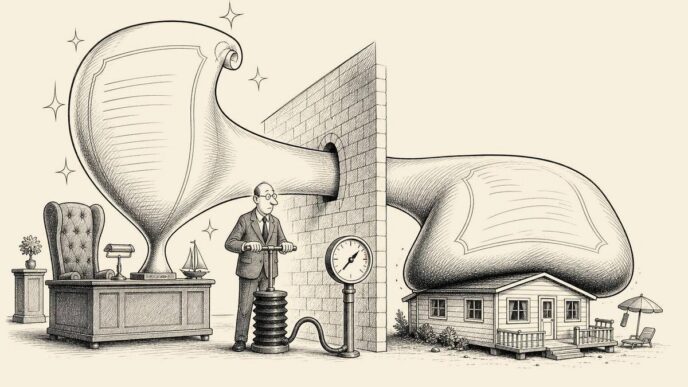
A new Belastingdienst position makes the tax rate less important than the proof kept behind it.
Picture a small Dutch engineering firm sending one experienced employee abroad for a long project. The client needs the person on site. The Dutch contract stays in place. The Dutch pension scheme continues. A foreign payroll adviser handles the local tax side, and the owner feels the project is under control.
The signal has to become readable
Years later, that employee retires in the Netherlands. The pension provider starts paying. Then someone asks what happened during those five foreign years. Were employer pension contributions taxed abroad? Were employee contributions deducted there or not? Which payslips still exist? A foreign assignment can follow the pension long after the commercial project has ended.
That is why the Belastingdienst Kennisgroepen position published on 26 May 2026 deserves more attention than its narrow pension wording suggests. The official case concerned a Dutch resident who stayed in a Dutch pension scheme during a five-year foreign assignment. The foreign country taxed the employment income. Employer pension contributions were taxed there. Employee pension contributions were not deducted from gross pay.
The rate is not the point
The striking detail is the foreign rate. It was a flat rate, and it was much lower than the Dutch marginal rate would have been. Yet the Belastingdienst did not make that lower rate decisive. A foreign levy can still match Dutch wage tax or income tax in nature and scope if, in substance, it works as an income tax on the worker’s income.
That is the useful correction for many owners and advisers. The first instinct is often to compare percentages. Dutch tax feels high, the foreign tax looks low, and the comparison seems too weak. The Kennisgroep position pushes the focus elsewhere. The better question is what the levy is. Is it an income-type tax on a natural person’s income, flowing into general public funds? Or is it something else, such as a social security charge or a payment for a specific service?
That distinction matters because the saldomethode is not a broad discount. It sits inside the official policy on the international aspects of pensions and annuities. Under the normal Dutch model, pension build-up gets tax relief and the later pension payment is taxed. Foreign work can break that symmetry. The Dutch pension scheme may continue without trouble, while the foreign system gives no deduction or exemption during build-up.
The pension record remembers the assignment
The saldomethode is the official way to soften that economic double taxation when the conditions are met. It does not make the whole pension tax-free. It can keep the relevant part of the pension payment outside Dutch wage tax and income tax, linked to pension contributions for which no foreign fiscal relief was received.
What the signal changes
The same 2026 Kennisgroep position confirms a second practical point. The exempt part under the saldomethode does not form part of the taxpayer’s verzamelinkomen. That is more than a technical label. Verzamelinkomen feeds other Dutch tax calculations, so the effect can reach beyond the first wage-tax line.
For a company owner, the deeper lesson is administrative. A foreign assignment is not finished when the employee comes home. The pension trail may need to survive payroll changes, pension reform, software migrations, adviser changes, and the retirement of the person who knew the story. In the engineering firm example, the weak point is rarely goodwill. It is whether the record still separates the assignment period, Dutch pension continuation, employer contributions, employee contributions, and the foreign tax treatment.
The current policy decision says the interested party must be able, on request, to make two points plausible. First, that foreign tax was actually levied in connection with obtaining the pension entitlements. Second, that the foreign tax corresponds in nature and scope to Dutch wage tax or income tax. For this purpose, the absence of employee premium deduction counts as actual taxation.
That is simple in words and often difficult in practice. The pension provider may hold contribution history. The employer may hold assignment letters and payroll summaries. The former employee may hold foreign assessments. The foreign payroll agent may hold the decisive payslip detail, if the system still exists. None of those parties alone may hold the full story.
Why old documents still matter
The 2025 Belastingdienst V&A 08-002 makes the point more numerical. It explains the saldomethode under older pension frameworks and under the Wet toekomst pensioenen contribution framework. In the newer contribution-based system, the evidence trail depends less on memory and more on paid premiums, ratios, and amounts for which no foreign fiscal relief was received.
There is also an older court warning behind this. In 2010, the Hoge Raad dealt with a pension partly built during foreign work and later pension payments during residence abroad. The Court accepted that earlier foreign taxation or non-taxation of pension payments can matter when deciding whether economic double taxation remains. A pension case can require a life history, not only a current-year tax return.
Small companies are not outside this
Large multinationals usually have mobility departments. Small companies often have something more fragile: a capable office manager, a pragmatic accountant, a foreign adviser, and a folder that made sense at the time. That can be enough while everyone is still present. It is less comfortable fifteen years later.
What founders should check
The sectors are easy to imagine. Engineering, technical installation, software implementation, specialist manufacturing, consultancy, and construction all send people across borders. A founder can create the same issue personally by working abroad while the Dutch pension arrangement continues. The official tax rule does not become simpler just because the company is small.
The practical discipline is sober. A good pension record for foreign work links the assignment dates to the Dutch pension scheme, the employer and employee contributions, the foreign taxable wage base, and the foreign assessment or payroll records. It should also link any later pension payments received while living outside the Netherlands. That is not bureaucracy for its own sake. It is the future tax position written in present documents.
When I return to the engineering owner in the opening scene, I do not see a mistake. I see the normal pressure of small business life. The client was waiting, the worker had to go, the payroll had to run, and the pension stayed in place because that felt responsible. The missing step is usually not technical brilliance. It is deciding, while the project is still alive, who keeps the evidence that retirement may need.
The new Belastingdienst signal is therefore calmer than it looks. A low foreign tax rate does not automatically close the door. A Dutch pension payment is not automatically relieved either. The door opens through the character of the foreign levy and through proof that still makes sense years later.
For cross-border work, memory is a weak tax asset. Documents are stronger. The firms that understand that now will not need to rebuild an old assignment from fragments when the pension finally starts paying.
Sources
- taxrulingsandpolicy.nl
- Belastingdienst Kennisgroepen
- Belastingdienst Kennisgroepen
- Belastingdienst Centraal Aanspreekpunt Pensioenen
- Belastingdienst Centraal Aanspreekpunt Pensioenen
- Wettenbank
- Wettenbank
- Wettenbank
Referenced in the article
Column | Ledger & Tax
The HOOPP Case: How €253 Million in Tax Refunds Became a Criminal Investigation
A Canadian pension fund executed 445 transactions over five years.
Column | Ledger & Tax
I Watched €750 Million Companies Get a Tax Break While My Invoice Got Audited
The OECD's 15% global minimum tax for corporations over €750 million revenue created unexpected compliance.
Column | Human Resources
European Workers Can Ease Dutch Shortages Only With a Real Bridge
For small employers, foreign recruitment starts with capacity, payroll discipline, and honest.
The Polder is written for readers who need the Dutch business environment translated into practical meaning. Corrections, source policy and editorial accountability are part of the publication record.