Circularity can support Dutch property value, but only when records, cash flow and ownership tell the same story.
Circular investing in Dutch property is no longer just a design conversation. It is moving into measurement, tax treatment, ownership clauses, financing questions and sale evidence.
The signal has to become readable
That matters most to the small owner. A large developer can spread the work across legal, tax, technical and sustainability teams. A founder with a shop, a small landlord with a few apartments, or a BV owner with a business unit does not have that luxury. One person often has to approve the contractor, speak with the lender, call the adviser, explain the rent, read the invoice and carry the cash-flow effect.
I read the Dutch circular-property discussion as a sober ownership question. A building part only has circular value if its value can travel. It must be identifiable, maintained, documented, financed, taxed and understood by the next user or buyer.
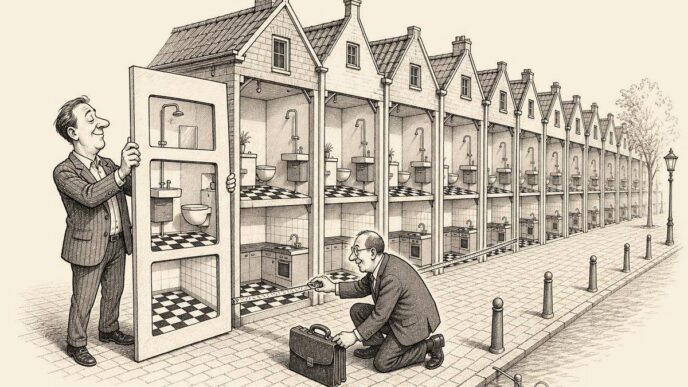
Take a simple case. A small healthcare practice buys an older ground-floor unit and renovates it with reused interior materials, demountable walls, a modular ventilation installation and leased lighting. The plan sounds sensible. It may reduce waste, improve the building and fit the practice’s public identity. The business questions arrive quickly. Who owns the lighting? Can the walls be removed without damaging the building?
Does the installation sit in the books as part of the building or as a separate asset? Is any environmental investment facility relevant? Will the next buyer pay for the story, or only for the evidence?
That is where circular property becomes serious.
The policy turn
The Dutch policy direction is clear. Rijksoverheid says the Netherlands aims for a fully circular economy in 2050. The National Circular Economy Programme was updated in 2025, with measures meant to accelerate the transition. CBS published fresh material-input monitoring in May 2026 and referred to a new 2035 goal of reducing raw-material use by 15 percent compared with 2016.
At the same time, PBL gives the transition a sharper edge. It says the earlier 2030 target of using 50 percent fewer primary abiotic raw materials is very unlikely to be reached. Its ICER 2025 also includes housing construction among the analysed product groups. Several circular-economy trends are still moving in the wrong direction, and markets for circular products remain limited.
That combination matters. Circularity is real, but it is not yet a mature price machine. The owner who spends extra money on circular materials cannot simply assume that the market will recognise the value later. The value has to be made visible. In real estate, that comes from boring things done well: contracts, invoices, specifications, maintenance records, ownership clauses, valuation notes and lease language.
What the signal changes
CBS also says circular-economy data are still largely a blind spot, with missing microdata and industry indicators. For a small property investor, that shifts more weight back to the project file. If national statistics remain thin, the owner’s own records have to do more of the work.
The building itself is becoming measurable
Dutch building policy is also becoming more measurable. The legislative calendar records a change to the Besluit bouwwerken leefomgeving that tightens the environmental-performance requirement for office functions and sets requirements for other use functions. Rijksoverheid explains that environmental performance is measured through a lifecycle method, from raw-material extraction and production through transport, use and demolition. Since 1 July 2019, that method makes secondary and renewable raw materials visible.
That is a quiet but important shift. The building is no longer judged only by location, square metres and energy label. Material use, lifecycle impact and future dismantling logic are moving closer to the investment conversation.
Energy pressure adds another layer. Owners of rental homes with labels E, F or G must improve them to at least label D by 1 January 2029. New requirements for existing utility buildings such as shops, offices, schools and care institutions are expected from 2030. A small landlord or business owner has to sequence these investments. A circular renovation that ignores energy deadlines can miss the real risk. An energy upgrade that ignores material choices may miss a chance to strengthen the asset for the longer term.
The construction market does not make this easier. CBS reported that permits were issued for 23.5 thousand new-build homes in the first quarter of 2026, while 13.7 thousand new-build homes were completed. Permits were also issued for 5.2 thousand new commercial buildings. Activity is there, but delivery remains a real business constraint. Circular choices that confuse procurement, delay works or weaken lender confidence can damage a sound idea.
Tax follows the asset, not the slogan
Circular language does not replace Dutch tax mechanics. Belastingdienst guidance on business buildings still starts with acquisition value, land value, residual value and useful life. Land may not be depreciated. A usual useful life for buildings is 30 to 50 years. The bodemwaarde, the tax floor for building depreciation, is equal to the WOZ value.
Since 2024, for income-tax entrepreneurs, the bodemwaarde for all business buildings is equal to the WOZ value, subject to transitional rules where relevant. That gives circularity an unexpected tax rhythm. If reusable components are expected to retain more value, the residual value may matter more. A higher residual value can reduce annual depreciation. That may be logical, but it should be understood before the investment is sold internally as both green and fiscally attractive.
MIA and VAMIL may help in specific cases, but only where the business asset qualifies. Belastingdienst says the asset must appear on the Milieulijst, must be new, must involve at least €2,500 per business asset and must be notified within three months after the investment. For 2026, Belastingdienst lists MIA percentages of 45 percent for asset codes F and G, 36 percent for A and D, and 27 percent for B and E. The word circular is not enough. The asset, timing and evidence do the work.
There is also an older classification question behind many new circular designs. A 2019 Court of Appeal judgment published by Rechtspraak, dealing with article 3.30a of the Wet inkomstenbelasting 2001, treats parts of a building, associated land and appurtenances as one business asset for depreciation and impairment. It also distinguishes certain removable equipment. That signal does not decide every modern circular structure, but it warns against easy assumptions. A demountable wall may feel separate to the designer. The tax question is more precise.
What founders should check
When I look at a circular property plan, I want that precision early. Not because the owner should become a tax specialist, but because the ledger should not be surprised after the contractor has left.
Value has to survive the next conversation
The market backdrop is strong enough to tempt easy optimism. CBS and Kadaster reported that prices of existing owner-occupied homes in April 2026 were 4.3 percent higher than one year earlier. The average transaction price was €486,101. Still, a circular premium has to be built at project level. A buyer, tenant, lender or valuer needs to understand what was installed, who owns it, how it performs, how it is maintained and what can be reused.
This is also a governance issue. Circular business models may involve leasing, subscriptions, supplier-retained ownership, maintenance duties, removal rights and residual-value promises. Those structures can be useful. They can also create confusion when the property is sold, refinanced or leased to a new tenant.
The claims need the same discipline. ACM has made clear in a consumer-market context that vague general sustainability wording can mislead when it is not supported by facts or explanation. In property language, that means circular, sustainable or climate-neutral should be linked to specific features and evidence. Where property is packaged into an investment product, AFM’s sustainability-disclosure expectations and SFDR logic may also become relevant for parties in scope.
For a small owner, the practical centre is not a glossy sustainability paragraph. It is a chain of evidence. The contractor’s specification should match the invoice. The invoice should match the ledger. The ledger should match the depreciation position. The lease should say who benefits and who pays. The sales material should say only what the records can support.
Circularity deserves that discipline. Without it, a circular investment can become a nice story with weak margins. With it, the same investment can strengthen use value, reduce future compliance pressure, support financing and make the building easier to explain at exit.
I would not treat circular property as a fashion. I would treat it as a long-life asset decision in a country that is slowly making material use measurable. The owner who keeps the story close to the numbers will be in a better position than the owner who keeps it in the brochure.
The conclusion is calm. Circular property can be good business. It simply has to earn its place in the numbers.
Sources
Referenced in the article
Column | Market Pulse
The Dutch Economy Still Moves, but Margins Have Less Patience
CBS points to weak confidence, export drag and cost pressure, not.
Column | Real Estate
Dutch Housing Permits Rise While Small Firms Watch the Clock
A larger housing pipeline helps demand, while small firms live by starts, prices and payment.
AEX Closing Brief | Market Pulse
AEX ends softer as rates, energy and weak confidence keep Amsterdam disciplined
AEX closing brief for 2026-05-29: a plain-English reading of the Amsterdam market close, the drivers.
The Polder is written for readers who need the Dutch business environment translated into practical meaning. Corrections, source policy and editorial accountability are part of the publication record.