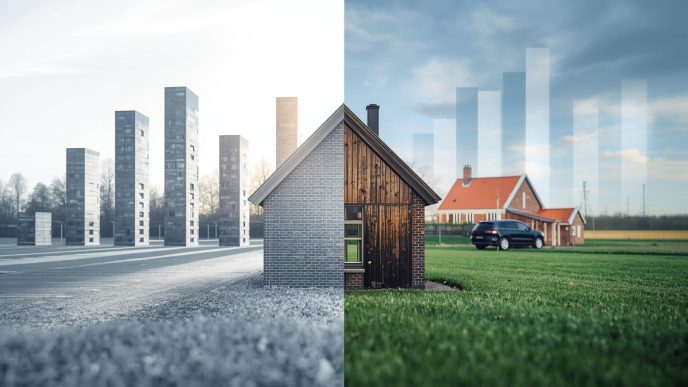
A faster national push will be won or lost in quotes, rosters, VvE meetings and invoice lines.
A small insulation contractor does not meet national policy in The Hague. He meets it at lunch, when a homeowner calls about subsidy and timing. Then a supplier wants a firmer order, and the calendar is already tight until the school holidays.
The signal has to become readable
The Rijksoverheid announcement of 22 June 2026 pushes that scene closer. The cabinet wants more speed in home insulation through the Nationaal Isolatieoffensief and the Energiehuis. The Nationaal Isolatieprogramma target remains 2.5 million insulated homes by 2030. This spring, the cabinet made €300 million available for faster insulation, including €80 million for energy coaches, energy fixers and the Energiehuis.
A faster front door
The business reading is wider than a subsidy headline. The plan is meant to make the customer journey easier through advisers, municipal support, finance links and a more recognisable front door. More households may arrive with help, expectations and urgency. For small firms, that means work. It also means pressure.
The demand will not land evenly. CBS calculated the average household energy bill at €1,993 per year using January 2026 prices and estimated 2026 consumption. That was €52, or 2.5 percent, lower than one year earlier.
Yet the average hides the customer who really calls first. CBS also shows large differences by household and home type. A multi-person household in an old, large detached home mainly heated with gas had an example bill of €3,370 per year. That bill feels concrete enough to trigger action.
The homeowner wants a warmer floor, a lower gas bill, or a roof that stops losing heat. The contractor has to turn that wish into a scope, a price, a date and an invoice that will still make sense later.
Municipalities make this market local. Earlier Rijksoverheid figures show that 340 of 342 municipalities applied in 2024 for the local approach under the insulation programme. Municipalities had proactively approached 1.3 million homeowners and 8,700 VvEs. The third tranche of the local approach made €471 million available for at least 213,000 homeowners and residents in mixed VvEs with poorly insulated homes.
So demand will not arrive as one clean national wave. It will arrive by street, neighbourhood, municipality and housing type.
Margins live in the invoice
Policy support can fill an order book, but it does not protect margin by itself. CBS reported that construction turnover excluding project development was 5.1 percent higher year on year in the first quarter of 2026. Specialised construction companies also saw turnover rise.
What the signal changes
At the same time, producer prices in the wood and building-materials industry rose by 3.7 percent. Construction confidence was weak, and construction recorded 128 bankruptcies in the quarter. That combination deserves respect. A fuller inbox is not the same thing as better business.
Belastingdienst guidance gives the VAT edge. For homes older than two years, labour for applying insulation material to floors, walls and roofs can fall under the 9 percent VAT rate when the purpose is energy efficiency. Materials are taxed at 21 percent. Other work may also sit at 21 percent. Mixed jobs need a clean split.
A small firm that bundles insulation, demolition, roof details, frames and finishing into one loose quote may be creating later correction work. The customer sees one home-improvement job. The ledger sees different VAT lines, materials, labour and proof.
Quote validity, deposit terms, supplier prices, subcontractor agreements and aftercare time are not paperwork hobbies. They decide whether supported demand becomes paid work or expensive movement.
VvE work starts before the first worker
The VvE part of the story deserves special attention. CBS reported that 1.5 million Dutch homes were part of a VvE on 1 January 2023. Mixed VvEs made up 47 percent of VvEs with homes. Behind one building decision can sit owner-occupiers, landlords and different financial interests.
A contractor may think the job is cavity-wall insulation, roof insulation or glass. The VvE may first need an agenda item, a vote, financing clarity, owner communication and a practical plan for disturbance. The slowest part of the job may happen before a worker arrives.
That changes the sale. A VvE does not only need a sharp price. It needs meeting-ready information: scope, options, assumptions, timing, access, nuisance, warranty and exclusions. A good adviser or contractor will treat that preparation as part of the product.
There is also an ecological layer. The Council of State judgment ECLI:NL:RVS:2023:2969 concerned cavity-wall insulation and possible harm to bats. In that case, a limited one-time endoscopic check and a walk around the home were insufficient to exclude bat presence. Rijksoverheid has also published material on eDNA as a method for detecting bat roosts in homes.
What founders should check
The practical message is calm. Speed and nature-proof execution have to be planned together. A rushed check can cost more time than a planned one.
The next property file
The current push is mainly about homes, but business premises sit on the horizon. Rijksoverheid says the Energiehuis is intended over time to serve other groups, including the SME sector and social property. For SMEs, this is a direction to watch, with details still to come through policy.
There is already property pressure around energy performance. Rijksoverheid states that rental homes with labels E, F or G must be improved to at least label D by 1 January 2029. For existing utility buildings such as shops, offices, schools and care institutions, requirements are expected from 2030, with national implementation details still to follow.
For a local shop owner, this is not a reason to panic. It is a reason to know the building. Who owns it? What is the label? Which investments belong to the landlord, and which affect the tenant’s daily costs? If the lease renewal comes before the energy work, the conversation should start early.
Calm work, not easy work
The insulation push is real. Rijksoverheid says ISDE applications rose from 97,000 in 2022 to 212,000 in 2025. Nationaal Warmtefonds loans rose from 15,000 to 31,000 in the same period. SVVE applications also increased, from 558 in 2023 to 673 in 2025.
Yet the strongest firms will not be the ones that say yes fastest. They will separate household, VvE, landlord and small property questions early. They will watch municipal demand in their own service area. They will price preparation time, keep VAT lines understandable and respect labour capacity.
UWV reported 28,500 construction vacancies in the fourth quarter of 2025. Demand remains strong for skilled workers such as electricians, plumbers, insulators and roofers. That is the real ceiling on many good intentions. Policy can accelerate interest. It cannot create an experienced crew by next Tuesday.
Back at the kitchen table, the contractor has the same issue in miniature. The household asks for comfort. The VvE asks for certainty. The municipality asks for pace. The tax invoice asks for precision. The worker asks for a realistic roster.
For small businesses in and around real estate, the lesson is simple but not small. Public money may bring demand closer to the street. Profit will still depend on sequence, proof, people and price. Insulation policy can warm homes. It should not burn the margin of the firms asked to deliver it.
Sources
- CBS source
- Meer vaart in isoleren woningen via Nationaal Isolatieoffensief en Energiehuis | Rijksoverheid.nl
- Rijksoverheid – Available home sustainability subsidy in 2026
- Rijksoverheid – Local insulation approach through municipalities
- Rijksoverheid – Municipal reach and VvE bottleneck
- Rijksoverheid – 2025 VRO annual-account context
- CBS – VvE housing stock and energy-label complexity
- Rijksoverheid – Rental housing and utility-building energy performance
Referenced in the article
Column | Market Pulse
Dutch Shoppers Feel Less Negative, But Margin Evidence Comes First
June’s confidence jump helps the conversation. The basket still has to protect margin.
Column | Ledger & Tax
A DGA’s Gym Bill Needs the Right Payroll Year First
Older arbo disputes and current WKR choices do not live under the same Dutch payroll rule.
Column | Real Estate
Slower Dutch House Prices Still Leave Buyers Short of Room
The May figures look calmer, but cash, tax and square metres still decide the deal.
The Polder is written for readers who need the Dutch business environment translated into practical meaning. Corrections, source policy and editorial accountability are part of the publication record.