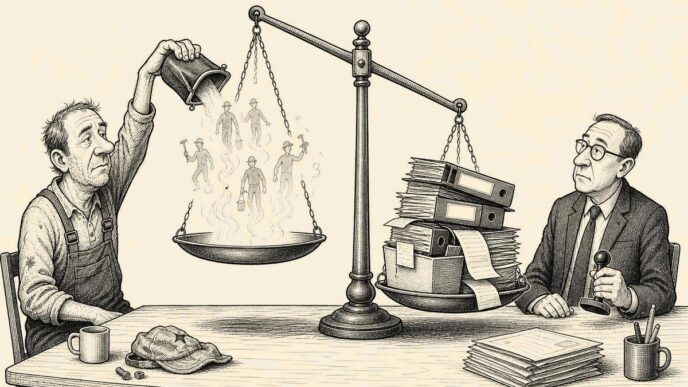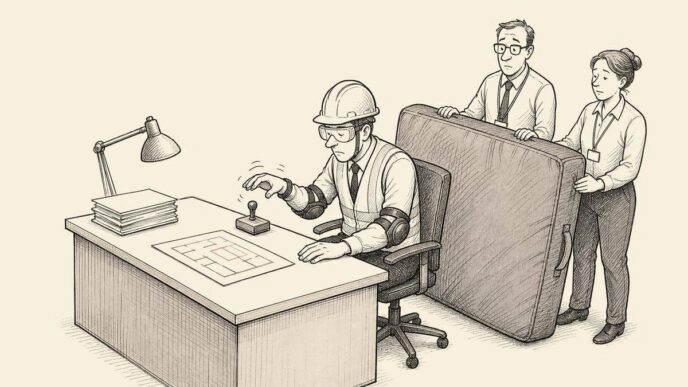
The housing market feels stretched, but a small owner wins a valuation argument with object data, not market mood.
A WOZ notice often lands like a routine household letter. For founders, freelancers, and directors, it deserves a closer reading. It can affect local tax, the income-tax return through the eigenwoningforfait, the accountant’s records, and the private cash base that often keeps a small company steady in difficult months.
The signal has to become readable
The frustration is understandable. CBS reported that the average WOZ value of a Dutch dwelling in 2025 was €398,000, 5.0 percent higher than one year earlier. Valkenswaard stood at €419,000, with a 10.3 percent increase. CBS also reported that Valkenswaard's WOZ value per square metre rose by 41.3 percent between 2021 and 2025. For an owner in the Eindhoven region, those figures are not abstract.
I read this first as a governance problem, not a tax quarrel. A higher assessment may be irritating. A poorly prepared objection is worse. It drains attention, creates loose correspondence, and can still leave the owner with the same value, the same tax base, and a weaker understanding of the property record.
The market is high, but that is not the whole argument
The official market picture is still firm. CBS and Kadaster reported that existing owner-occupied homes were 4.3 percent more expensive in April 2026 than one year earlier. Prices were unchanged from March to April, but still stood 15.8 percent above the previous July 2022 peak. In the first quarter of 2026, existing homes were 5.2 percent more expensive nationally than one year earlier.
The local picture is more measured than the regional story sometimes suggests. In that same first quarter, CBS and Kadaster listed Valkenswaard at 2.9 percent year-on-year price growth, Eindhoven at 4.2 percent, and Veldhoven at 1.9 percent. The Eindhoven region clearly carries housing pressure. Rijksoverheid has recognised that pressure through housing acceleration funding in the Eindhoven Metropolitan Region, involving the state, Noord-Brabant, ASML, and 21 municipalities. That context matters.
It does not settle one WOZ value.
Dutch WOZ law is built around a specific value, on a specific date, for a specific property. Article 17 of the Wet WOZ defines the value concept. Article 18 sets the value date and the condition of the property on that date. Article 22 says the municipal official establishes the value by a formal decision that can be challenged. For homes, the implementing regulation requires systematic comparison with homes for which market data are available.
What the signal changes
That is a dry legal structure with a very practical consequence. If the market feels irrational, the feeling may explain why the assessment hurts. It does not explain why the chosen comparable homes, corrections, surface areas, maintenance ratings, or location factors are wrong.
A kitchen table example
Imagine a self-employed designer in Valkenswaard. She works from home. She has an old kitchen, outdated frames, and a roof that will need work in the next few years. Her WOZ value rises. She knows clients from the Brainport economy have changed the local housing market. She hears stories about overbidding. Her first reaction is that the municipality has gone too far.
That reaction is human. It is not yet evidence.
A useful challenge starts with the valuation report. Which reference homes were used? When were they sold? Are they really comparable in type, floor area, plot size, renovation level, maintenance, and location? Were extensions counted correctly? Is the poor condition visible, dated, and linked to value? Does the expected correction make a meaningful euro difference after local taxes and income-tax effects are considered?
That is the point where annoyance becomes governance. The owner stops arguing with the mood of the market and starts testing the calculation.
The burden is not only on the owner
Dutch WOZ review is not a one-way street in favour of municipalities. In litigation, the municipal official has to make plausible that the value has not been set too high. Published judgments show both sides of that discipline. A municipality can carry the value with a coherent comparison matrix and clear corrections. A municipality can also lose when its evidence does not hold up.
For the owner, the lesson is not resignation. It is precision.
Broad statistics have their place. CBS figures can show that a municipality has seen strong value movement. Kadaster can show that transaction volumes and the mix of homes sold may influence average prices. In the first quarter of 2026, Kadaster reported more than 76,000 home sales, 18 percent more than one year earlier. It also noted that increased sales of small investor-owned homes partly held down the average purchase price. Those facts help explain the environment.
They do not replace the valuation of one house.
Averages flatten differences. Asking prices are not the same as completed transactions. Last year's WOZ value is not a ceiling. A general claim that a region is overheated does not answer whether this corner house, apartment, terrace house, or mixed-use home was valued correctly on the relevant date.
Why founders should care
For a founder, the WOZ value sits in an awkward place between private life and business discipline. The home may be private property, but the cash pressure is real. If the owner works from home, the household buffer and the business buffer often touch each other. Belastingdienst explains that the eigenwoningforfait is a percentage of the WOZ value of the own home used as the taxpayer's main residence, and that the amount is added to income in the tax return. Rijksoverheid also explains that WOZ values are used by municipalities, the tax administration, and water boards.
What founders should check
That does not mean every higher WOZ value deserves a fight. It means the assessment deserves a proper place in the records.
A small owner benefits from knowing the value date, the assessment year, the final value after any objection, and the exact tax items that use the number. The accountant should not work from a vague memory of a municipal letter. The file should contain the decision, the valuation report, any correction decision, relevant photographs, maintenance documents, and the final figure used in the tax return.
There is also a time-cost question. A reduction that saves a modest annual amount may be worth pursuing when the evidence is strong and the mistake is clear. The same reduction may be a poor use of attention when the argument rests mainly on irritation. Founder time has a price. So do professional fees, deadlines, and distraction.
A calmer way to read the next assessment
The best first move is not outrage. It is a slow reading of the object data. Floor area, plot size, outbuildings, construction year, renovations, energy features, maintenance, and location are the bones of the assessment. If those bones are wrong, the objection has a practical route. If they are right, the comparison homes and corrections become the next question.
I would also separate the story from the proof. The story may be that the Eindhoven region is expensive, that buyers have competed hard, and that housing policy now reflects serious pressure. The proof is narrower. It shows whether the municipality's selected market evidence fits this property well enough.
That distinction protects the owner from two mistakes. The first is accepting every municipal value because the market is high. The second is challenging every high value because the market feels unfair. Both are weak forms of governance. The stronger habit is to test the number, price the effort, and keep the evidence in order.
WOZ pressure is real. So is the discipline needed to deal with it. For small business owners, that may be the quiet lesson inside a tax assessment: the question is not whether the market feels reasonable. The question is whether the records can show, calmly and specifically, what this property was worth on the date the law requires.
Sources
- CBS source
- Semantius
- Wettenbank
- Wettenbank
- Rechtspraak, Hoge Raad
- Rechtspraak, Rechtbank Oost-Brabant
- Rechtspraak, Rechtbank Zeeland-West-Brabant
- CBS
Referenced in the article
Column | Market Pulse
Fewer Dutch Bankruptcies, but Payment Pressure Still Needs Attention
April's CBS figures show fewer court failures. Closures, cautious consumers and sector stress still leave.
Column | Real Estate
A Cooler Housing Market Is Still Heavy
The Dutch price index paused in April, but small firms still carry the pressure through wages, credit.
Column | Human Resources
The Labour Reserve Already Has a Badge
Many Dutch part-time workers want more hours. For small employers, the real question is whether.
The Polder is written for readers who need the Dutch business environment translated into practical meaning. Corrections, source policy and editorial accountability are part of the publication record.