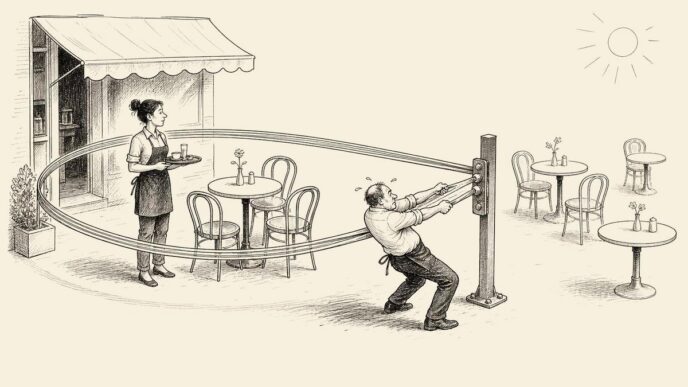
The Wtta turns hiring through another company into a shared labour, tax, and evidence file.
A Monday morning problem rarely arrives as a statute. It arrives as a gap in the roster. Two people are ill, the orders are still there, and the owner calls the agency that has always found someone by tomorrow.
The signal has to become readable
For anyone using Dutch external labour, that familiar call is changing. On 11 November 2025, the Eerste Kamer adopted the Wet toelating terbeschikkingstelling van arbeidskrachten, the Wtta. The law starts on 1 January 2027. Enforcement follows on 1 January 2028.
From that date, a company hiring supplied workers may only use a lender on the official NAU list, unless an exception applies. The quick HR fix becomes a buyer-side responsibility.
Buyer-side control
The first shift is simple, but not small. Registration moves toward admission. The Nederlandse Autoriteit Uitleenmarkt, the NAU, will assess lenders and keep a public register. Lenders must report before 1 January 2027. Assessment starts on 1 July 2027.
For the inlener, the company using the supplied worker, the agency’s status is no longer background noise. Rijksoverheid says fines for operating without admission can also reach companies that use staffing agencies. The Nederlandse Arbeidsinspectie will enforce the Wtta system from 1 January 2028.
This is a change in responsibility, not a ban on flexible labour. Dutch firms will still need outside workers. CBS counted 378,000 open vacancies at the end of the first quarter of 2026. That was 91 vacancies for every 100 unemployed people.
Healthcare, trade, and business services still made up more than half of all vacancies. In a tight labour market, the pressure to hire through intermediaries does not disappear. It just becomes more expensive to get wrong.
The old shortcut gets thinner
Think of a small distribution company with twelve employees and four agency workers in busy weeks. The owner checks the agency once, agrees a rate, approves hours, and pays the invoice. If the same agency always delivers, trust does most of the work.
What the signal changes
Under the Wtta, trust is not enough by itself. The useful question becomes more concrete: which legal entity supplies the worker, is it admitted or exempt, does another supplier sit behind it, and does the work on the floor match the contract?
KVK says the current Waadi information moves to the public Wtta register of the NAU from 1 January 2028. The KVK Waadi check for inleners disappears then. Until that transition, relevant Waadi data still belongs with KVK.
That creates an awkward year. Companies cannot drop the old check too early. They also need to prepare for the new register. Small firms feel this first, because one person often chooses the supplier, sets the shift, approves the timesheet, and releases payment.
What the work really looks like
The legal border is not the invoice label. The Waadi definition turns on making workers available for pay so they work under another party’s supervision and direction, without an employment contract with that other party. The statute also sets out exclusions, including delivered work, help without profit, and some intra-group situations.
That distinction matters on the floor. If the agency worker follows your roster, uses your tools, receives daily instructions from your team leader, and fills the same role as your own staff, the relationship looks like labour supply. If a supplier delivers a defined result under its own supervision, the picture may be different.
The same discipline applies to pay. The Arbeidsinspectie says supplied workers, including agency workers and payroll workers, are entitled to the same working conditions, including wages and other payments, as comparable employees of the inlener in the same or an equivalent role.
That makes the buyer’s own wage data part of the file. Comparable roles, allowances, working hours, and conditions are not just internal HR details. They help determine whether the supplier can pay the worker correctly.
Tax and the chain
The Wtta adds an admission gate. It does not remove Belastingdienst inlenersaansprakelijkheid. An inlener can be held liable if the lender fails to pay payroll taxes and VAT for supplied workers. The risk can also run through a doorlener, where one supplier passes labour through another.
What founders should check
For a small company, this is where HR and bookkeeping meet. A g-rekening, the blocked account used for payroll-tax and VAT amounts, can reduce liability for the amount correctly paid into it when the conditions are met. It is not decoration. It is evidence.
Back in the distribution company, the invoice now asks more questions. Are the hours correct? Is the invoice split right? Does the payment route match the tax risk? Is the supplier identity clear? Can the archive explain why this worker was inside the business?
That sounds dry. It is not. It is how a business keeps flexibility without losing control of the people working inside its operation.
A courtroom warning
There is another reason to look early. Temporary work that repeats for years can stop looking temporary. Rechtbank Den Haag ruled on 17 April 2026, in ECLI:NL:RBDHA:2026:9257, on a temporary agency worker in Albert Heijn distribution centres. The worker had been there for more than seven years and four months and had to be deemed to have an employment contract for an indefinite period with Albert Heijn.
The court found misuse of the agency construction in the facts of that case. One judgment does not decide every workplace. It does show the pressure point. When the same supplied worker fills a structural role for years, the risk is no longer only about agency admission.
CBS also showed that temporary staffing prices were 5.0 percent higher year on year in the fourth quarter of 2025, while full-year turnover in the sector fell by 0.1 percent. Admission work, administration, audits, and contributions cost money. The pressure does not stay inside the supplier’s margin.
What this means on Tuesday morning
The calm preparation is not dramatic. A careful owner will want a clear view of every person working in the business who is not on its own payroll. Agency work, payroll work, detaching, outsourcing, doorlending, and zzp work need to be separated. The route should match the work, the supervision, the payment, and the evidence.
Flexible labour remains useful. It helps a shop survive seasonal pressure, a care provider fill shifts, and a warehouse keep promises to customers. The Wtta does not remove that reality. It raises the standard around it.
The Monday morning call may still happen. The difference is that, by 2028, the strongest answer will not be only yes, send someone. It will be yes, and we know who supplies that person, under which route, with which working conditions, and with which tax risk left on the table.
Sources
- Wtta heeft ook gevolgen voor bedrijven die personeel inhuren · Salaris Vanmorgen
- Rijksoverheid – Wtta core rule and timing for inleners
- Nederlandse Arbeidsinspectie – NAU register and Arbeidsinspectie enforcement
- Rijksoverheid – Wtta cost and contribution rules for lenders
- KVK – Waadi registration transition to Wtta register
- Nederlandse Arbeidsinspectie – Current Waadi registration fines before Wtta enforcement
- Wettenbank – Definition of labour supply and boundary with contracting
- Rijksoverheid – Contracting, uitzenden, and payrolling distinction
Referenced in the article
Column | Ledger & Tax
Low Contractor Rates Put Dutch Payroll Risk on the Table
The proposed €38 presumption is civil law, but the tax pressure is already real.
Column | Human Resources
Heavy Work Needs Proof Before Payroll Promises an Exit
A Dutch employer cannot settle a heavy-work question with sympathy alone.
The Polder is written for readers who need the Dutch business environment translated into practical meaning. Corrections, source policy and editorial accountability are part of the publication record.