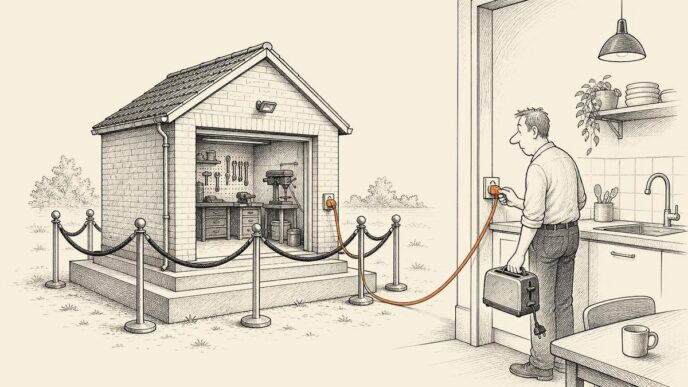




The old surplus story misses the real issue: local timing, senior housing and usable liquidity.
The Dutch housing market is usually described through shortage, prices and construction delays. That is understandable. Those are the pressures buyers, tenants, builders and employers feel first. But there is another clock underneath the market, slower and less visible: the age of the household behind the front door.
Cash pressure comes first
In 2013, PBL warned that older people move far less often than younger people. Its point was simple and still useful. In the short term, ageing can keep homes out of circulation. Over a longer period, as babyboom households leave independent living or die, more homes may return to the market, especially owner-occupied homes.
That old signal has now reached the years in which people are tempted to ask whether the predicted supply is arriving. I think that is the wrong question. In 2026, the Netherlands is not looking at a simple housing surplus story. PBL put the statistical housing shortage at 400,000 homes in 2024. CBS and Kadaster reported that existing owner-occupied homes were 4.3 percent more expensive in April 2026 than one year earlier. Prices were flat from March to April, but that is cooling, not relief.
Ageing is real. The market around it is tight.
The hidden calendar under the front door
CBS reported that at the start of 2025 the Netherlands had 3.76 million people aged 65 or older, more than the 3.72 million people aged 0 to 20. It expects the 65-plus group to rise further in 2030 and 2040, while the 80-plus group is expected to grow from more than 0.9 million in 2025 to 2.1 million in 2070.
For housing, the 80-plus figure matters more than many business owners realise. No one leaves a home because a spreadsheet calls them elderly. Homes return to the market when care needs change, stairs become a daily problem, a partner dies, family decisions are made, or the household can find a credible next place to live.
At the end of 2024, CBS counted 1,210,025 occupied homes with a reference person aged 75 or older. Of those, 715,770 were single-family homes. That is a large part of the ordinary housing stock held by older households, but it is not a promise that those homes will appear for sale on a neat date.
Think of a small contractor in a provincial town. His parents live in a debt-light family home. His own business plan assumes that, when they move, the house will be sold and part of the family capital will support succession or a workshop purchase. But there is no suitable apartment nearby, no care-ready alternative they trust, and no clear family agreement on timing. On paper there is wealth. In the business calendar there is no cash.
Credit still sets the limit
That is the practical lesson. Housing wealth is not liquidity until it has a date, a buyer and a decision structure.
The hinge is not age, it is a credible next home
Rijksoverheid has not treated ageing as a passive supply solution. In May 2026, the cabinet announced € 120 million for new housing forms for older people. The policy ambition is 290,000 extra homes for older people up to and including 2030. The target matters because senior housing is not only a welfare topic. It is a flow-through mechanism.
If older households have suitable alternatives, larger homes can return to the market earlier and more calmly. If those alternatives are missing, people stay where they are, even when the home no longer fits their body, household size or care needs.
CBS now monitors housing types for older people, including zero-step homes, clustered homes and care-suitable clustered homes. Those categories may sound technical, but the business meaning is plain. A home without steps solves only part of the question. A home near services, social contact and care support can make a move realistic.
This is where real estate work needs more precision. Developers cannot assume that any small apartment serves older demand. Brokers cannot read every 75-plus household as a future listing. Contractors should not treat adaptation and conversion as side work. The movement of older households depends on whether the next dwelling is technically accessible, socially usable and acceptable to the family.
Why business owners should care
For many micro and small business owners, housing is not separate from the company. The private home may be retirement capital, informal bank comfort, family wealth, a home office, a future inheritance asset, or the silent fallback in a recovery plan. Premises decisions also depend on the same local housing market that shapes staff availability and customer demand.
That makes ageing a governance issue. I do not read the older PBL signal as a price forecast. I read it as a timing warning. A future sale is not cash today. A region with many older owner-occupiers may have future supply, but only if there are buyers, mortgage capacity and suitable alternatives for sellers.
Credit conditions still matter. DNB reported more than € 890 billion in Dutch household mortgage debt at Dutch financial institutions at the end of 2025. DNB and AFM also warned in 2026 that relaxing lending standards can lift bids, buyer debt and house prices. Extra homes later do not automatically create affordability if buyers cannot finance them responsibly.
What small firms should separate
There is also a fiscal and ledger side. CBS reported that the oldest household group more often benefits from Wet Hillen because own-home debt is lower on average and more homes have already been repaid. For a founder who quietly assumes that family property will fund a business step, this difference matters. Low mortgage debt may mean strong equity, but it may also mean the owner can wait.
What belongs in the local reading
National averages are useful for direction. They are poor tools for deciding on a shop lease, a small development, a staff-housing concern, or a family succession plan.
CBS and Kadaster reported that existing owner-occupied prices rose in almost all municipalities in the first quarter of 2026, but not with the same strength everywhere. Kadaster also reported that investors sold many small homes in that quarter, while the peak of the private-investor sales wave appears to have been reached. That is a different supply source from older-household outflow. Investor sales, estate sales, downsizing and newbuild completions do not behave alike.
Construction adds another layer. CBS reported 23,500 permits for newbuild homes in the first quarter of 2026 and 13,700 completed newbuild homes. Rijksoverheid still aims for 100,000 new homes a year. The distance between permits, completions and the right type of home is where many local assumptions fail.
Since PBL and CBS no longer publish new regional population and household forecasts in the old municipal form, business owners need a more practical local reading. Age structure, transaction speed, municipal plans for senior housing, permits, completions, care access and local buyer depth belong in the same conversation. For renovation, splitting, conversion or care-related housing, municipal rules and environmental-plan checks also belong there before numbers harden into commitments.
A calmer conclusion
The ageing of the Netherlands will shape housing supply. It will affect which homes come loose, which homes remain occupied longer, which neighbourhoods need more services, and which families discover that property wealth and usable cash are not the same thing.
But it will not arrive as one clean national surplus date. The market is still tight. Prices are still higher than a year earlier. Construction is still catching up. Senior housing is still a hinge, not a solved condition.
For the small business owner, the useful move is not to predict a national correction. It is to make property assumptions explicit: what is private, what is business, what is pledged, what depends on family timing, and what depends on local demand. Ageing is a turnover clock, not a discount promise. It asks a quieter question: whether the property story behind the business has dates, alternatives and local evidence, or only hope.
Sources
- PBL
- Planbureau voor de Leefomgeving
- Centraal Bureau voor de Statistiek
- Rijksoverheid
- Centraal Bureau voor de Statistiek
- Centraal Bureau voor de Statistiek
- Centraal Bureau voor de Statistiek
- Centraal Bureau voor de Statistiek
Referenced in the article
Column | Real Estate
Dutch Housing Permits Rise While Small Firms Watch the Clock
A larger housing pipeline helps demand, while small firms live by starts, prices and payment.
Column | Real Estate
Temporary Housing Permits Fell, and Dutch Employers Feel the Strain
A smaller permit flow is now part of the labour problem, not only the housing problem.
Column | Market Pulse
The Dutch Economy Still Moves, but Margins Have Less Patience
CBS points to weak confidence, export drag and cost pressure, not.
The Polder is written for readers who need the Dutch business environment translated into practical meaning. Corrections, source policy and editorial accountability are part of the publication record.