A Court of Appeal ruling shows why transfer rights, registers and tax-year records matter.
Box 3 often looks private until it touches the company. A founder may see the Dutch wealth box as separate from the BV, the shop, the practice or the freelance business. Yet private tax pressure has a habit of returning through liquidity, dividend timing, partner allocation and the cash buffer behind the business. That makes Dutch Box 3 control a records problem, not only a private tax calculation.
Private wealth now needs a record
That is why the judgment of Gerechtshof 's-Hertogenbosch of 29 April 2026 matters beyond one private fund arrangement. The case concerned the 2022 rules for an open fonds voor gemene rekening, or FGR. The court did not treat the name of the agreement as decisive. It looked at rights, records and transfer mechanics.
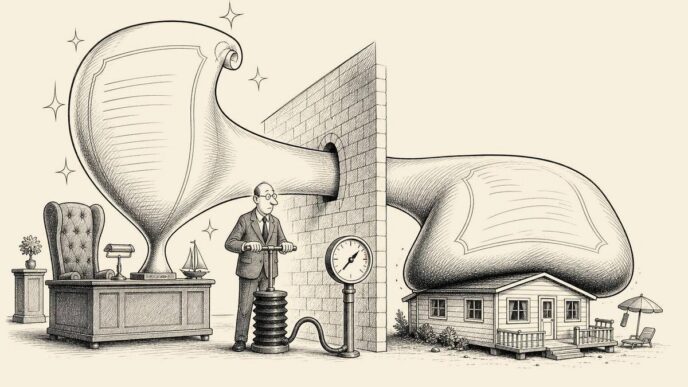
Imagine a founder household that wants to organise private savings through a fund agreement. The document uses fiscal language. It mentions participations. It gives the structure a formal shape. But there is no separate participant register, no negotiable certificate, and a new participant can enter only if everyone agrees to amend the agreement. That is not a market. It is a closed room with a tax label on the door.
The document did not create the tax result
The court case turned on the 2022 wording of Article 2 Wet Vpb 1969. Under that regime, participation rights in an FGR counted as transferable only if transfer did not require consent from all participants. Free tradability was part of the qualification.
In the case before the court, no bearer certificates or comparable negotiable documents had been issued. There was also no participant register. Entry and transfer would effectively require an amendment of the fund agreement. That meant consent from all participants. The court therefore held that the participations were not freely tradable.
The result was plain. No open FGR had been created for 2022. The assets remained part of the Box 3 savings and investment base. The lesson is familiar in practice: tax treatment follows legal qualification, and legal qualification follows the facts.
Timing is part of the tax story
For small business owners, this is not only a tax point. It is a record-keeping point. A founder who keeps a careful business ledger but a loose private wealth record stays exposed where private and business cash decisions meet.
The current rules are narrower
The judgment looks back to 2022, but the current setting has moved. From 1 January 2025, the FGR and VBI regime changed under the Wet aanpassing fonds voor gemene rekening en vrijgestelde beleggingsinstelling. Current Belastingdienst guidance says that only investment funds and UCITS-type funds as referred to in Article 1:1 Wft can qualify as taxable FGRs. The participation rights must also be freely tradable.
That is a different world from a private agreement between closely connected persons. Dutch tax law now leaves less room for private wealth wrappers that rely mainly on wording. A structure needs substance, administration and a tax-year position that all point in the same direction.
The transparent-fund side matters just as much. Belastingdienst guidance says that if an FGR does not meet the conditions, the benefits are attributed to the participants. Belastingdienst Kennisgroepen states that participants in a transparent fund report the underlying assets and debts in Box 3 according to their pro rata entitlement. From 1 January 2025, Article 2.14bis Wet IB 2001 attributes assets, debts, income, expenses and costs of a transparent fund to participants according to entitlement.
So the issue does not disappear when the fund label fails. It moves to the participant. The private record then has to show what the person owns, which debts belong with it, what income arose, what costs were linked, and how values changed during the year.
Timing still carries weight
Some readers will look at the 2022 Box 3 percentages and ask whether this was only a technical dispute. For 2022, the Belastingdienst calculation page states a fixed return of 0.00 percent for bank and savings balances, 5.53 percent for investments and other assets, and 2.28 percent for debts. The Box 3 tax rate was 31 percent.
Even then, classification still matters. It affects the tax base, partner allocation, debt treatment, assessment mechanics and later comparison with actual return. If other assets or debts sit in the same Box 3 position, a weak classification can disturb more than one line in the return.
What founders should separate
The wider Box 3 system also makes timing heavier. In 2024, the Hoge Raad set a framework for actual return. Actual return is assessed over the taxpayer’s whole Box 3 wealth, including bank balances, per calendar year. It includes income such as interest, dividends and rent, and also positive and negative value changes, including unrealised changes.
Belastingdienst states that letters about actual return for 2022 started from July 2025. It also says that around 10 million Opgaaf werkelijk rendement forms may be received, with processing that may run until 2030. A tax year can close on paper while the evidence question stays alive for years.
The planned new Box 3 system remains part of that longer transition. The Wet werkelijk rendement box 3 was adopted by the Tweede Kamer on 12 February 2026 and was still at the Eerste Kamer stage in the official legislative calendar at the latest listed milestone of 24 April 2026. Rijksoverheid describes 2028 as the intended start.
The practical discipline
The practical lesson is not that every founder should avoid every pooled arrangement. That would be too blunt. The lesson is that a private fund position deserves the same discipline as a serious business ledger. The agreement, register, bank accounts, transfer clauses, ownership records and tax return should tell one story.
For 2025 and 2026, the transition arrangement deserves conscious handling as well. Current Belastingdienst guidance says that certain transparent funds may choose not to be treated as an FGR in those years by not registering as an FGR. That is not a side note. It is a tax-year position with consequences for participant-level reporting.
Old templates are the weak spot. A family agreement, a foreign fund concept or a document copied from a previous planning year may still look tidy. But Dutch qualification asks a colder question: can someone else really obtain or transfer the rights without all-participant consent, and do the records show that reality?
The Den Bosch judgment is clean Dutch tax common sense. If a fund is real, the rights must be real. If a fund is transparent, the participant’s record must be real. The name may start the conversation. The evidence carries the year.
Sources
- Taxence
- Rechtspraak
- Wettenbank
- Belastingdienst
- Wettenbank
- Belastingdienst
- Belastingdienst Kennisgroepen
- Belastingdienst
Referenced in the article
Column | Ledger & Tax
The Dutch Innovation Box Rewards Profit After the Risk Is Taken
The regime is close to u20ac3 billion a year. Smaller innovators should read it as a question.
Column | Governance
One Founder, Two Dutch BVs, and the Salary Risk Between Them
A Belastingdienst position on connected bodies shows why ownership, work, and payroll evidence must be read.
The Polder is written for readers who need the Dutch business environment translated into practical meaning. Corrections, source policy and editorial accountability are part of the publication record.