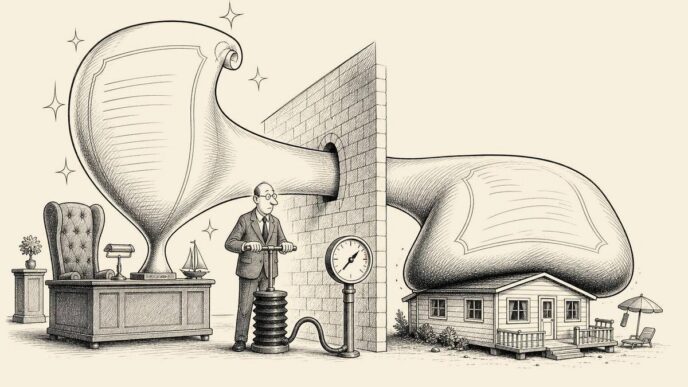
A lower actual return may matter less than the date on the assessment.
Picture a small BV owner at the kitchen table after dinner. The laptop is open, the income tax portal is on screen, and the private investment account sits next to the company bank account in another tab. The question sounds simple: will Box 3 recovery bring money back? That makes Dutch Box 3 control a records problem, not only a private tax calculation.
Private wealth now needs a record
I have heard that question in many forms. Sometimes it comes from a founder who kept private savings as a buffer for the company. Sometimes from a ZZP worker who moved money between business risk and household safety. Sometimes from a director-shareholder who hoped a refund would make a dividend decision easier.
The uncomfortable answer is plain: Box 3 recovery starts with dates.
On 8 May 2026, Advocate General Pauwels advised the Hoge Raad in a Box 3 massaal bezwaar plus test case. The case concerned IB/PVV assessments for 2017 to 2020, and the question was whether a taxpayer who had not objected on time should still receive recovery through ambtshalve vermindering by relying on the Kerstarrest. It is not a final judgment of the Hoge Raad, but it is a serious signal.
The calendar comes first
The Kerstarrest of 24 December 2021 changed the Box 3 debate. The Hoge Raad held that the 2017 system could breach human rights when tax was charged on a deemed return higher than the actual return. For many taxpayers, that judgment became the moral centre of the issue.
Tax recovery, though, moves through procedure. Article 9.6 of the Wet inkomstenbelasting 2001 gives the route for ambtshalve reduction of an assessment. Article 45aa of the Uitvoeringsregeling inkomstenbelasting 2001 sets exceptions. One of those exceptions can block reduction when the incorrectness follows from case law that arrived only after the assessment had become irrevocable, unless the Minister of Finance has provided otherwise.
In business terms, that is direct. If the assessment was allowed to close, a later court judgment may not reopen that year. The six-week objection window can matter more than the size of the possible refund.
Why founders should care
Box 3 is private income tax. It is not company profit tax. Still, for small business owners, the private balance sheet is rarely far from the company.
Timing is part of the tax story
Take a designer with a small BV, private savings, a securities account and a second apartment rented part of the year. A possible Box 3 reduction may feel like future working capital, even if it arrives through the household. It may affect whether she delays a dividend, repays a private loan, or keeps extra cash aside for a quiet summer.
That is where the practical risk begins. A possible refund is not cash in hand. Belastingdienst says it may receive about 10 million Opgaaf Werkelijk Rendement forms. The first messages are expected during 2026, and some taxpayers may wait until 2030. Forms for several years are handled one by one.
Our designer at the kitchen table should not treat that possible recovery like a customer invoice due next month. It belongs in a different box: possible, dated, documented and slow.
Two gates, not one
The current Box 3 discussion has two gates.
The first gate is procedural. Was there a timely objection? Was the assessment still open? Was there a timely request for ambtshalve reduction where that mattered? Does the taxpayer fall within the massaal bezwaar plus route for non-objectors for 2017 to 2020?
Belastingdienst describes that collective route as one procedure for people who made no objection or objected too late and therefore did not receive Box 3 recovery for 2017 to 2020. If the Hoge Raad rules that non-objectors qualify, the result applies to the listed groups. Until then, the route remains conditional.
The second gate is evidence. In 2024, the Hoge Raad held that recovery can still be needed where the statutory rules tax more than the actual return. Actual return is assessed over the whole Box 3 position for the year. It includes income and value changes, including unrealised gains and losses.
What founders should separate
Since the Wet tegenbewijsregeling box 3 entered into force on 19 July 2025, proof has become the working language of recovery. For 2021 and later years, Belastingdienst says no objection is required for the actual-return route. A separate form applies for each year.
The private ledger has changed
Many founders keep company records with discipline and private wealth records with memory. Bank statements are somewhere. Investment reports sit in a portal. Property values are reconstructed later. Debt interest appears when the adviser asks for it.
That habit no longer fits Box 3.
Belastingdienst explains actual return as real income from wealth plus value changes in one calendar year, assessed over the total Box 3 position. Costs generally do not come off. Interest on Box 3 debts can. From 2026, an amount for own use of a second home or other real estate also enters the calculation.
This is not a reason for panic. It is a reason for order. A private wealth file now needs year-by-year clarity: savings, investments, property, debts, income, interest, values and changes. The Opgaaf Werkelijk Rendement also passes through a selection module. Some cases are processed directly, others go to manual review. A readable file travels better.
Back at the kitchen table
I read the Advocate General’s conclusion as a reminder that Box 3 recovery is now a sequence, not a slogan.
First comes the assessment date. Then the objection position. Then any ambtshalve request. Then massaal bezwaar plus, if that is the route. Only after that comes the actual-return calculation and the evidence behind it.
For the small business owner, the practical question is not only whether the old Box 3 charge was too high. It is also whether the year is still reachable, whether the proof is complete, and whether the timing can be carried without leaning on money that has not arrived.
At the kitchen table, that changes the conversation. The founder should not begin with the refund figure. The better starting point is the calendar, followed by the evidence. Calendar discipline is not glamorous. In Dutch tax life, it is often the cheapest protection.
Sources
Referenced in the article
Column | Ledger & Tax
Box 3 Refund Hopes Need Dates Before Optimism
The latest court signal turns a familiar tax grievance into private liquidity.
Column | Governance
Dutch Tax Refunds Put Identity, Evidence and Cash in One Chain
A refund is not only tax arithmetic when access, data, evidence and payment meet at the same.
The Polder is written for readers who need the Dutch business environment translated into practical meaning. Corrections, source policy and editorial accountability are part of the publication record.