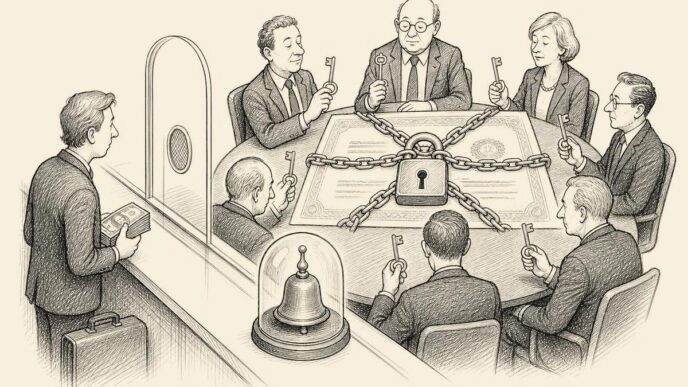
The latest court signal turns a familiar tax grievance into private liquidity discipline.
If you run a small Dutch business, Box 3 can look like a private matter until the moment you count a possible refund as part of your safety margin. The tax sits in the personal income tax return, but the money often sits much closer to the business than the law suggests. It may be the owner’s reserve, the DGA’s dividend plan, the ZZP worker’s buffer, or the expat entrepreneur’s Dutch cash cushion.
Private wealth now needs a record
That is why the 8 May 2026 conclusion of Advocate General M.R.T. Pauwels matters beyond tax litigation. The conclusion concerns non-objectors who seek ambtshalve vermindering of IB/PVV assessments for 2017 to 2020 after the 24 December 2021 Box 3 Christmas judgment. In plain English, people who did not object in time want old final assessments reduced because later case law showed the Box 3 system was wrong in important respects.
The Advocate General advises that the cassation grounds fail and that rejection of those requests is lawful. Government public information still treats the issue as pending because the Supreme Court must still rule on compensation for non-objectors.
I would read that as a warning against treating a grievance as a receivable.
The uncomfortable difference
A tax charge can feel wrong and still be hard to reopen. That is the uncomfortable core of this dispute.
For income tax, ambtshalve vermindering runs through article 9.6 of the Wet IB 2001 and article 45aa of the Uitvoeringsregeling inkomstenbelasting 2001. Article 45aa contains the new-jurisprudence exception. If the incorrectness of an assessment follows from case law issued only after the assessment became final, the assessment is not reduced through that route unless the Minister of Finance decides otherwise.
Many taxpayers feel the system speaking a different language from ordinary fairness. The public debate asks whether people paid too much. The procedural route asks whether the assessment is still reachable. Those are not the same question.
Picture a ZZP consultant with private savings and an investment account. Her 2018 and 2019 assessments were final before the Christmas judgment. She did not object because, at the time, a successful objection looked remote. Years later, she hears about Box 3 recovery and starts to count a possible refund against a new laptop, a VAT reserve, or a few quieter months between contracts.
The emotional logic is understandable. The control logic is weaker. Until the route, amount, and timing are clear, the refund is not cash. It is a pending tax position, or perhaps no recoverable position at all.
The private balance sheet enters the room
For founders, private tax is rarely only private in economic terms. Many small Dutch companies lean on the owner’s personal liquidity. Savings cover a slow quarter. A dividend decision depends on household tax. A shareholder loan or current-account balance may move because private cash feels temporarily available. Box 3 can therefore affect business behaviour without ever appearing in the company ledger.
Timing is part of the tax story
That is why the distinction between closed, pending, and confirmed matters. A closed year may carry frustration, but it should not support business planning. A pending year may deserve attention, but it is not working capital. A confirmed reduction or refund can enter cash planning, although even then timing deserves care.
Massaal bezwaar plus was created to handle the non-objector question for 2017 to 2020 in a collective way. Belastingdienst says that if the Hoge Raad rules in favour of non-objectors, the outcome will apply to everyone in the relevant groups. That is a calming point. It also means the practical work for a business owner is not to panic, but to know exactly which years sit where.
A founder who cannot quickly see assessment dates, finality dates, objections, requests for ambtshalve vermindering, Belastingdienst letters, and submitted forms does not yet have a usable tax record. They have a memory of a tax problem. Memory is not enough for Box 3 anymore.
Actual return is not a magic back door
The actual-return route has added a second layer of confusion. It is important, but it is not a universal key for every old final assessment.
Belastingdienst guidance says that for 2017 to 2020, non-objectors may not always use the Opgaaf werkelijk rendement form. Access depends on the assessment date, whether the assessment was already final, and whether a timely request was made. For 2021 and later, the guidance is different: taxpayers do not need to have objected and will receive a letter if they may report actual return.
Actual return also asks for more discipline than many private asset holders are used to. Belastingdienst explains it as real income from assets plus changes in value during the calendar year. The calculation looks at the total Box 3 asset and debt position, not only at the asset that feels unfairly taxed. A negative total actual return for a year is set at zero and cannot be offset against another year.
Costs are generally not deductible, with limited exceptions such as interest on Box 3 debts and certain real-estate investments. From 2026, Belastingdienst also refers to a private-use addition for a second home or other real estate used personally or partly personally.
That changes the nature of the private record. Bank statements, broker statements, property values, rental income, debt interest, and correspondence all become part of the same annual story. For expat entrepreneurs, the pressure can be higher because assets and documents may sit in more than one country while the Dutch return still needs one coherent position.
What founders should separate
There is also a timing reality. Belastingdienst says it may receive around 10 million Opgaaf werkelijk rendement forms. The first messages go out during 2026, and some taxpayers may not receive a response until 2030. The Belastingdienst 2026 annual plan also shows the scale of the operation, with around 360,000 citizens forecast to qualify for a refund for one or more years under the counterproof regulation and up to 975 full-time equivalents needed in 2026 for Box 3 counterproof work.
A valid route can still be slow. For a small business owner, slow money is not the same as available money.
A calmer way to read the refund
The wider direction is clear. The Netherlands is moving from a forfaitary Box 3 system toward more actual-return evidence. Rijksoverheid records the intended start date for the new actual-return system as 1 January 2028, and the Tweede Kamer adopted the Wet werkelijk rendement box 3 proposal on 12 February 2026. The political and technical path may still be demanding, but the administrative message is already visible: private wealth taxation is becoming more evidence-heavy.
I would therefore treat Box 3 as a private ledger discipline, not as a yearly afterthought. That does not mean turning every founder into a tax lawyer. It means keeping a simple timeline for 2017 onward, separating the non-objector litigation question from the actual-return evidence route, and asking for a year-by-year classification rather than a general opinion that Box 3 may lead to money back.
The useful question is not only whether the old tax felt unfair. The useful question is whether the record shows the route, the year, the evidence, the amount, and the likely timing. If those five elements are unclear, the position should not carry a business cash decision.
This is especially true for DGA owner-managers. Box 3 may sit outside the BV, but private recovery expectations can influence dividend timing, shareholder funding, current-account choices, and household liquidity. A possible refund should not quietly finance operating losses, delayed supplier payments, or a planned distribution before it has survived the legal and administrative route.
The calm position is neither outrage nor optimism. The Advocate General’s conclusion points toward formal finality for many 2017 to 2020 non-objectors, while the Hoge Raad still has to give the final answer. The actual-return route may matter greatly for taxpayers within scope, but it demands evidence and patience.
Dates come before optimism. Evidence comes before cash. In Box 3, that is no longer just good administration. It is the difference between a private tax hope and a business decision you can safely live with.
Sources
Referenced in the article
Column | Ledger & Tax
Box 3 Is Now a Private Control File for Founders
Dutch private wealth taxation is moving from simple percentages to proof, timing and liquidity.
Column | Ledger & Tax
Dutch Tax Execution Puts Proof, Timing and Trust Under Pressure
A short Parliamentary letter points to a larger discipline for small.
The Polder is written for readers who need the Dutch business environment translated into practical meaning. Corrections, source policy and editorial accountability are part of the publication record.