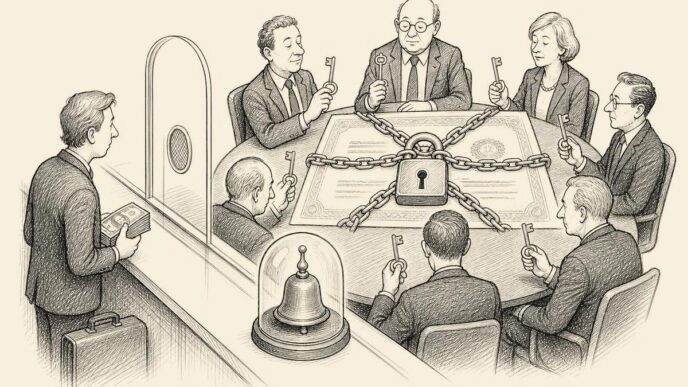
The law has not changed, but the weak spot sits where pension rights, premium debt and VAT meet.
For most small employers, a pension premium never feels like a VAT question. It arrives through payroll, a sector fund, an adviser’s calculation or a monthly payment run. It sits in the wage-cost chain, close to social security contributions and far from the VAT return.
That comfortable distance is exactly why the recent pension-fund VAT dispute deserves attention.
The economic route comes first
On 15 May 2026, Advocate General Ettema issued conclusions in two pension-fund cases before the Hoge Raad. The technical question concerns VAT deduction by pension funds on costs such as accountants, actuaries and pension administration software. The business question is broader. If pension execution is not covered by the VAT insurance exemption, the Advocate General considers the whole pension premium to be the taxable amount, not only a separate surcharge for execution costs.
That is the line that should make an owner-manager sit up, without panic. The opinion is not a final judgment. It does not change premium invoices by itself. For now, the administrative position stated by the State Secretary of Finance on 12 November 2025 remains the practical anchor. The Belastingdienst continues to treat pension execution as one exempt service in line with the Amsterdam court approach until the Hoge Raad rules. Pension funds that follow that position do not have to calculate VAT on pension premiums during that waiting period.
Still, a tax position can be stable today and fragile tomorrow. I read this as a ledger and governance signal, not as a reason for rushed correction.
Where the VAT question sits
The legal tension is neat, but its consequences are not abstract. Article 11(1)(k) of the Dutch VAT Act contains the insurance exemption. Insurance logic expects a relationship between cover and a premium. Dutch pension law is built differently. The employer has the premium obligation towards the pension administrator, but an employee’s pension rights may not generally be made dependent on whether the employer has actually paid.
That separation protects the worker. It is also awkward for VAT. If the law says, in effect, that pension build-up is not simply a no-payment, no-right transaction, then the question becomes whether the insurance exemption fits the pension-fund service cleanly enough.
The Advocate General’s proposed route is to ask the Court of Justice of the European Union for guidance. That is not procedural decoration. It shows that the Dutch legal chain is dealing with a real fault line between pension protection and VAT classification.
Legal form is not the whole story
For pension funds, the immediate dispute is about input VAT. Belastingdienst guidance is clear on its basic rule: VAT on costs is deductible when the goods or services are used for taxable turnover, not when they are used for exempt turnover. If pension execution is exempt, supplier VAT on relevant costs can become a cost inside the fund. If pension execution is taxable, input VAT recovery may look better, but output VAT becomes the larger issue.
That is the trade-off. The tempting door to deduction may open into a room where the full premium is under discussion.
The small employer’s version of the problem
Picture a small installation company with eight employees. The company participates in a sector pension fund. The owner sees a premium notice, the payroll office processes the employer contribution, and the accountant books the cost each month. Nobody in the business thinks of the pension premium as a VAT-sensitive item. It sits in the same mental drawer as wages.
That is normal. It is also incomplete.
The company may not control the fund’s litigation strategy, but it does control its own pension record. Which pension arrangement applies? Is participation mandatory for the activity actually carried out? How are premiums booked? Are payment arrears visible and reconciled? Is any execution-cost surcharge shown separately, and if so, does the accounting treat that line as explanation rather than a magic separation?
A separate line on an invoice does not decide the VAT nature of the service. The Amsterdam court treated pension execution by an undertakings pension fund as one inseparable economic service. The Arnhem-Leeuwarden court later reached a different outcome for employee-participants, but it also treated the full premium as the consideration for the taxable service. The Advocate General’s conclusions keep that harder possibility alive.
This is why the topic belongs in the employer’s cost conversation. Not because every small business must become a pension VAT specialist, but because pension premiums are part of the cost base, the cash forecast and the evidence trail.
Cost pressure is already present
The timing matters. CBS reported that negotiated wages in the first quarter of 2026 were 4.5 percent higher than one year earlier. Contractual labour costs, which include employer contributions such as pensions and social insurance, rose by 4.4 percent.
That does not measure the VAT exposure in these pension cases. It does show the environment in which the question lands. Small employers are already adjusting prices, rosters, hiring plans and cash buffers around higher labour costs. A conditional VAT issue around pension premiums does not need to be immediate to be relevant. It only needs to be credible enough to deserve a place in planning conversations.
Follow one revenue stream
The pension transition adds another layer. DNB reported that by 31 March 2026, 30 pension funds had converted to the new pension system. Funds have until 1 January 2028 to transfer accrued pension entitlements. At the same time, pension providers changing schemes under the Wet toekomst pensioenen work with communication-plan requirements supervised by the AFM.
When contracts, systems, participant communication and calculations are already being rebuilt, weak tax wording becomes more expensive. A VAT position that is understandable inside a tax memo but inconsistent with premium communication or ledger treatment will not age well.
The invoice route still matters
One detail in the Advocate General’s reasoning is especially practical. The comparison with PPG Holdings does not automatically help where the disputed costs are invoiced to the pension fund rather than to the employer. In plain language, it matters who receives the service, who bears the legal cost and what the economic relationship actually is.
That is a useful reminder for small companies too. VAT is not only a rate on an invoice. It is a relationship between supply, consideration, use, deduction and evidence. The ledger should be able to explain that relationship without relying on a label added later.
For an employer, the cleanest practical work is modest. Pension premiums can be reviewed next to payroll, employer social contributions and monthly liquidity. Premium liabilities can be reconciled against payments. Fund correspondence about scheme changes and premiums can be kept with the payroll and pension records, not lost in an inbox. If a business has unusual participation, director-participant status or sector-scope questions, the pension arrangement deserves more than a passing glance at year-end.
That is not dramatic work. It is disciplined work.
A calm reading of the signal
The best reading of the Advocate General’s conclusions is neither alarm nor indifference. The law has not changed. The Belastingdienst position still prevents immediate disorder. The Hoge Raad has the next move, and a European question may follow.
But the dispute has already done something useful. It has shown where the pension premium is vulnerable as a business record. The weak spot is not only in the VAT return of a pension fund. It sits where the employer’s premium obligation, the worker’s protected pension right, the fund’s supplier invoices, the taxable base and the company’s payroll ledger meet.
Small businesses do not need to predict the final ruling to improve their position. They need to know what their own records would say if the pension fund’s treatment changed, if a premium notice looked different, or if an adviser asked why a cost had been booked in a particular way.
In Dutch business life, many serious tax problems start as ordinary administrative habits. A pension premium that is treated as background for too long can become one of them. The wiser approach is quiet attention: know the arrangement, understand the cost chain, keep the records coherent and leave room in the budget for employer costs that do not always move on your preferred calendar.
Sources
Referenced in the article
Column | Ledger & Tax
VAT Recovery Under Pressure Needs More Than a Clean Invoice
A Gelderland transport case shows why cash, creditor pressure and VAT evidence must stay in the same.
Column | Ledger & Tax
Dutch Tax Plan 2026 Turns Into a Ledger Test
Dutch Tax Plan 2026 now asks whether payroll, prices, leases and records can absorb the rules.
Column | Ledger & Tax
A Faster BPM Portal Still Needs the Right Hands on It
Dutch vehicle tax is moving online, but registration still depends on identity, mandate and payment.
The Polder is written for readers who need the Dutch business environment translated into practical meaning. Corrections, source policy and editorial accountability are part of the publication record.