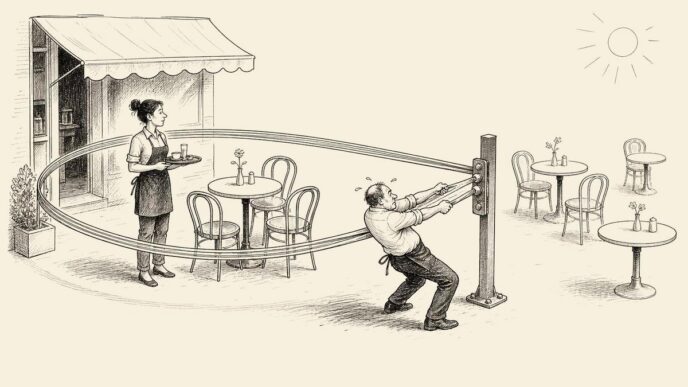
CBS shows wage growth cooling from 2024 highs. The test is hours, prices, and payroll discipline.
A small employer often feels wage pressure before it appears in a chart. It arrives on Monday when the roster is full on paper but thin in the workshop. Someone is ill. A customer wants the old price. An employee asks whether travel costs will finally be lifted. Sometimes it arrives later, through Dutch holiday allowance on variable pay that was treated too casually in the payroll.
The signal has to become readable
The official frame belongs on the payroll desk. In May 2026, collectively negotiated hourly wages, including special remuneration, were 4.2 percent higher than a year earlier, according to CBS. Contractual wage costs per hour rose by the same 4.2 percent.
New agreements may read softer than the spike of 2024. Yet the company still carries the wage base already inside the business.
The wage number is not alone
Cooling is real. It is not a return to cheap labour. CBS put cao wage growth at 4.5 percent in the first quarter of 2026, down from the 6.8 percent peak in the third quarter of 2024. In May the provisional figure stood at 4.2 percent.
For private companies the May increase was 4.4 percent. Government was at 3.4 percent. Broad figures land in narrow places: one hourly rate, one route plan, one replacement shift, one contract renewal.
Inflation keeps both sides alert. CBS reported consumer inflation of 3.5 percent in May, up from 2.8 percent in April. A worker sees rent, food, energy, transport, and childcare. An employer sees wages, materials, rent, software, sick pay, and clients who resist the next invoice increase.
What the signal changes
So this is the phase where a temporary shock turns into an operating habit. It asks for practical discipline, not drama.
Payroll is a cash decision
DNB’s 12 June forecast expects Dutch growth of 0.8 percent for 2026 and inflation of 2.7 percent. Households are cautious and business investment is restrained. That is not a backdrop where every labour cost increase flows neatly into prices.
Take a maintenance firm with eight employees. Its largest client signed a fixed annual price in January. Two workers move up the wage scale in July. A van allowance is under review. The planner covers sickness by sliding jobs between days.
In the accounts the wage rise is a percentage. In the week it becomes late work, overtime, delayed invoices, and a founder doing extra hours after dinner. The real question is cost per delivered hour, not cost per paid hour.
Paid absence, travel time, preparation, supervision, waiting for parts, and rework all sit inside the same margin. CBS put sickness absence at 5.8 percent in the first quarter, above the long-term average since 1996. For a team of seven or twelve, one absence can reshape the week.
The labour market still has teeth
The market has cooled, not loosened. At the end of the first quarter there were 378 thousand open vacancies and 91 vacancies for every 100 unemployed people, CBS reports.
That shapes pay talks away from the table as well. Pressure rises when a good employee can leave, a vacancy stays open, or a replacement will cost more and need months to learn the work.
Sixty-four percent of companies reported staff shortages. Among small employers with 5 to 50 workers, 20.1 percent used more automation, and the same share limited production or supply. In practice, some firms cannot hire enough, cannot automate fast enough, and cannot keep every job at the old price.
Cao coverage is a control question
The Dutch cao should not scare foreign founders. It should make them careful. A cao can apply through the employer’s own agreement, membership of an employer organisation with a binding cao, a generally binding sector declaration, or incorporation in the employment contract, as Rijksoverheid explains. Cao terms prevail over less favourable individual terms.
What founders should check
A recent judgment shows why scope and statutory rights both matter. In ECLI:NL:GHARL:2026:3092 the Arnhem-Leeuwarden Court of Appeal held that the Metaal & Techniek technical installation cao did not apply to Energiewonen. The reason was practical: the undertaking mainly sold and advised on solar panels, while installation work was done by a sister company.
Even so, the employer had to pay €18,408.82 in back holiday allowance over variable pay, plus statutory interest and a statutory increase reduced to 15 percent. The case is a clean reminder of the Dutch holiday allowance and variable pay issue: being outside a cao may remove one exposure. It does not remove statutory wage risk.
Small decisions now carry weight
From 1 July 2026 the statutory gross minimum hourly wage for workers aged 21 and older is €14.99. Since 2024 the Netherlands has used a statutory minimum per hour rather than fixed monthly, weekly, or daily minima. For part-time and variable-hour rosters, the hourly check is not a formality.
The travel allowance also moves. Belastingdienst has raised the untaxed kilometre allowance from €0.23 to €0.25, with retroactive effect from 1 January 2026. This follows an approved policy decision ahead of the 2027 Tax Plan. That creates room for tax-free reimbursement if processed correctly. Whether to pay the higher amount depends on the contract, the cao, or company policy.
Back at the workshop, the owner does not need drama. He needs to know which employees sit under which wage rules, which contracts can absorb a price rise, which jobs waste hours, and which absence risks need a plan. He also needs to explain the wage picture to staff without pretending that customers always pay more on command.
The calm answer is not to hope wage growth disappears. It may cool further, or it may not. The stronger answer is to keep payroll accurate, price labour honestly, protect useful training, and measure delivered hours with the same seriousness as paid hours.
Dutch wage pressure no longer looks like a sudden wave. For small employers, that may be the harder stage. A wave passes. A higher waterline changes where you can safely stand.
Sources
- CBS labour market data
- Cao-loonafspraken in mei 2026 ruim boven 3 procent · Salaris Vanmorgen
- CBS – Quarterly cao wage trend and sector spread
- CBS – Consumer inflation and wage comparison
- DNB – Macroeconomic outlook after newer DNB forecast
- CBS – Labour market tightness and vacancies
- CBS – Monthly unemployment and WW context
- CBS – Productivity response to staff shortages
Referenced in the article
Column | Editorial
The Dutch Proof Habit Has a Price
Dutch compromise is pushing more unresolved choices into the files of small firms before the rules feel settled.
The Polder is written for readers who need the Dutch business environment translated into practical meaning. Corrections, source policy and editorial accountability are part of the publication record.