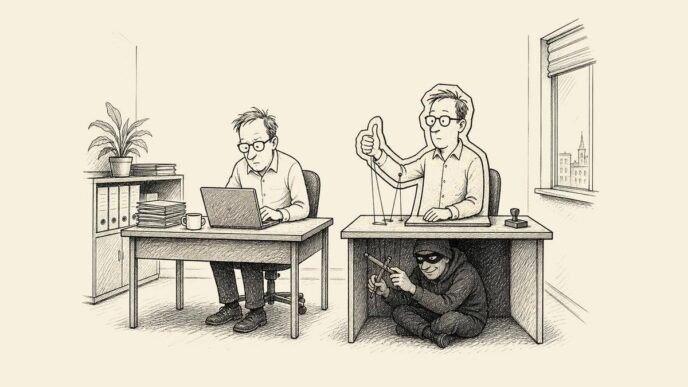
Dutch compromise is pushing more unresolved choices into the files of small firms before the rules feel settled.
On Friday afternoon, a Dutch employer can have the work under control and still feel that the real test has moved somewhere else. The roster is filled, customers have paid, the freelancer has delivered, the sick employee has a reintegration path and payroll has closed the month. Yet the question has changed. Can the company still explain, later, why it treated this person as self-employed, this pay element as separate, this licence as safe, this tax assumption as reasonable?
The signal has to become readable
That is the Dutch proof habit. We do not only make rules. We build files around them. Often that is wise. A country with dense labour law, public trust, tax pressure and local licensing cannot run on smiles and labels alone. But a file is not neutral. It moves weight from the rule-maker to the business desk, and the smallest desk feels that weight first.
The question behind the file
We Dutch like compromise because it keeps the room intact. We consult, soften, phase in and correct. I value that. It is one reason the Netherlands usually avoids the blunt swings that damage both workers and employers. But compromise has a shadow side when it leaves the practical standard unfinished. If the answer is postponed, who carries the uncertainty in the meantime?
The zzp debate makes the question sharp. The old comfort of the invoice has gone. The government has removed the clarification part of the VBAR bill, while the lower-paid legal presumption remains on the legislative track and Belastingdienst enforcement against false self-employment is already part of business reality. That does not give a small firm one clean operational rule. It gives the firm a file about authority, embedding, independence, risk and the way work actually happens.
I do not mourn the old theatre. Work should be named honestly. A contract label should not turn an employee into an entrepreneur by magic. Still, honesty needs usable language. If a planner, care provider, designer, installer or restaurant owner cannot see clearly where independence ends and employment begins, the discussion does not disappear. It enters the planning sheet, the email trail, the assignment wording and the Monday morning decision to hire or not hire.
When honesty needs instructions
The same tension appears behind a bar, although the setting is different. A hospitality licence may hang on the wall, but in files touched by Wet Bibob it also lives in the till, the cash trail, stock records, financing history and the owner’s explanation when the municipality asks questions. That caution has a reason. Horeca can attract hidden control, informal loans and cash pressure. A municipality should not treat a licence as a decorative paper.
Yet here too the Dutch question is not whether proof matters. Of course it matters. The question is whether the standard becomes clear before suspicion takes over. A sloppy cash book can be a sign of weak administration, not criminal influence. A family café can have urgent loans, mixed help and old habits without being a front. If public trust is measured through the ledger, the owner needs to know that the ledger is part of the licence before the file is already in trouble.
What the signal changes
Payroll adds a quieter version of the same problem. A court ruling on holiday allowance and variable wage elements has reminded employers that commission, turnover-linked pay and overtime cannot be treated as harmless extras when statutory holiday allowance is calculated. For workers, that precision protects real wages. For employers, it means every pay promise may later become evidence of what the wage really was.
In a large company, that is a process issue. In a small company, the person making the promise may also be checking the bank, answering customers and covering a sick colleague. If the wage trail is only understood when holiday allowance is due, the rule has arrived too late in business life. We should be honest about that cost. It is paid in corrections, distrust and a reluctance to use variable rewards even where they might fit the work.
When the state asks for patience
The imbalance becomes sharper when the state itself is late. The proposed temporary pause on administrative penalty payments for late WIA assessments and reassessments may have a practical logic. UWV backlogs will not be solved by moving penalty money from one public pocket to another. But the delay does not become weightless because the penalty is switched off.
The employer still has a person at the table, a salary history, a reintegration file and a team that needs planning. The employee still waits for income certainty. The next decision may depend on a public assessment that does not arrive on time. When private parties miss deadlines, the Dutch system asks for records, explanations and consequences. When public capacity fails, employers and workers are asked to absorb uncertainty with maturity.
I understand the administrative reality. Systems with doctors, legal tests and long-term sickness files cannot be repaired overnight. But if delay becomes normal enough to need legal accommodation, we should ask a Dutch question with Dutch seriousness: where does that delay go? It goes into cash planning, payroll expectation, work relations and the quiet patience of people who did not create the backlog.
The future enters early
Tax shows the same rhythm from another side. The Tax Plan 2027 is not final law, but signals around 2027 already touch 2026 choices. A two-cent travel allowance sounds small until it enters commuting budgets, wage talks and cost assumptions. The future rule begins to shape present behaviour before the final text has settled.
That is not always wrong. Businesses need time to prepare, and government should not govern by surprise. The Dutch system often works because signals come early. The difficulty is that early signals can crowd the present with provisional decisions. A founder may not need final law to feel the pressure of dates, assumptions, invoices, staff promises and cash timing.
What founders should check
This is where the Friday employer returns. She does not experience zzp status, Bibob questions, holiday allowance, WIA delay and future tax changes as separate policy worlds. She experiences them as one business week. The state sees domains. The company sees people, money, records and the risk of having to explain everything later.
What are we accepting?
The question is not whether the Netherlands should become less careful. I do not want a cruder country. False self-employment should not be hidden behind invoices. Public licences should not be naive. Variable pay should not weaken wage protection. Public money and tax rules need proof. The better question is what we are accepting when carefulness becomes late clarity.
Are we postponing political disagreement and asking small firms to hold it as documentation risk? Are we postponing enforcement pain and letting businesses learn the standard only when a file is tested? Are we postponing investment in public capacity and turning delay into private planning? These are not dramatic questions, which is exactly why they matter. Dutch pressure often arrives as a small line in a spreadsheet.
A file can protect fairness. It can also hide the fact that nobody has made the practical choice clear enough. That is the point I would not like us to miss. The company file is no longer a back-office habit. It is where unresolved Dutch choices become visible.
If that produces cleaner business, good. If it mainly produces better documented fatigue, we will have mistaken proof for direction. The Dutch compromise of this moment may be that we keep the conversation open while closing the burden around the ledger. For small firms, the result is not panic. It is a colder awareness: the rule may still be moving, but the evidence is already expected.
Sources
- For Zzp Work, the Invoice Is No Longer the Story
- A Horeca Licence Lives in the Till, Not on the Wall
- For ANBI Boards, Goodwill Needs a Cleaner Paper Trail
- A Founder's Income Story Can Become Courtroom Proof
- For BV Crypto, the Tax Risk Starts Before the Loss
- Dividend Relief Is Moving Toward the Real Risk Holder
- Variable Pay Can Quietly Raise the Dutch Holiday Allowance Bill
- Box 3 May Soften, but the Cash Question Stays Private
Referenced in the article
Column | Ledger & Tax
A Cross-Border Exit Can Leave Payroll With the Real Bill
A Den Haag tax ruling turns a senior severance deal into a wage-tracing.
Column | Ledger & Tax
Tax Plan 2027 Is Already Touching 2026 Cash Decisions
A two-cent travel allowance shows why founders should date assumptions before the law is final.
Column | Compliance
When a Scam Payment Still Has a Valid Signature
Dutch payment fraud is moving the burden toward limits, second checks, and a clear incident timeline.
The Polder is written for readers who need the Dutch business environment translated into practical meaning. Corrections, source policy and editorial accountability are part of the publication record.