This week showed a country where cash, tax, housing, labour and trust increasingly depend on files that can survive contact with reality.
The Dutch file is no longer paperwork
This week did not tell a story of sudden crisis. It told a stricter story. The Netherlands still moves. Houses still sell, factories still book turnover, bankruptcies eased in April, and the AEX drifted lower without drama. Yet under that surface, the tolerance for loose evidence is shrinking.
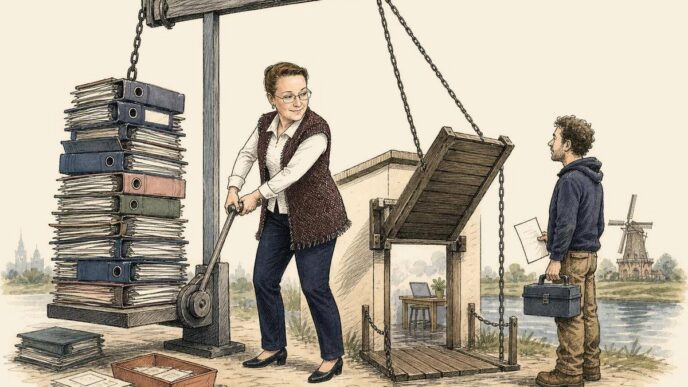
I read the week as a warning against a very common business instinct: treating administration as a later explanation. In the Dutch system, the file is becoming the business event itself. A tax position, a bank transfer, a salary decision, a green claim, a customs declaration or a housing use is no longer only judged by what the entrepreneur meant. It is judged by whether the records tell one coherent story.
The signal has to become readable
That is not a small technical change. It changes power. The party with a clear file can move, collect, defend and explain. The party with fragments has to reconstruct reality under pressure, often when a bank, tax authority, court, customer, employee or municipality is already asking harder questions.
That was the strongest line running through the week: Dutch business is not becoming impossible. It is becoming less forgiving of improvised proof.
Markets still move, but the room is thinner
The market articles gave no permission for panic. CBS reported that industrial turnover rose 2.3 percent in the first quarter of 2026, while average output prices were 1.2 percent lower. That combination matters. More sales do not automatically mean more oxygen. If volume rises while prices fall, the real question is margin, payment timing and usable capacity.
The same was visible in the broader economy. CBS placed the May 2026 business-cycle indicator at minus 0.51, with 11 of 13 indicators below their long-term trend. The point is not collapse. The point is impatience. Weak confidence, export drag, cost pressure and tighter financing conditions leave less room for mistakes that used to be absorbed by growth.
Housing gave the same message in another language. Existing owner-occupied homes were 4.3 percent more expensive in April 2026 than one year earlier, while prices were unchanged from March. That is cooling, not relief. Temporary dwelling permits fell from 6,166 in 2024 to 3,089 in 2025. For an employer, that is not only a housing statistic. It is a recruitment statistic, a retention statistic and a wage pressure statistic.
A cooler market can still be heavy. This is the Dutch paradox of the week.
Trust now starts before the invoice
The KVK article was almost brutal in its simplicity. On 21 May 2026, KVK reported that 55 percent of entrepreneurs do not check a new business relation for a KVK number. One in five do not or hardly check new relations. At the same time, 60 percent of Dutch companies change at least one registered detail each year.
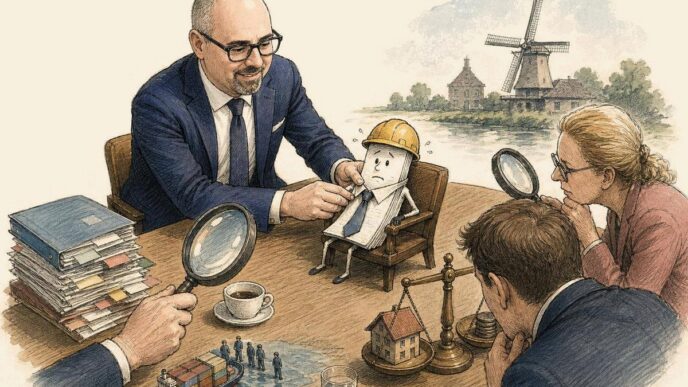
That is not an argument for suspicion. It is an argument for a pause before exposure. A contract, invoice or payment already assumes that the counterparty exists, may sign, performs the stated activity and uses the stated payment route. If those pieces do not match, trust has not been built. It has been assumed.
The bank ruling made that sharper. ING was allowed to terminate relationships after large receipts, large payments, transfers abroad and cash withdrawals remained insufficiently explained in the bank’s view, even though the company had supplied annual accounts, invoices, agreements, declarations, hours records and reports. That is the uncomfortable lesson. Having documents is not always the same as having an understandable money trail.
What the signal changes
Customs representation carried the same risk in import form. The name on the declaration can decide who faces duty, VAT pressure and recovery discussions after a correction. In trade, the routine field on the form is often where the later cash fight begins.
The Dutch system is asking a plain question: who did what, for whom, under which authority, with which money trail?
Tax and salary are becoming governance tests
The tax pieces this week were not only about tax. They were about control. In the criminal tax case involving a consultant, a CV and a BV, the important lesson was not the courtroom drama. It was the need for the structure, invoices, bank flows, returns and explanation to describe the same commercial reality.
The privilege dispute around tax files carried a second lesson. Dutch law protects certain roles, capacities, communications and materials. It does not protect every professional note merely because tax is involved. For smaller companies, where accountant work, tax advice, lawyer correspondence and source administration often sit close together, role clarity is not cosmetic. It affects what the file becomes when a dispute changes character.
The Belastingdienst position on one founder working for two wholly owned BVs added another layer. Separate companies do not automatically end the analysis when ownership, work and remuneration are linked. Salary evidence has to match the real working structure, not only the legal boxes.
Pay transparency moves in the same direction. The Dutch implementation bill for Directive 2023/970 is intended to enter into force on 1 January 2027 if both chambers agree. Equal pay already exists. The newer pressure is explanation: job value, pay range, progression, variable pay and historical differences become governance material.
Memory is a weak payroll system.
The product, the claim and the data now carry evidence
ACM’s sustainability focus showed that commercial language is also becoming a control file. Green claims, circular promises, warranty scripts, repair routes, product lifetime and software support are not only marketing choices. They are statements that may need evidence behind them, especially as EU consumer green-transition rules move closer.
The Data Act guidance points in the same direction for connected products and related services. Smart vehicles, agricultural machines, sensors and linked services produce data that users may need to access and move. For a small firm, the product is no longer only the object sold or used. It includes generated data, access routes and cloud exit reality.
Export documentation added the trade version of the same idea. With revised PEM preferential-origin rules from 1 January 2026 and provisional EU-Mercosur application from 1 May 2026, origin proof has moved from back-office form to pricing, cash collection and customer trust. A certificate is not an ornament. It can decide whether a commercial promise survives border control and payment review.
What founders should check
This is where the Dutch economy is quietly modernising. Not through slogans, but through evidence attaching itself to ordinary business language.
Housing, permits and local files shape business reality
The real-estate articles reminded us that business control does not stop at the company door. A WOZ objection is not won by anger about a stretched housing market. It depends on object-specific evidence. Room-based housing use is not merely a practical solution when labour is short. In Deventer, a penalty recovery survived because the address had already been subject to an order and the housing-use file mattered.
This is where many entrepreneurs underestimate the Dutch state. It can be patient, decentralised and procedural. Then suddenly the local file becomes decisive. The address, the permit, the valuation method, the number of rooms, the registered use and the municipal history all matter.
The fall in temporary housing permits makes this more than a property topic. If housing is scarce and faster temporary supply weakens, labour mobility becomes harder. A company can have demand, contracts and a candidate, and still fail because the worker cannot live near the job. That pressure then returns through wages, turnover, planning and service quality.
Housing is now part of operational control, even for firms that never wanted to think of themselves as property businesses.
What I take from the week
The Dutch model still has a clean logic: shared rules, visible records and practical governance. I respect that logic. But it is becoming harder on companies that run by memory, habit or friendly assumption.
This week’s evidence says the next Dutch business advantage may be less glamorous than strategy and more durable than optimism. It is the ability to make the file and the reality meet before someone else tests them.
That applies to the bank account, the payroll, the import declaration, the sustainability claim, the KVK check, the salary range, the tax role, the origin document and the housing permit. These are not separate administrative irritations. They are the places where trust is either stored or lost.
A founder does not need to become defensive. The better posture is colder and simpler. If the company says something, pays something, claims something, imports something, houses someone, prices something or reports something, the records need to show the same business.
That is the Netherlands I saw this week: not dramatic, not broken, but stricter. The economy still gives room to work. It gives less room to explain later.
Sources
- The File Has To Tell One Story
- A Cooler Housing Market Is Still Heavy
- The KVK Number Is Where Trust Gets a File
- The Tax File Is a Governance File
- Dutch Sustainability Claims Are Becoming Business Control Files
- Dutch Industry Is Selling More, but Cash Still Needs Proof
- The Dutch UN Tax Position Raises the Price of Messy Records
- One Founder, Two Dutch BVs, and the Salary Risk Between Them
Referenced in the article
Column | Compliance
Customs Representation Ties Dutch Import Authority to Cash and Recovery
The name on the declaration can decide who faces duty, VAT pressure and recourse when an import.
Column | Governance
One Founder, Two Dutch BVs, and the Salary Risk Between Them
A Belastingdienst position on connected bodies shows why ownership, work, and payroll evidence must be read.
Column | Real Estate
Dutch Housing Permits Rise While Small Firms Watch the Clock
A larger housing pipeline helps demand, while small firms live by starts, prices and payment.
The Polder is written for readers who need the Dutch business environment translated into practical meaning. Corrections, source policy and editorial accountability are part of the publication record.