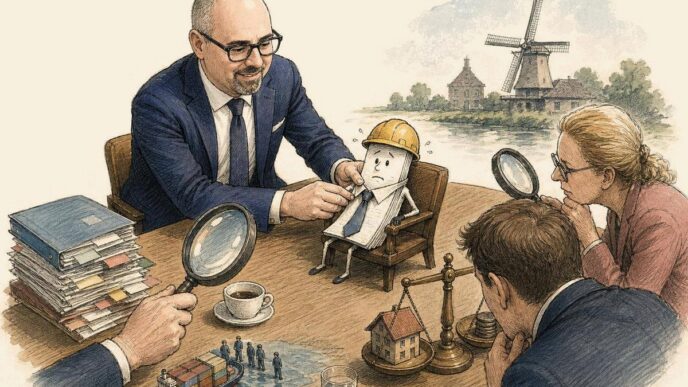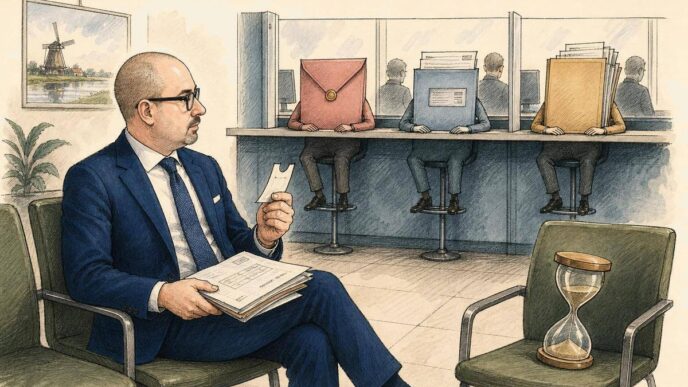
This week showed a country turning work, tax and support into proof before comfort.
Trust now has a file
The Dutch economy still likes to describe itself through trust. We trust the agreement. We trust the consultation. We trust the reasonable employer, the responsible worker, the honest taxpayer, the practical entrepreneur. I recognise that culture. It is one of the reasons the country works as well as it does.
But this week’s business signals pointed to a sharper version of that trust. The Netherlands is not becoming distrustful. It is asking for receipts.
The signal has to become readable
That is a different country from the one many companies still imagine they are operating in. The old Dutch compromise often allowed room for habit, improvisation and local understanding. A small employer knew who could work extra hours. A founder knew which private assets were parked where. A restaurant knew who was on the floor. A tax adviser could repair the story later. A manager could introduce a tool first and write the guidance afterwards.
The new pattern is less forgiving. Not because the Dutch state has suddenly become dramatic, but because many systems are running out of slack. Labour is tight. Tax execution is under pressure. Public assessment capacity is scarce. Political promises have to become portals, deadlines, evidence and decisions. In that environment, the company file becomes the place where culture meets consequence.
Work is becoming visible
The clearest signal came from labour. Flexibility is not disappearing from the Dutch labour market, but it is being made more legible. CBS counted 2.7 million employees with a flexible employment relationship in the first quarter of 2026. Including self-employed workers without staff, about 3.9 million workers, roughly four in ten, were in flexible work. That is not a side issue. It is part of how the country staffs itself.
The proposed Wet meer zekerheid flexwerkers does not simply say that flexibility is bad. It asks what kind of flexibility can be defended once it enters a contract, a roster and a wage file. If zero-hour contracts move toward bandwidth contracts, the cultural question becomes practical: how much availability is real, how much is convenient fiction, and who carries the cost when demand changes?
There is a second Dutch reflex here. When labour is scarce, we look for people outside the organisation. Yet CBS counted 574 thousand underutilised part-time workers in the first quarter of 2026, people already working part time who wanted and were available for more hours. On average, they wanted 8.5 extra hours per week.
Why is that not the first reserve every employer studies? Perhaps because extra hours inside the existing workforce are less glamorous than recruitment. They require a harder conversation about rosters, childcare, fatigue, margins and predictability. The labour reserve already has a badge, but it does not become usable capacity by wishful thinking.
Support is not comfort
The proposed crisis-retention scheme showed the same Dutch direction from another side. The Wet personeelsbehoud bij crisis is still a proposal, with possible entry into force in 2029 if approved. It would replace the old short-time working route with an UWV-assessed system for exceptional crises. For general use, a business would need at least 20 percent less work over two months, with a maximum duration of six months.
It sounds like support, and it is meant as support. But it is not comfort. It is conditional relief through evidence. A company that wants help keeping people during a crisis will need to show the crisis in its payroll, work volume and administration. That is sensible. It also exposes a Dutch habit that deserves more scrutiny: we often debate the generosity of a scheme before asking whether small employers can produce the proof cleanly when pressure is highest.
What the signal changes
The same point appeared in the 30 percent facility case. A zero-hour start may be lawful in employment terms, but in the court signal described this week, the absence of a fixed agreed wage at the first payroll step damaged the continuation of the facility at a new employer. The later fixed contract did not repair the starting file.
That is a very Dutch lesson, and not only for international recruitment. The first contract is not just a beginning. It can be the evidence that future decisions depend on.
The door can close
In hospitality, the evidence question became physical. A Leiden restaurant was ordered to close for one month after repeated serious violations found by the Nederlandse Arbeidsinspectie, involving minimum wage rules, work authorisation and working time law.
What struck me was not only the sanction. It was the combination. Wages, hours, identity, permission to work, payroll tax records and management follow-up no longer live in separate moral boxes. They form one operating file. If that file breaks, the restaurant door can close.
For a small business owner, that is uncomfortable because daily operations often feel more urgent than documentation. The lunch service starts. The client is waiting. The employee is sick. The truck must leave. The refund is needed. The software tool is already being used. The tax return deadline is near.
But the Dutch institutional answer is increasingly the same: urgency does not replace proof. It may explain a mistake. It may not protect the business from the consequence.
Tax enters the living room
The tax articles this week carried the same message into private and corporate life. Box 3 is no longer a quiet annual calculation for private wealth. It has become an evidence file shaped by temporary forfaitary taxation, legal restoration, counterproof, manual processing and the planned move toward actual return from 2028.
For founders and owner-managed companies, that matters because the line between business discipline and private liquidity is rarely as clean as policy language suggests. Private assets, debt, investments, second homes and company cash pressure often speak to each other. The question is no longer only what the tax rate is. It is whether the private file can explain timing, return and liquidity when the system asks.
The Dutch income tax refund now follows that same chain logic. DigiD access, BSN identity data, registration records, prefilled income data, bank information, payroll records, automated selection and manual review meet in one place. A refund is not only a number. It is a trust event between citizen, employer, adviser and administration.
What founders should check
At the larger end, Pillar 2 is a direct issue for groups in scope, with Dutch filing through Digipoort opening on 1 June 2026 and first deadlines following in June and August. Most micro and small firms will not be directly hit by the global minimum tax. Still, they may feel the discipline through groups, suppliers and advisers that need cleaner tax stories.
Even the lorry charge belongs in this pattern. A temporary 22.3 percent discount gives transport-heavy firms some breathing room after the charge starts, but the deeper question remains: which kilometres actually pay for themselves?
Innovation has a receipt too
The innovation box debate added an important Dutch tension. The regime is worth close to 3 billion euros a year and rewards profit after risk has already been taken. For large firms, that can be powerful. For smaller innovators, the benefit often arrives only after ownership, qualifying assets, profit and evidence are already in place.
This is where Dutch policy can sound more accessible than it feels. We say we want innovation. We design a tax instrument. Then the smallest innovators meet timing, proof and scale barriers before they meet relief. Is that wrong? Not automatically. But it should make us honest about what kind of innovation policy this is. It is not early oxygen. It is a reward for documented success.
The broader Tax Plan 2026 signal was similar. The law has moved from proposal to implementation. For companies, the useful question is no longer what was politically discussed months ago. It is whether payroll, invoices, private withdrawals, corrections and adviser files can absorb what is already in force.
That is not a romantic view of entrepreneurship. It is the view from the ledger.
Tools need judgement
AI at work may look like a different subject, but it is not. UWV’s employer survey showed fast adoption. Establishments where AI was not used fell from 60 percent in 2024 to 34 percent in 2025. Those using AI to a reasonable, high or very high degree doubled from 16 percent to 32 percent. Yet only six out of ten employers already using AI provide guidance to workers.
Here again, the Netherlands is ahead in use and slower in governance. We like trying practical tools. We like solving the problem first. But when a tool shapes work, output, selection, planning or communication, who remains responsible? The worker? The manager? The supplier? The owner who never wrote down the rule?
The retirement signal from UWV belongs beside this. Older workers do not only leave vacancies. They take judgement, exception memory, client history and informal mentoring with them. A role can be refilled faster than the wisdom behind it. If AI enters faster than knowledge is transferred, the company may become more efficient and less capable at the same time.
That is the Dutch question I take from this week. Not whether the Netherlands still trusts business. It does. But trust is being translated into files, deadlines, contracts, portals and proof. Will we organise that proof while the business is still calm, or only when the system has already asked for it?
Sources
- Retaining People Will Require Proof
- Dutch Flex Work Is Becoming a Ledger Question
- The Labour Reserve Already Has a Badge
- The First Contract Can Break the Dutch Expat Payroll Promise
- Box 3 Is Now a Private Control File for Founders
- When Payroll Proof Becomes the Door Key in Dutch Hospitality
- The Global Minimum Tax Is Becoming a Dutch Ledger Test
- When Sickness Files Become the Gatekeeper for Dutch Employers
Referenced in the article
Column | Human Resources
The Labour Reserve Already Has a Badge
Many Dutch part-time workers want more hours. For small employers, the real question is whether.
Column | Ledger & Tax
The Dutch Tax Refund Now Tests the Whole Control File
Prefilled data, registration records and cash timing now meet in one tax.
Column | Ledger & Tax
The Lorry-Charge Discount Will Not Fix a Weak Road-Cost Ledger
A temporary Dutch rate cut gives transport-heavy firms breathing room, but July still asks a sharper.
The Polder is written for readers who need the Dutch business environment translated into practical meaning. Corrections, source policy and editorial accountability are part of the publication record.