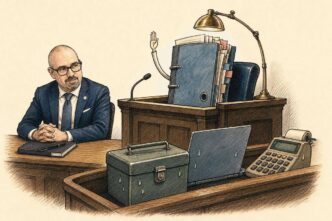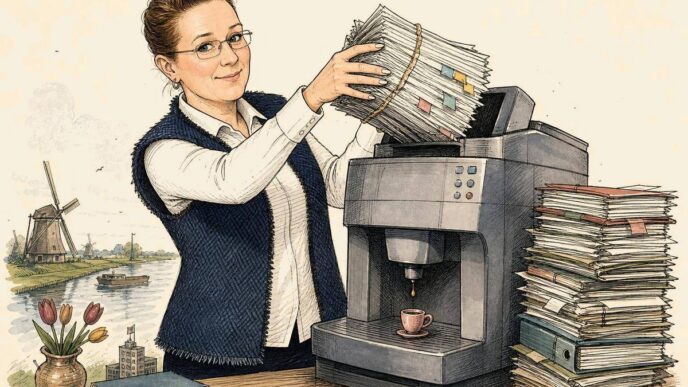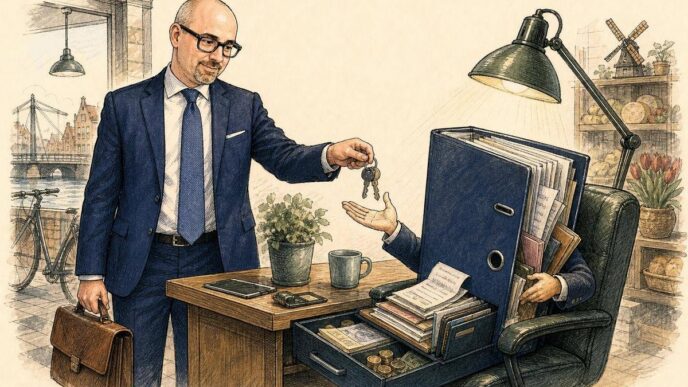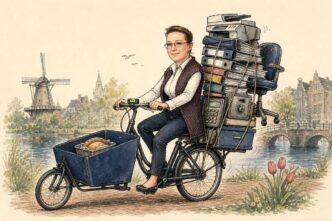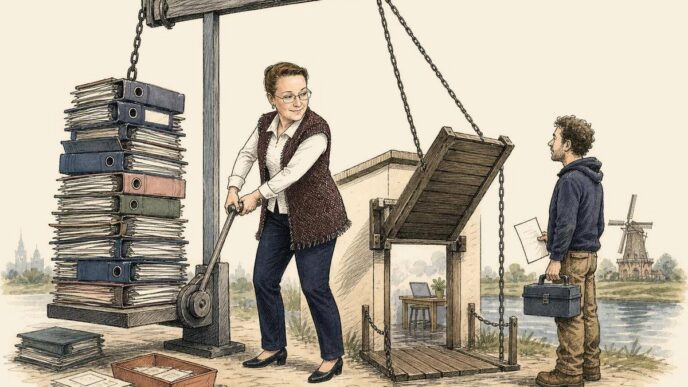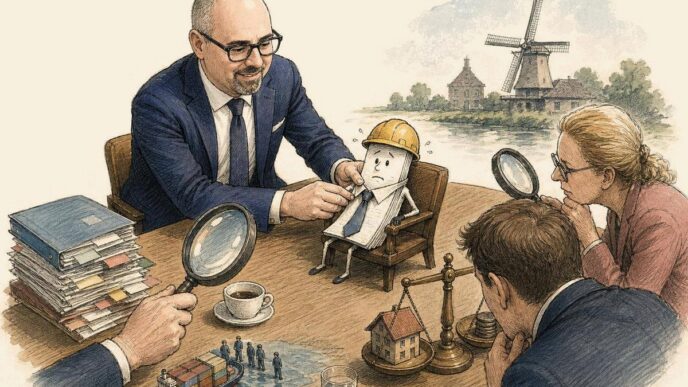




Demand has not vanished, but the right to grow now belongs to firms that can carry cost, cash, people and responsibility.
The Friday question
A Dutch founder can often read the country better from a desk than from a stage. The open invoices say one thing. The payroll run says another. The order book still looks alive, but the cash date has moved, the supplier is less patient, and the next hire wants certainty that the business itself may not feel. Nothing in that scene looks like panic. It looks like a country asking a quieter and harder question: can you really carry what you say yes to?
That is the thought I take from this week. The Netherlands is not short of activity. Goods move, people still need work, firms still need machines, customers still buy, and digital models still search for trust. But the easy assumption behind growth is being withdrawn. Turnover is no longer enough. A plan is no longer enough. A platform claim is no longer enough. The full burden now sits behind the yes.
The signal has to become readable
I am not Dutch, and I do not pretend to think like someone formed inside this system. What I have learned to respect is the Dutch preference for decisions that can be shared: clear numbers, clean rules, visible responsibility and little patience for theatre when the bill arrives. I also read it with the eye of someone who has worked close to ledgers, risk, disputes and entrepreneurs under pressure. A system is most honest when the comfort leaves it. This week, the comfort left several rooms at once.
Thinner public room, harder private choices
DNB gave the broad frame. For 2026, the central bank expects Dutch GDP growth of 0.8 percent, inflation of 2.7 percent, and an EMU government deficit of 3.3 percent of GDP. That deficit is above the European 3 percent reference value. None of this tells a bakery, a software agency or a metal supplier what price to put on a Monday quote. It does tell them that the public buffer is not expanding while costs still need to be carried.
This is where macro data becomes business discipline. A country can still grow and still feel less generous inside the company. Energy, wages, rent, credit, tax dates and customer hesitation do not move in one clean line. The founder who mistakes activity for strength will discover the difference in cash. The founder who prices with memory from a better year will carry today’s cost with yesterday’s courage.
I do not read the Dutch economy as broken. I read it as less willing to subsidise weak assumptions. That is different. It means the firm that knows its margin, its payment dates and its real capacity has room to act. The firm that lives on volume and delay is being exposed.
Cash judges before profit does
Late invoices show the point without decoration. When customers pay slowly, the small supplier becomes the banker of the chain. Wages still need to be paid. VAT dates may arrive before the customer has paid the invoice. DNB’s credit-cost picture keeps showing that SMEs pay more for outstanding bank credit than larger companies. The result is a quiet transfer of risk from the stronger party to the smaller one.
This is not only a complaint about manners. It is a market structure. A large customer that stretches payment may protect its own cash while borrowing from a supplier that never agreed to become a lender. The contract says trade. The ledger says revenue. The bank account says something colder.
What the signal changes
Return to the founder at the desk. The order accepted in March may still look profitable on paper in June, but paper does not pay staff. If the customer pays late, fuel has moved, wages have moved and tax has not waited, the original yes has changed shape. The hard question is not whether the sale was real. It is whether the firm should have accepted that risk at that price from that customer.
Trust is now a role, not a slogan
The same discipline is moving through digital business. ACM’s refusal to register Abykys B.V. as a data intermediation service under the European Data Governance Act matters beyond one company. It says that a business selling a neutral position in data must show that neutrality in its role, its revenue model and its conduct. A platform cannot borrow the language of trust and then treat proof as an afterthought.
This is a useful Dutch line. Digital markets have been full of words that sound clean until someone depends on them: platform, intermediary, marketplace, connector. Sometimes those words describe a fair role. Sometimes they hide power over access, data, ranking, terms and evidence. When a small firm builds its customers, files and sales route on someone else’s system, role clarity is not a legal luxury. It is business survival.
I do not dislike platforms. I dislike pretending that dependence is neutral because the interface is smooth. If trust is part of the product, then responsibility is part of the product. The Dutch instinct here is right: name the role, show the incentives, and do not ask the market to believe what the structure does not support.
Investment waits for a responsible yes
The physical economy gave the same signal in another form. CBS reported that Dutch industrial producers expect to invest 3 percent less in 2026 in buildings, machinery, vehicles, computers and other tangible fixed assets than in 2025. The turn matters. In autumn 2025, industrial entrepreneurs still expected investment in 2026 to be more than 5 percent higher. By spring, that had changed into decline.
A delayed machine is not an abstract event. It is a supplier waiting for an order, a workshop reconsidering capacity, a bank asking for stronger numbers and a manager deciding whether the next shift can be justified. I do not read this as cowardice. A machine is not only bought. It must be fed with orders, power, people, maintenance and cash. When those pieces are less certain, the responsible company pauses.
The danger is that too many responsible pauses begin to reinforce each other. The buyer waits. The supplier waits. The subcontractor waits. The lender waits for more comfort. No one has declared defeat, yet the chain loses tempo. That is why Dutch business discipline must not become paralysis. A careful yes is healthy. A country where every useful investment becomes too difficult to defend is wasting its own competence.
Labour relief is not labour comfort
The labour signal also resists easy reading. CBS reported unemployment at 3.9 percent in May 2026, with 399 thousand unemployed people. At first glance, that sounds like pressure easing. The detail is more stubborn: over the previous three months, the number of unemployed people fell, but the number of people with paid work also fell and the non-labour force grew.
What founders should check
That is not a clean loosening of the labour market. It is a sideways movement. Employers do not hire percentages. They hire people who can reach the job, accept the hours, carry the work, fit the wage, and stay long enough for training to matter. If people leave the labour force, or cannot match the route into available work, the headline gives comfort that the roster does not feel.
This is where the Dutch system must keep its practical honesty. Counting is a strength, but counting is not the same as design. If firms still need people while people remain outside paid work, then the problem sits in routes, housing, skills, contracts, risk and execution. For a small employer, that lands as a real decision: hire now and carry the uncertainty, or wait and lose capacity.
The country I read
The Dutch direction I see is not decline. It is a stricter sorting of serious business from assumed business. A firm that wants to grow now has to carry more than demand. It must carry payment timing, labour reality, digital dependence, financing cost and the public rules around its role. That is not pleasant, but it is honest.
There is also a choice inside it. Stronger firms can use the moment to push risk downward, pay later, demand more, and call it efficiency. Or they can understand that markets decay when the small supplier becomes the unpaid shock absorber of every chain. Public authorities can add clarity where trust is being sold, speed where investment is useful, and discipline where rules have meaning. Or they can make responsibility expensive without making behaviour better.
I respect the Netherlands most when it does not hide behind soft language. Consensus has value only if it produces conduct that can survive the invoice, the worker, the customer, the supervisor and the market. Otherwise it becomes a polite mist over unequal power.
The founder at the Friday desk does not need a heroic story about resilience. He needs customers who pay on time, workers who can enter the job, platforms that state their true role, lenders who price real risk, and public choices that do not turn useful investment into a maze. Above all, he needs the discipline to ask whether the next yes is responsible.
That is the Dutch business question now. Not whether the country can still grow in the abstract. It can. The question is whether each promise in that growth can be carried by the firm that makes it, and whether the market around that firm behaves honestly enough to let responsibility win.
Sources
- More Benefits and Empty Shifts Reveal a Dutch Hiring Gap
- When a Scam Payment Still Has a Valid Signature
- Dutch Export Growth Leaves Founders Counting the Real Cost
- AEX slips as Amsterdam declines Europe’s relief
- Amsterdam refuses the relief rally
- Late Dutch Invoices Put Small Suppliers in the Banker’s Seat
- Data Brokers Must Prove Neutrality Before Selling Trust
- The Dutch Housing Strain Starts Before the Job Contract
Referenced in the article
Column | Market Pulse
More Benefits and Empty Shifts Reveal a Dutch Hiring Gap
The labour market still has work, but many starter routes are too narrow to carry people.
Column | Governance
Data Brokers Must Prove Neutrality Before Selling Trust
ACM's Abykys refusal turns a clever platform model into a boardroom question about role, revenue.
Column | Ledger & Tax
After the Tax Click, the Books Still Have to Speak
The filing is not the finish line. It is the moment when a return enters a control route.
The Polder is written for readers who need the Dutch business environment translated into practical meaning. Corrections, source policy and editorial accountability are part of the publication record.