The Dutch economy remains open to prices, labour, cloud tools and tax comfort, but tolerance now depends on clear responsibility.
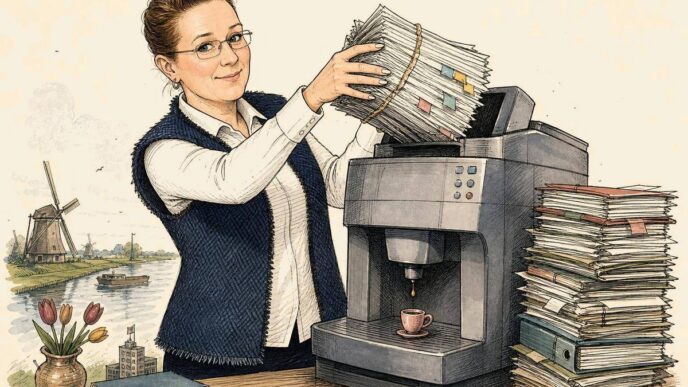
A founder does not meet the Dutch economy in a forecast. He meets it when the quiet part of the week finally arrives and the loose ends stop hiding. A supplier wants a higher price. A client is late again. A worker asks what will happen to the roster. The software bill has changed. The tax adviser asks for documents that were supposed to be simple to find.
The signal has to become readable
That is where Dutch trust becomes commercial. Not in the headline, but in the moment when a decision needs a reason another person can understand.
I am not Dutch. That matters, because distance can make a system clearer if it is used with respect. I have learned to respect the Dutch preference for clean, shareable decisions: why this price, why this worker, why this route, why this exception, why this delay. The Dutch style can be blunt. It can also trust forms too much. But its better instinct is serious. A decision should be able to sit at the table with other people and survive the questions.
What stayed with me is a harder thought. The Netherlands is not becoming hostile to business. It is becoming less patient with business that asks for trust while leaving the consequences unclear.
The new permission is conditional
CBS reported that 68 percent of Dutch adults think the Netherlands should admit labour migrants, but with a maximum number. Another 17 percent would admit all labour migrants. That is not a closed country. It is an open country with a boundary around its consent.
For employers, the point is not the politics of the number. The point is that labour is no longer only a private input bought by a company that cannot fill vacancies. The worker also needs housing, transport, payroll clarity, agency discipline and a place in a local community already under pressure. The vacancy may belong to the employer, but the consequences do not stop at the factory gate, the hotel kitchen, the warehouse door or the greenhouse.
This is where Dutch logic becomes sharper than it first sounds. It asks whether the commercial need has been organised well enough for others to accept it. I do not read that as softness. I read it as market discipline with a public face. A company using scarce labour is also using public tolerance, and that tolerance is now more conditional.
Prices test character before arithmetic
CBS also confirmed that Dutch CPI inflation rose to 3.5 percent in May 2026, after 2.8 percent in April. For small firms, that number is useful, but it is not a universal permission slip. It does not mean every price can rise by 3.5 percent and still be credible.
What the signal changes
Inflation reaches companies unevenly. Energy, transport, rent, wages, financing, stock and services hit different ledgers at different speeds. A restaurant, a contractor, a cleaning firm and a software reseller may all speak about higher costs, but the truth sits in different lines. Customers know this, even when they do not see the accounts. They feel whether a price rise has a real story behind it or whether the company is borrowing a public number to cover a weak margin model.
I have seen both failures. Some entrepreneurs wait too long and then try to repair a year of damage with one heavy price letter. Others move too quickly and call every increase inflation. Neither is strong. The first hides from the market. The second insults it.
The Dutch market is not innocent, but it is practical. A clear price rise, made early and explained plainly, can be accepted. A late price rise with a vague reason often turns into distrust. Margin discipline is therefore not only arithmetic. It is timing, evidence and tone.
Speed has become part of trust
The AFM fine imposed on bunq B.V. made the same point in a stricter setting. On 2 June 2026, the Autoriteit Financiële Markten imposed an administrative fine of €170,000. The case concerned seven complaints from customers who had become victims of online fraud and received a substantive response too late.
This is easy to file away as a banking story. That would miss the signal. The wider lesson is about time. Once a customer, worker, supplier, buyer or regulator is waiting for a real answer, the outside clock has started. Internal debate may be necessary. Legal review may be sensible. Fraud checks may take work. But the person waiting is not living inside the organisation's process.
Small companies are not banks, and they should not pretend to have the same systems. Yet the same business truth appears in smaller form. A disputed invoice, a damaged delivery, a payroll mistake, a data problem or a missing refund can show the character of a company faster than a mission statement ever will. The answer may not be complete on day one, but silence and delay create their own facts.
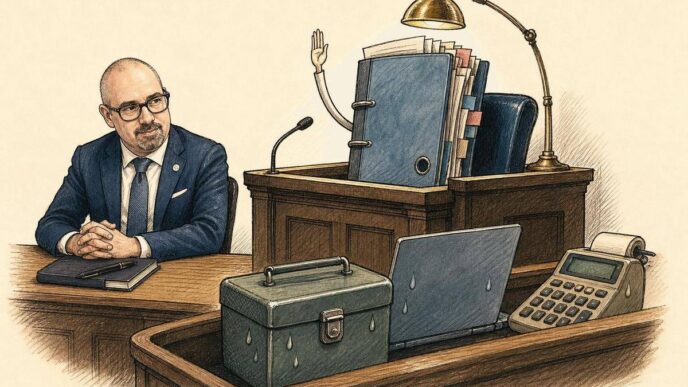
This is why I distrust the lazy split between entrepreneurship and administration. Administration is not the enemy of enterprise. Bad administration is. Good administration is memory under stress. When pressure arrives, the company needs to know who owns the answer, what was promised, what was sent, what was paid and what happens next.
Memory has moved outside the building
CBS reported that 69 percent of Dutch companies with 10 or more employed persons used paid cloud services in 2025. In the ICT sector, the share was 89 percent. That number ends the old discussion about cloud as a modern preference. For many companies, cloud systems are now where the company keeps its books, customer files, payroll links, project proof, orders and daily work.
The convenience is real. I use these tools. Most serious operators do. The mistake is to confuse convenience with control. A company that rents its memory has to understand the terms under which that memory can be reached, exported, protected and restored.
What founders should check
This is not only an IT question. It is a director's question. What happens when an employee leaves with access rights still open? What happens when a provider changes conditions, a payment fails, an outage arrives during a VAT deadline or a tax file has to be reconstructed years later? The cloud has made the back office lighter and faster. It has also moved company proof into contracts, passwords, permissions and platforms that many owners barely read.
The Dutch tax certainty file points in the same direction. Advance comfort, where relevant, no longer lives apart from the company as a polite letter in a folder. It has to match the ownership chart, the ledger, the activity, the transfer pricing record, the tax return and the payment trail. Comfort starts with the company's own facts. Advisers can argue, shape and warn. They cannot turn a weak reality into a strong one by writing better sentences around it.
The Dutch direction is stricter than it sounds
Seen together, these signals do not describe a frightened Netherlands. The economy is still trading. Employers still need workers. Customers still buy. Companies still raise prices. Digital tools keep spreading. Tax certainty still has a place. The direction is not withdrawal.
The direction is conditional openness. The Netherlands still accepts movement, but it asks who carries the cost when that movement is badly organised. It accepts labour migration, but not without pressure on housing and payroll being part of the conversation. It accepts price rises, but not vague arithmetic. It accepts digital convenience, but not directors who cannot find their own records. It accepts tax comfort, but not as a substitute for real substance.
That is the harder Dutch trust test now. The question is no longer only whether a company can grow, recruit, bill, digitise or structure itself efficiently. The question is whether it can explain the consequences when the decision touches someone else: a worker looking for a room, a customer facing a higher price, a fraud victim waiting for an answer, a tax inspector reading the ledger, or a director trying to recover the company's memory from a platform.
I write this as someone who has won and lost in business. Losses teach respect for proof, but also for timing, tone and responsibility. A company is often weakest in the gap between what the owner believes happened and what the company can show happened. That gap is where cash leaks, trust breaks and governance becomes personal.
The founder at the quiet weekend table does not need drama. He needs a colder honesty. Which price rises have a real cost reason? Which labour choices depend on public patience? Which complaints have waited too long? Which cloud systems now hold the company's spine? Which tax positions rest on facts rather than memory?
The Netherlands still gives business room. It is just narrowing the room for business that cannot explain itself. That is not anti-market. It is the Dutch market becoming more serious about responsibility.
Sources
- Fewer Russian Firms, Harder Questions for Dutch Deals
- Group Service Fees Are Moving From Tax Policy to Daily Evidence
- When Care Money Leaves the Care Route, Governance Must Answer
- A Property Tax Loss Is Not Part of the Rent Roll
- When Start-Up Capital Looks Like Trouble, Finance Doors Narrow
- A Thin Dutch Quarter Puts Margins Back on the Table
- A Second Company Bicycle Can Tighten Payroll More Than It Looks
- A Dutch Room Can Pull Cross-Border Builders Into Dutch Tax
Referenced in the article
Column | Market Pulse
Dutch Volunteers Returned, but Local Capacity Feels Thinner
CBS reported on 11 June 2026 that 47.0 percent of Dutch residents aged 15 or older did volunteer work.
Column | Market Pulse
Dutch Inflation Rose, but Your Margin Has Its Own Clock
CBS put May inflation at 3.5 percent. Small firms need a sharper reading than the headline.
Column | Governance
Dutch Tax Certainty Now Starts With the Company’s Own Records
A smaller ruling pipeline still asks directors to prove the facts behind cross-border tax comfort.
The Polder is written for readers who need the Dutch business environment translated into practical meaning. Corrections, source policy and editorial accountability are part of the publication record.