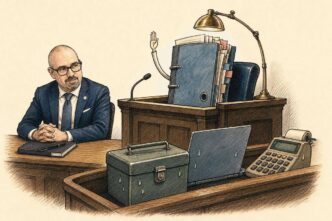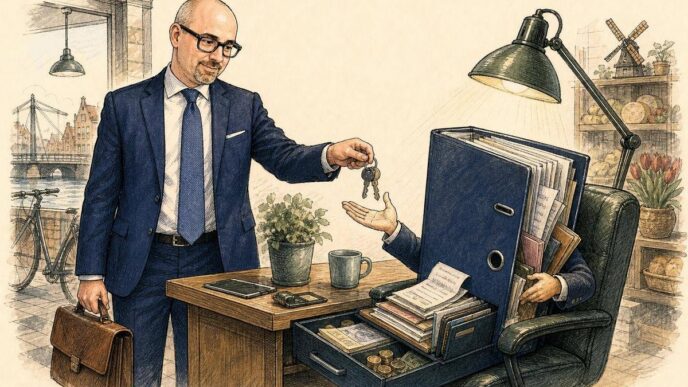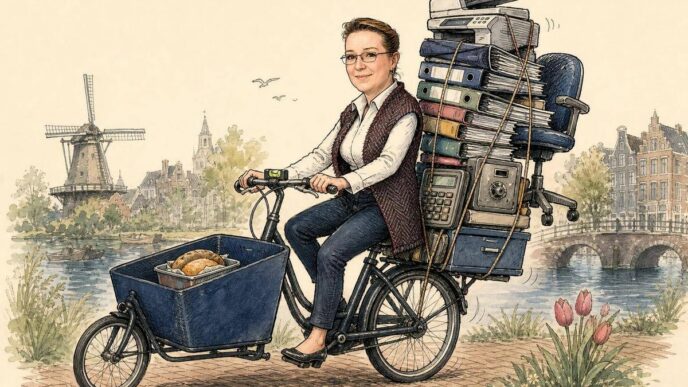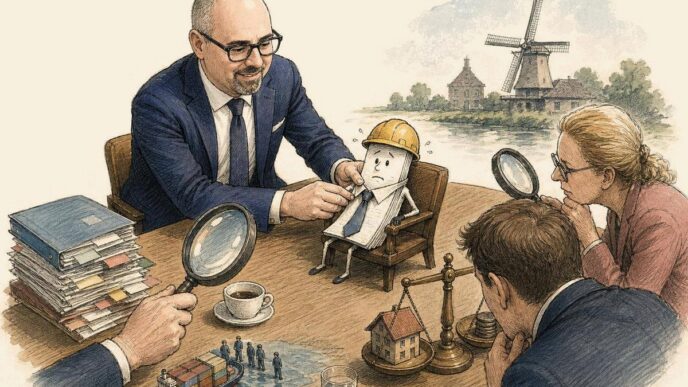



This week showed how Dutch compromise still works, but only when real businesses can carry the evidence, delays and costs.
On a Friday afternoon, a founder can have four Dutch files open without calling the day exceptional. One screen shows a VAT refund that would help cash next month. Another shows a payment waiting for approval, with a changed bank account number in the supplier e-mail. On the desk lies an employment contract with a non-compete that once felt standard. In the background, a lender is asking whether a new location can really open this year, given power, staff and permits.
The signal has to become readable
None of this is dramatic in the Dutch sense. It is ordinary. That is exactly why it matters.
The question I carried from this week is not whether the Netherlands has too many rules. That is too easy, and usually too lazy. The better question is sharper: what are we still calling trust when every practical check has moved to the smallest desk?
The old bargain is changing
The Dutch system has always been comfortable with conditional certainty. We consult, record, object, appeal, adjust and wait for the proper form. This can be irritating, but it also protects the country from wild swings. A rule is not only a command here. It is often a negotiated instrument, with thresholds, exceptions, implementation dates and room for correction.
That habit has served business well when time, administration and patience were available. A shopkeeper, care provider, consultant, family company or small manufacturer could live with a certain amount of formal delay because the system, in return, offered predictability. If the documents were right, the decision would eventually follow. If the tax return matched the evidence, cash would move. If a contract said what the parties meant, the clause could be trusted.
This week showed a more uncomfortable version of that bargain. The documents still matter, perhaps more than ever, but the time and capacity to maintain them are thinner. The system still asks for proof, yet it often asks after the business moment has passed.
A VAT refund is a clean example. A short Hoge Raad tax ruling did not need a new doctrine to be useful. It reminded founders that a refund is not cash until the file can support it. Old invoices, stopped activities, asset sales, corrections and missing trails are not background details. They decide whether the money is real for the business.
Proof before comfort
That is a very Dutch lesson, and a fair one in principle. Public money should not move only because someone says the return is right. But fairness in principle is not the same as fairness in use. A small firm that treats a refund as incoming cash may already have promised wages, rent or a supplier payment before anyone asks whether the old ledger still speaks clearly enough.
The same tension sits behind the fiscal access right. Article 66a of the Algemene wet inzake rijksbelastingen points toward more access to tax data relating to the taxpayer or withholding agent. That is good. More transparency from the Belastingdienst should make the relationship less one-sided. Yet the official route is staged, not a single complete file opening overnight.
What the signal changes
So the business cannot wait for the state file to become perfect. The company still has to keep its own proof, its own dates, its own invoices, its own explanation of why a position was taken. Is that unreasonable? No. But it tells us something about where Dutch trust now lives. It is not in the promise of transparency. It is in the entrepreneur's ability to survive until transparency is usable.
Speed has shortened trust
Payments show the same change in another language. DNB reported that fraudulent transactions in transfers, card payments and cash withdrawals in the Dutch payment system rose by 30 percent in 2025, to about 658,000. The reported amount rose by 22 percent, to EUR 198 million. For a national payment system, those figures can be discussed in ratios and resilience. For a small business, they arrive as a question at 16:42: should this invoice be paid now?
The Netherlands likes fast payments. Customers expect them, suppliers appreciate them, banks have built around them, and companies have organised their routines accordingly. Speed has become part of commercial decency. Nobody wants to be the slow payer without a reason.
But speed changes the meaning of control. A second pair of eyes, a phone call to verify a changed bank account, a rule for payment links, a pause before an instant transfer: these are not old-fashioned habits. They are the new manners of trust. If fraud enters ordinary routines, then ordinary routines must become more deliberate.
Here again, the smallest desk carries the real test. A bank can warn. DNB can publish figures. Software can flag risk. But the founder, bookkeeper or office manager still has to decide whether the payment moment is clean. Dutch trust used to mean that systems reduced suspicion. Now it may mean that serious people dare to slow down at the exact moment the system is designed to move fast.
When protection gets a price
The proposed reform of the non-compete clause asks a related cultural question. The cabinet has sent the Wetsvoorstel modernisering concurrentiebeding to the Raad van State. The direction is practical: invoking a non-compete would require employer compensation, duration would be capped at one year, geography would have to be specified, and relationship clauses are in scope.
This is not an attack on employers. It is a correction of a lazy habit. Too many clauses have been used as a kind of cheap fog around future employee movement. If a company genuinely needs to protect customers, knowledge or a narrow market position, it should be able to explain that protection and pay for the restriction when it uses it.
Still, the question for small firms is not theoretical freedom. It is price and proof. What is the value of a customer relationship in a three-person sales team? What does a local service company lose when a planner leaves and takes route knowledge, names and timing with her? Which risk is real, and which is only discomfort dressed as protection?
The Dutch compromise is visible here. Workers should not be locked into a labour market by broad clauses. Employers should not be told that all commercial memory is free to walk out the door. The proposed answer is bounded protection with a cost. That is sensible. But it also means that founders must stop copying old contract language and start deciding what they truly need to defend.
Execution is the new reputation
The same issue appears in the wider investment climate. The Netherlands can still attract serious projects. That should not be talked down. The country has law, infrastructure, people, location, language skills and a long commercial memory. International capital does not ignore those strengths.
But attractiveness is no longer enough if conversion from idea to invoice becomes too slow. Electricity, staff, permits, space, fiscal clarity and administrative capacity are not side issues. They are the route between interest and activity. A project does not employ people because the Netherlands has a good reputation. It employs people when the building can open, the grid connection works, the permits are usable, the tax position is clear enough, and the staff can be found.
What founders should check
This is where Dutch culture should be most honest with itself. We are good at balancing interests. We are less good at admitting when balance has become waiting. A country can keep all stakeholders at the table for so long that the business case leaves the room.
For a founder, this is not a national ranking story. It is the question of whether to sign, hire, borrow, lease or postpone. If a plan depends on three public processes and two scarce resources, optimism is not a strategy. The Dutch word for caution is often realism. But realism also requires saying when the machinery is too slow for the opportunity.
The small desk in the middle
Return to the founder on Friday afternoon. She is not asking for a rule-free country. Most Dutch entrepreneurs are more practical than that. They know that tax refunds require invoices, payment systems require checks, employee restrictions require justification, and investment needs public order around scarce space and infrastructure.
What she needs is a clearer view of where the burden is being placed. If the state opens tax data only in stages, her own records must carry the first fight. If payments move faster while fraud rises, her approval routine must carry more suspicion. If a non-compete becomes a costed instrument, her contract must carry a real choice rather than a copied phrase. If investment depends on sockets, staff and permits, her plan must carry slower timing before the first invoice exists.
The Dutch system often speaks in future tense: access will improve, rules will modernise, capacity will be built, procedures will be clarified. Business lives in present tense. Wages are due now. Rent is due now. A supplier wants payment now. A worker asks for an answer now. A customer decides now.
So the question is not whether Dutch compromise still has value. It does. The question is whether we are honest about its carrying cost. Who finances the waiting? Who keeps the evidence? Who bears the mistake when trust was reasonable but the proof was incomplete?
What are we accepting
I do not think the Netherlands should become louder, harsher or faster simply because other countries sometimes confuse speed with strength. That is not our best lesson to learn. The better Dutch reform would be quieter and more demanding: every new right, limit, access route or control rule should state where the practical burden lands tomorrow morning.
If it lands with the founder, say so. If it lands with the payroll worker, say so. If it lands with the bookkeeper who must stop a payment before coffee has gone cold, say so. If it lands with the investor waiting for a grid connection or permit, say so. Then we can judge the rule as adults, not as believers in paper certainty.
This week did not show a broken country. It showed a country asking more of its businesses while still using the language of trust. That can work only if trust is matched by usable records, timely decisions and honest prices.
The next Dutch compromise should not ask only whether the rule is balanced. It should ask whether the business that must live with it has the hours, cash and proof to make the balance real.
Referenced in the article
Column | Ledger & Tax
Annuity Payouts Can Hit Income Tax When Savings Feel Safer
Old retirement products need contract evidence before Box 3 stories reach the tax return.
Column | Human Resources
More Tax Transparency Still Leaves Founders Holding the Evidence
The fiscal access right is arriving in stages, so company records still carry the first burden.
Column | Ledger & Tax
Dutch Investment Appeal Runs Into Sockets, Staff and Permits
The country still attracts serious projects, but founders must plan slower conversion from idea to invoice.
The Polder is written for readers who need the Dutch business environment translated into practical meaning. Corrections, source policy and editorial accountability are part of the publication record.