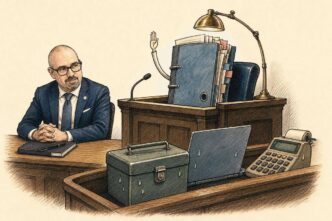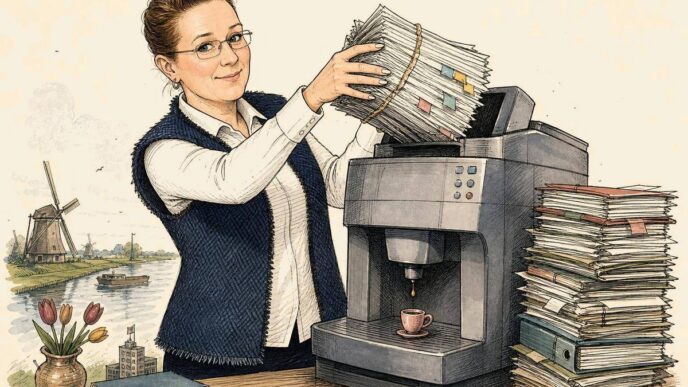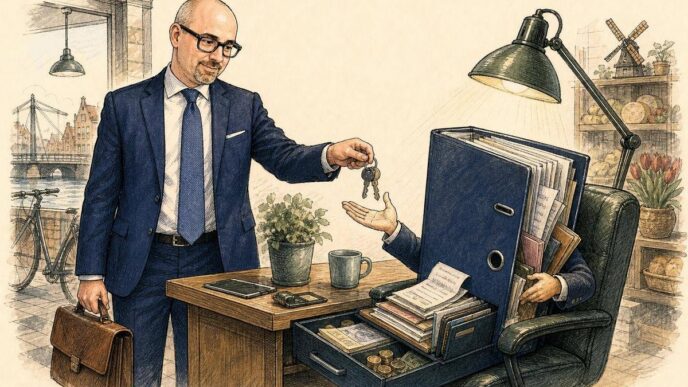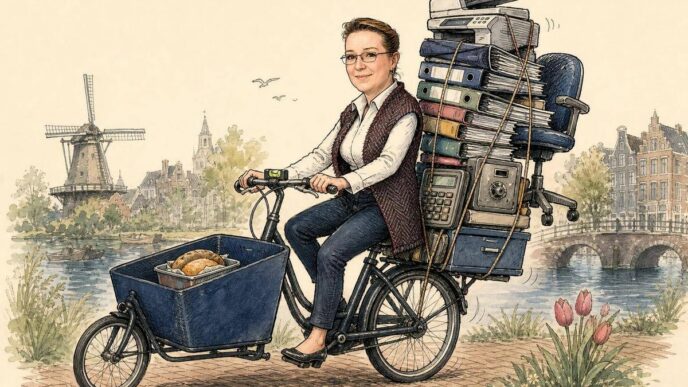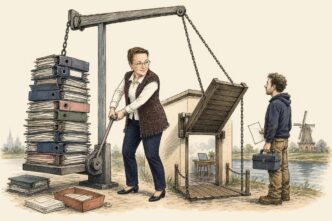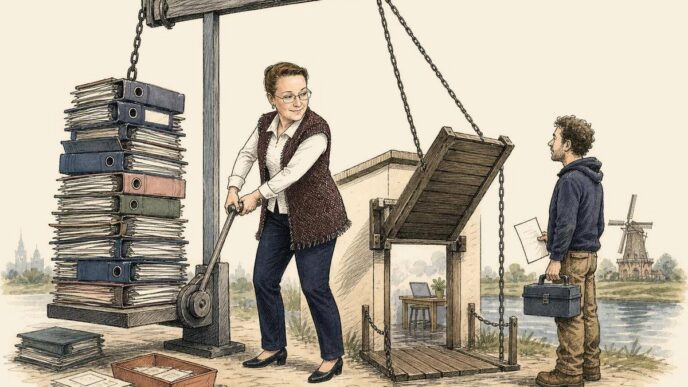
The useful signal from the week was not weakness, but a stricter test of which firms can turn movement into durable value.
On Friday afternoon, a small Dutch firm can look healthy from the outside. Orders are open, staff are still working, the accountant has sent a question, a customer is negotiating a price, and one tax message waits for attention. The room is ordinary. That is why it matters. Dutch business direction is not first felt in a press release or a stock index. It is felt in the moment when the owner has to decide what can be promised, what can be priced, and what can be carried.
The signal has to become readable
I am not Dutch. I did not inherit the Dutch reflex for rules, counters and shared decisions. I learned it by sitting with ledgers, permits, tax dates, bank questions and entrepreneurs who prefer a workable answer over a beautiful speech. I respect that logic. It is clean when it works: make the responsibility visible, make the rule shareable, make the next step clear. But respect does not require softness.
The same logic now asks harder questions of business, because a system built on order has little patience for companies that use that order while keeping their own choices vague.
Movement is not protection
The hard thesis I carry from the week is this: the Netherlands still has motion, but motion no longer protects a weak firm. Export strength, wage pressure, housing demand and tax communication all pointed in the same direction. The country is not frozen. Customers still buy, companies still trade, homes still sell, and public systems still function. The harder point is that every one of those movements now comes with a condition.
CBS reported that Dutch GDP grew by 1.6 percent in 2025, and that more than half of that growth came from exports of goods and services. The sharper detail is that the contribution came mainly from domestic value added, especially goods made in the Netherlands. That is not a small signal. It says the Netherlands still makes, moves and sells real value. It also asks a less comfortable question: who keeps that value after wages, energy, logistics, financing, supplier prices and payment delays have taken their share?
I have seen order books that looked like victory and behaved like debt. The workshop was full, the owner felt vindicated, the bank relaxed for a moment, and everyone spoke about growth. Then the timing showed its teeth. Suppliers indexed first, customers resisted new prices, payroll kept its date, and the margin that existed in the quotation disappeared in the cash account. In that moment, turnover became decoration. Only the margin told the truth.
The margin is where responsibility becomes visible
The export story is therefore not a celebration of Dutch strength on its own. It is a test of the kind of strength firms have. Are they protected specialists, disciplined suppliers and price makers, or are they busy hands inside someone else’s margin chain? A country can show export-led growth while individual firms carry the pressure badly. National strength and company fragility can exist in the same quarter.
What the signal changes
That distinction matters because the Netherlands is good at producing activity. Ports, logistics, skills, registers, banks, contracts and international trust all help a firm move. Yet movement is only the first layer. The second layer is control over value. A founder who cannot say where the margin leaks, which customer costs too much to serve, or which contract no longer pays for its own risk is not managing growth. He is sponsoring it.
Labour makes the timing harder
CBS also reported that the labour income share in the Dutch market sector rose from 70.4 percent in 2024 to 70.6 percent in 2025, with labour compensation growing faster than operating profits. In a national account table, that looks modest. In a small firm, it arrives as timing pressure. Wages move through law, collective agreements, scarcity, retention and social expectation. Prices move through conversations, customer mood and competitive fear.
This is not a case for treating labour as the enemy. That would be lazy and wrong. The Dutch economy depends on decent work, trust in wages and people who can live from the hours they sell. But a firm that cannot connect wage timing to invoice timing is exposed. Payroll has a date. A price increase has resistance. Between those two facts sits the daily discipline of the owner.
The serious employer knows this before any statistic confirms it. Keeping people is not only a moral choice and not only a cost decision. It is a pricing decision, a planning decision and a courage decision. If the company wants skilled staff, reliable rosters and less churn, the price of the product or service has to carry that choice. When it cannot, the business has to face the truth early, not cover it with another month of busy work.
Demand is real, but it negotiates
Housing gave the same message in a different language. CBS reported that 5,126 new-build owner-occupied homes were sold in the first quarter of 2026, 19.1 percent fewer than a year earlier. At the same time, almost 56,000 existing owner-occupied homes were sold, 8.7 percent more than in the first quarter of 2025, while prices still rose. That is not a simple weak market. It is a split market with need, money, hesitation and limits moving together.
The Netherlands needs homes. That fact is not in doubt. Yet need does not erase the buyer's monthly limit, the lender's calculation, the municipality's process, the contractor's labour problem or the developer's cost base. A project can answer a social shortage and still fail the buyer's arithmetic. This is the Dutch market lesson that reaches far beyond housing: demand is not permission to ignore the final price.
The same pressure sits at the restaurant table, the repair counter, the advisory proposal, the software renewal and the factory quotation. The customer has not disappeared. The customer has become more selective. Some tills move while some rosters hurt. Some quotes are accepted, others stay unanswered because the buyer wants the service but not the burden. Optimism, in this market, must be itemised.
The counter is part of the market
The tax communication signal belongs in the same argument, but not because tax mail is exciting. It belongs because it shows how Dutch responsibility moves through small practical channels. The draft Regeling berichtenverkeer Belastingdienst placed the choice between paper and digital tax messages inside a formal communication question. For a firm, the issue is not paper against portal. It is whether the company has one reliable way to notice, route and act when a tax message starts a deadline.
What founders should check
This is where outsiders often misunderstand the Netherlands. They see paperwork. I see a market infrastructure that converts trust into dates, access rights, signatures and consequences. The system may explain itself politely, but it will not manage the company's confusion. If the owner, adviser and portal each hold part of the answer, the risk is not theoretical. A right can weaken simply because nobody owned the next step.
That does not make the Netherlands anti-business. It makes the Dutch bargain clearer. The country offers roads, ports, courts, registers, statistics, tax systems, payment habits and a public language of rules. In return, the firm is expected to know what it sells, what it owes, who may speak for it, and whether its price can carry the promise. That bargain is severe only for businesses that prefer the benefits of order without the discipline that order demands.
The old excuse is fading
I say this as someone who has won deals, lost time, misread timing and learned to distrust the first beauty of a full agenda. Difficult systems interest me because they reveal character. A clean system does not remove pressure. It shows where pressure belongs. That is useful for entrepreneurs, but only if they accept the discomfort early enough.
The founder on Friday afternoon does not need a grand theory. He needs to ask which contracts still keep margin, whether wage pressure has been priced honestly, which customers are buying value and which are buying delay, and who watches the tax route when the week becomes busy. Those are practical questions, but they are also governance questions. Responsibility has moved into the price, the roster, the inbox and the cash date.
My reading is direct: Dutch strength is becoming conditional. The firm with the most activity will not automatically be the strongest firm. The stronger firm will be the one whose activity survives its own numbers first. It will trade without pretending margin is guaranteed, hire without pretending wages can be postponed into hope, sell into demand without forgetting the buyer's limit, and deal with public systems without relying on memory and goodwill alone.
That is not a retreat from enterprise. It is a more adult form of enterprise. The Netherlands still rewards movement, but it increasingly rewards movement that can explain itself. Strength must be legible now, not only visible.
Referenced in the article
Column | Editorial
The Netherlands Keeps Trusting Systems That Now Need Proof
This week showed how Dutch compromise still works, but only when real businesses can carry the evidence, delays.
Column | Market Pulse
Export Orders Can Hide the Real Dutch Margin Question
CBS shows exports carried 2025 growth, but 2026 asks which firms keep the value.
Column | Compliance
Paper Choice at the Tax Office Needs One Tax Inbox
A September draft turns tax mail into a control question, not a format question.
The Polder is written for readers who need the Dutch business environment translated into practical meaning. Corrections, source policy and editorial accountability are part of the publication record.