Dutch rules remain careful, but their real test is the hours, proof and cash they ask small businesses to carry.
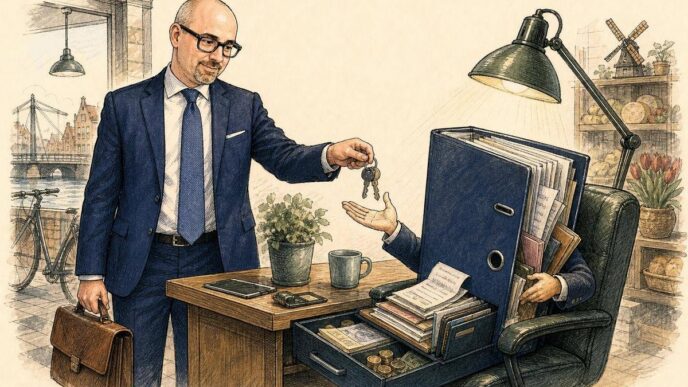
In a small Dutch firm, Monday morning does not arrive as policy. It arrives as a laptop opening, a payroll question, a sick message from a colleague, a customer waiting for an answer and a founder trying to remember whether the tax file is really finished. The Netherlands often speaks in careful steps. Business life does not always have that luxury.
The signal has to become readable
The week did not give me a list. It gave me one question: where does Dutch compromise actually live after we have agreed it? I ask that from inside the culture. I know the Dutch preference for room, timing, consultation and a practical exception when the hard edge looks too sharp. I also know the comfort of believing that because the sentence is balanced, the result will be balanced too.
That is the part we should question more often. A compromise can be wise and still move the work to the wrong place. It can protect people and still hide the hours needed to make the protection real. It can avoid harshness in law while creating pressure in the roster, the ledger or the household budget.
The comfort of the click
Start with the tax return, because it shows the Dutch rhythm clearly. A founder files, receives confirmation and moves on. VAT, wages, orders and staff problems do not wait. The click feels like closure because the system has a portal, a date and a visible end point.
Yet after a Dutch income tax return is submitted, the file can still be compared with earlier years, third-party data, business records, bank traces, payroll and later evidence. That is not strange. A serious tax system has to check whether the story in the return fits the records behind it. The point is not suspicion. The point is timing.
For many entrepreneurs, the practical work starts before the control question arrives. The invoice must be explained while memory is still fresh. The bank movement must match the books. A low salary, a late payment or a mixed business cost needs a record that can speak without the founder sitting beside it. We are good at trusting process in the Netherlands. Sometimes we trust it so well that we forget the file has only moved to another room.
The humane rule needs a body
The same question appears in absence. Dutch law and practice try not to abandon workers when illness becomes long or complicated. That is a civilised instinct, and I do not want a colder country. But a humane rule still needs a body that can carry it.
What the signal changes
Official Dutch signals around sickness absence and psychological fatigue point to a pressure that small employers feel first in the roster. One long absence can remove a full function, not just a headcount. The wage continues, the reintegration file begins, the colleague who covers extra hours becomes tired too, and the customer may notice before any policy maker does.
Here the Dutch compromise is at its best and its weakest. We want care, continuity and responsibility. We do not want employers to treat illness as a quick exit route. Good. But do we look closely enough at the shop, practice, garage, agency or small office where the obligation is carried by people who were already short of time? The value may be right. The load may still be uneven.
Rights arrive before the nursery
Paid parental leave raises the question in a softer, but no less practical, way. The right has a serious purpose. Parents need time with children, fathers should not be left with a symbolic entitlement, and work and care cannot be treated as separate lives. A country that says family matters must also make room for family time.
Still, the right reaches the employer before it reaches the nursery. It enters the weekly planning, the payroll run, the timing of UWV payments, the income calculation at home and the conversation between a worker and a manager. If the worker fears a loss of money or status, the right is not fully usable. If the employer cannot cover the shift, the same right becomes a quiet pressure point inside a small team.
This is where I think Dutch policy often needs a sharper test. Not only is the right formally available? Also, can it be used without damaging trust? Can the smallest workplace carry the planning? Can the household manage the cash gap? A right that exists on paper but is difficult to use creates disappointment. A right that is used without enough planning creates resentment. Neither outcome is the social result we say we want.
Earlier certainty is still a choice
The flex-worker reform takes the question into hiring. The Tweede Kamer adopted the Wet meer zekerheid flexwerkers on 12 May 2026. If the Eerste Kamer also agrees, Rijksoverheid has indicated that the rules can enter into force on 1 January 2028. The direction is clear: less routine use of temporary constructions for work that is, in practice, not temporary.
That direction is understandable. The Netherlands has lived too long with a comfortable contradiction. We value security, but we have allowed too many working lives to remain provisional. If a role is structural, why should the uncertainty stay mainly with the worker?
What founders should check
For a small employer, however, this is not only a moral correction. It is an earlier business decision. Is the work seasonal, or is it permanent? Is demand uncertain, or has the company become used to placing uncertainty on the worker? Can the cash pattern support a lasting job? The reform may improve honesty, but it does not remove risk. It changes who must name the risk, and when.
This is not a reason to resist every change. It is a reason to stop pretending that better labour rules are carried by intention alone. Earlier certainty for workers requires earlier clarity from employers. Earlier clarity from employers requires numbers, customers, margins and courage. Dutch compromise often buys time before a choice becomes hard. In this case, the culture may need to accept that time itself was part of the problem.
The question for Monday
I keep returning to that Monday desk. Tax, absence, leave and hiring do not sit in separate folders for the founder. They meet in the same morning, often with the same person making the decision. The Dutch system may have different legal routes for each subject, but the small business has one calendar and one bank account.
So what are we really accepting when we praise careful compromise? Are we accepting a society that avoids crude outcomes and gives people room? I hope so. Or are we also accepting a habit of postponing execution questions until they land with the people who have the least spare capacity? I fear that is also true.
The Netherlands does not need to become louder to become more honest. It needs to ask earlier where each rule will live. In whose payroll system? In whose roster? In whose proof file? In whose household budget? In whose weekend?
If the answer is always the same small circle of founders, employers, advisers, payroll clerks and workers, then the compromise is not as shared as it sounds. It may still be well meant. It may even be necessary. But it is not finished when we have agreed the words. It is finished only when Monday morning can carry them.
Sources
- After the Tax Click, the Books Still Have to Speak
- Property BV Directors Cannot Pay Themselves by Memory Alone
- Dutch Veterinary Bills Need Clarity More Than a VAT Shortcut
- Burn-out Pressure Reaches Small Employers Through the Roster
- Box 3 Refund Hopes Meet the Calendar and the Bank Balance
- Dutch Flex Rules Push Roster Habits Into Earlier Hiring Choices
- A DGA’s Gym Bill Needs the Right Payroll Year First
- A Dutch Tax Objection Can Fail Before the Argument Starts
Referenced in the article
Column | Human Resources
Dutch Payroll Costs Are Outrunning the Wage Headline
Official wage costs are still rising, and small employers feel it first in rosters, prices, and cash.
Column | Governance
A Dutch Online Meeting Still Has to Earn Its Decision
The adopted bill makes digital access possible, but valid decisions still need patient governance.
Column | Ledger & Tax
After the Tax Click, the Books Still Have to Speak
The filing is not the finish line. It is the moment when a return enters a control route.
The Polder is written for readers who need the Dutch business environment translated into practical meaning. Corrections, source policy and editorial accountability are part of the publication record.