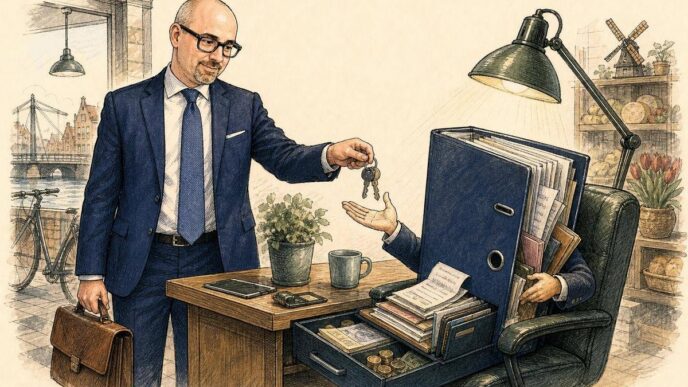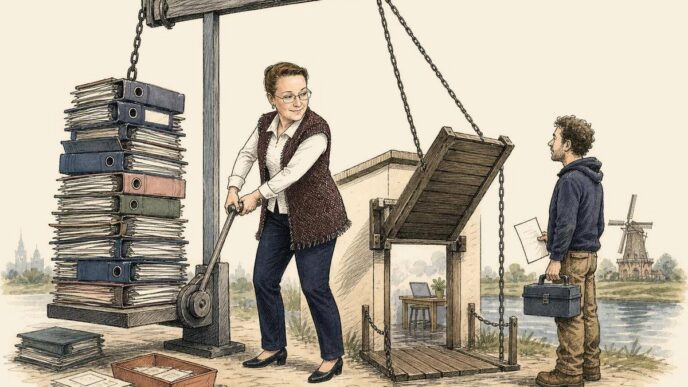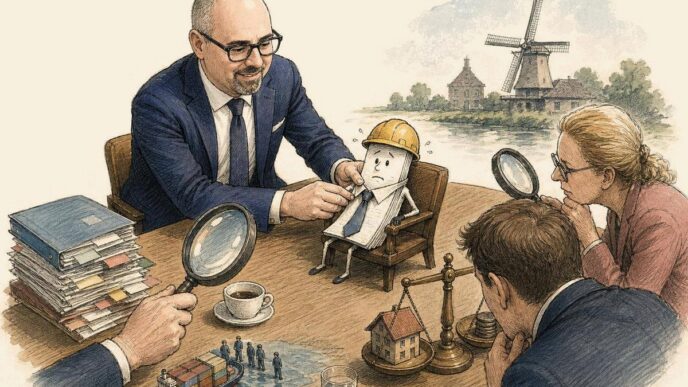
The useful signal from the week is that convenience now carries a duty to explain who bears the risk.
On Friday afternoon, a founder does not think in legal categories. He sees a roster with gaps, a power connection that may not carry the next machine, a payment option that could lift sales, and a cloud contract nobody has read since the company was smaller. Each item looks practical. Together they ask a harder question: who carries the risk when convenience stops being convenient?
The signal has to become readable
I am not Dutch, and that matters for the way I read this country. I did not inherit the Dutch habit of clean rules and shared decisions. I learned to respect it from the outside. At its best, Dutch logic does not worship paperwork. It asks whether a decision can be explained at a table, checked by another person, and defended when memory becomes weak.
The hard thought I carry into the weekend is this: the Netherlands is making dependency visible. Not forbidden. Not morally dirty. Visible. If a business depends on platform labour, electricity transport, checkout credit or a cloud gatekeeper, that dependence is no longer just a private convenience. It becomes part of the company’s real structure.
Convenience is not neutral
The Amsterdam Court of Appeal’s Temper ruling gave the labour signal its sharpest edge. On 16 June 2026, the court held that workers using Temper are temporary agency workers, under ECLI:NL:GHAMS:2026:1612. For many companies, the point is not only the legal label. The point is that a shift booked through a clean digital interface can still carry the old questions of labour responsibility.
That is uncomfortable because modern business likes the speed of separation. The company wants the worker now, the platform arranges the route, and the invoice arrives later with a professional face. But the person still walked into a workplace. Someone still decided the hours, the task, the safety instruction and the price of that labour.
A director who says the platform arranged it may be describing the buying channel, not the responsibility. Dutch labour law has always been suspicious of forms that hide substance. The Temper signal fits that older instinct. When a company benefits from labour, it cannot treat the route into the workplace as a decorative detail.
The same pattern appears at the checkout. AFM has opened the door for early licence applications before the Dutch implementation law for the new Consumer Credit Directive is final. From 20 November 2026, Dutch consumer credit discipline moves closer to deferred payment, buy now, pay later products and similar checkout routes.
What the signal changes
A small webshop may see only conversion. I understand that. Margins are thin, attention is short, and a customer who leaves the basket unpaid is not a philosophical problem. Still, when credit enters the sale, the company is helping shape a payment decision. That changes the meaning of the button. It is no longer only a sales tool. It is a risk route with a customer at the other end.
Capacity has become part of governance
The grid signal is more physical, but not less serious. ACM reported that the College van Beroep voor het bedrijfsleven rejected NorthC Datacenters’ appeal against ACM’s dispute decision in its case with Liander. The case is specific. The lesson is wider. Electricity transport capacity is no longer background scenery for growth.
For years, many business plans treated infrastructure as a quiet promise. Find the building, sign the lease, order the machines, hire the staff, and the system would carry the plan. That order is less safe now. A freezer, kitchen, charging yard, workshop, server room or production line can be limited by capacity that does not move at the speed of ambition.
This is where market behaviour changes. The serious founder no longer asks only whether customers exist. He asks whether the place can carry the company, whether the contract matches the intended use, and whether timing has been priced honestly. Demand without capacity is not a plan. It is a hope with a purchase order attached.
Exit is part of the deal
The digital version of the same problem sits in the cloud. ACM’s signal, together with the European Commission’s preliminary position that Microsoft Azure and Amazon Web Services should comply with Digital Markets Act gatekeeper obligations for cloud services, should not be read as a distant Brussels story. It reaches the ordinary company that stores invoices, customer data, production records, planning tools and access rights in rented digital rooms.
The practical question is plain. Can the company retrieve its data, keep records readable, connect another system and continue serving customers if terms, prices or access change? If the answer is vague, the cloud supplier is not only a supplier. It is a point of control inside the business.
This is not an argument against technology. Dutch companies should use strong systems, platforms and providers when they make work better. The point is narrower and harder. Efficiency should not become captivity. A supplier relationship that offers no real exit is not only an IT risk. It is a governance fact.
Responsibility moves toward the beneficiary
What ties these signals together is not administration. It is responsibility moving toward the party that benefits. The company that uses the platform benefits from labour. The company that plans expansion benefits from scarce grid capacity. The retailer offering deferred payment benefits from a smoother sale. The firm using cloud infrastructure benefits from scale it did not build itself.
In a looser market, those dependencies can stay soft. People accept vague roles because everyone is moving. Money is available, labour can be found, power is assumed, software feels cheap, and the customer keeps buying. A tighter market behaves differently. It asks who was relying on whom, who had the better information, and who pushed risk down the chain without naming it.
What founders should check
That is the deeper Dutch direction. The Netherlands is not becoming less practical. It is becoming practical at a harder level. The old practical question was whether something worked. The newer question is whether the company can explain how it works when money, labour, energy, credit or data comes under strain.
I have sympathy for entrepreneurs who are tired of files. I have been at tables where proof felt like another stone in the backpack. A company does not survive because its folders are elegant. It survives because customers pay, workers show up, suppliers deliver, cash holds and decisions are taken in time.
But good proof is not the enemy of business. Bad proof is. A file built after the problem arrives is theatre, and usually expensive theatre. A file built while the decision is made is different. It forces the company to name the dependency before that dependency becomes a dispute.
This is also why I do not read the week as a compliance story. Compliance is the surface word. The real subject is market adulthood. A company may still choose speed, outsourcing, credit tools and powerful digital suppliers. The adult version of that choice is to know what has been accepted, who may be harmed if it fails, and what the company can still control.
The Friday table comes back
Back at the Friday table, the founder still has to decide. The roster must be filled. The expansion may still be worth pursuing. Checkout credit may still help the business. The cloud supplier may still be the best one available. Dutch logic does not demand paralysis. It demands that the decision has a spine.
That spine is made of plain questions. Who is doing the work? What capacity is truly available? What does the customer understand at the moment of payment? Can the company leave the supplier without losing its own memory? These are not grand questions. They are the questions that separate a growing business from a fragile one.
The Netherlands is making dependency visible because crowded markets need cleaner responsibility. That is not bureaucracy. It is the price of doing business in a country where shared systems still matter, but no longer hide every weakness for the company using them.
Sources
- Late Dutch Invoices Quietly Turn Suppliers Into Lenders
- Sanctions Checks Need an Owner Before the Bank Calls
- When a Police Report Leaves Your Company Still Exposed
- A Wage Can Disappear Before the Invoice Looks Wrong
- A Dutch Online Meeting Still Has to Earn Its Decision
- Dutch Shoppers Feel Less Negative, But Margin Evidence Comes First
- Dutch Mileage Relief Still Leaves Employers With a Travel Decision
- Slower Dutch House Prices Still Leave Buyers Short of Room
Referenced in the article
Column | Ledger & Tax
Old Dutch Losses Do Not Pay Tomorrow’s Tax Bill
A Gelderland court signal shows why founders must keep loss claims alive while the assessment route.
Column | Compliance
Checkout Credit Moves From Sales Button to Board Responsibility
The AFM licence window turns BNPL into a question of role, proof, cash, and consumer care.
Column | Ledger & Tax
A Dutch VAT Refund Is Cash Only After the Evidence Holds
A short Hoge Raad ruling shows why old invoices can decide tomorrow's cash.
The Polder is written for readers who need the Dutch business environment translated into practical meaning. Corrections, source policy and editorial accountability are part of the publication record.